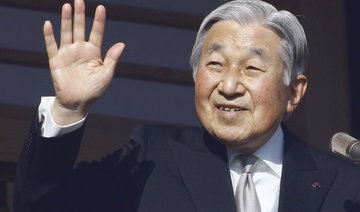
TOKYO: Japan’s Emperor Akihito on Wednesday expressed “deep remorse” about his nation’s wartime acts, as Tokyo marked the 73rd anniversary of the end of World War II.
The carefully choreographed annual ceremony is the last Akihito and his wife Empress Michiko will attend before the emperor abdicates in April.
“Reflecting on our past and bearing in mind the feelings of deep remorse, I earnestly hope that the ravages of war will never be repeated,” the 84-year-old monarch said in a televised address.
“Together with all of our people, I now pay my heartfelt tribute to all those who lost their lives in the war, both on the battlefields and elsewhere, and pray for world peace and for the continuing development of our country.”
It was Akihito’s father, war-time emperor Hirohito, who announced his decision to surrender in a radio address on August 15, 1945.
Japan signed documents officially formalizing the surrender on September 2, 1945.
Though he has no political power, Emperor Akihito has hinted throughout his reign at pacifist views, sharply at odds with the aggressive expansionism Japan pursued under his father’s rule.
He has annoyed Japanese right-wingers by acknowledging that his country inflicted “great suffering” in China, and expressing regret over Japan’s brutal rule of the Korean peninsula.
Japan’s Prime Minister Shinzo Abe also spoke at the ceremony, pledging to remember war dead while building a peaceful future.
“Never again will we repeat the devastation of war. Humbly facing history, we shall stand firm on this pledge,” he said, avoiding any specific expression of regret.
Abe has been criticized for what some see as a revisionist attitude to Japan’s wartime record, though he has softened his rhetoric as he works to improve ties with Beijing.
In recent years, he has avoided visiting the controversial Yasukuni shrine that honors Japan’s war dead, including convicted war criminals, offering a ritual cash donation instead.
Previous visits by Abe and other senior Japanese politicians have angered China and other Asian neighbors.
Yasukuni honors some 2.5 million people, mostly Japanese, who perished in the country’s wars since the late 19th century.
It also enshrines senior military and political figures convicted of war crimes by an international tribunal after World War II.
Abe last visited in December 2013 to mark his first year in power, sparking fury in Beijing and Seoul and earning a diplomatic rebuke from close ally the US.
Groups of Japanese lawmakers visited the shrine Wednesday, but Abe’s key cabinet members were not expected to be among them.


![]()

Japan emperor expresses World War II ‘remorse’
Japan emperor expresses World War II ‘remorse’
- The carefully choreographed annual ceremony is the last Akihito and his wife Empress Michiko will attend before the emperor abdicates in April
- Japan signed documents officially formalizing the surrender on September 2, 1945

Latest updates


© 2026 SAUDI RESEARCH & PUBLISHING COMPANY, All Rights Reserved And subject to Terms of Use Agreement.