

Muslim population misinformation fuels Islamophobia in India

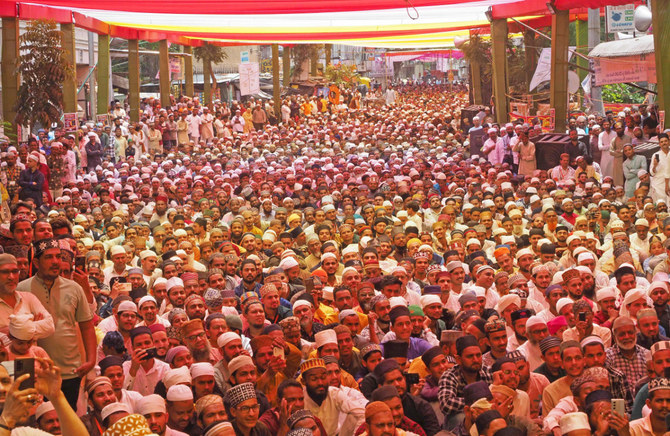
In this photo taken on April 30, 2023, Muslims gather during a congregation in Ahmedabad. (AFP)
Short Url
Updated 03 May 2023
Follow

Muslim population misinformation fuels Islamophobia in India

  • India is home to 1.4 billion people, including around 210 million Muslims, but birthrates have declined across the board over recent decades in tandem with global trends

NEW DELHI: Amit Upadhyay repeats online misinformation as he claims to know why India’s population is growing: he says his Muslim neighbors are having too many babies, so Hindu women have a responsibility to bear more of their own.
A pharmacist by trade, Upadhyay is one of many social media influencers from India’s majority faith to have cultivated large audiences by spreading false demographic data to claim the country is being refashioned into an Islamic state.
For them, last month’s announcement that India had overtaken China to become the world’s most populous nation was not a cause for celebration, but a call to action.
“I tell all my Hindu customers to produce more children, to counter Muslims,” Upadhyay, who in his spare time curates a popular Facebook page from his home in Uttar Pradesh state, told AFP.
“Or else they will become a threat and eventually wipe out the Hindu religion from India.”
Upadhyay regularly publishes widely shared Islamophobic posts to his nearly 40,000 followers.
One post in April warned of an alleged plot by Muslims to “multiply their population to take control of India.”
India is home to 1.4 billion people, including around 210 million Muslims, but birthrates have declined across the board over recent decades in tandem with global trends.
The country’s last National Family Health Survey in 2021 showed an overall fertility rate of 2.0 children per woman, rising marginally to 2.3 for Muslim women.
A forecast issued the same year from the Pew Research Center said that India’s Muslim community would grow to 311 million by 2050.
But despite their growing share of the national population, Muslims would remain a small minority in a country of 1.7 billion people by mid-century, according to the US-based think tank’s projections.
That has not stopped the spread of viral disinformation on Facebook, WhatsApp and other social media platforms claiming India is soon to become a Muslim-majority country.
One Facebook post sarcastically greeted news that India’s population had overtaken China’s by thanking Muslims “for producing 5-10 children” each.
Another post on Twitter said that the Hindu faith would soon disappear from India, while a supposed Muslim majority would replace the country’s constitution with “Islamic law.”

Conspiracy theories that allege a Muslim plot to secure the faith’s numerical supremacy in India have been a staple of Hindu nationalist ideologues for years. Similar theories of immigrants and minorities “replacing” majority populations have also been embraced by the far-right in other countries.
At times the theories have been indulged by Prime Minister Narendra Modi’s Bharatiya Janata Party (BJP), which has come to dominate national politics partly through its muscular appeals to the country’s Hindu majority.
BJP lawmaker Rakesh Sinha introduced into parliament a population control bill in 2019 that proposed to limit all Indian households to two children, garnering the support of 125 other MPs.
The bill was withdrawn after critics accused Sinha of targeting Muslims when he gave a speech on the supposedly glaring disparity between Hindu and Muslim birthrates — an accusation he denied.
The UN’s April announcement that India is now home to more humans than any other country on the planet has reinvigorated these claims.
“Hindus will get married once, and have two children,” Ishwar Lal, a member of a Hindu-nationalist group affiliated with the BJP, said in a public speech after the announcement.
“Whereas Muslims get married four times and have so many children that they can have their own cricket teams.”
The same month, at a popular pilgrimage destination in the Himalayan foothills, a religious sermon exhorted a crowd of the Hindu faithful to wage their own demographic counter-offensive.
“From two children, Hindus have come down to producing one child,” priest Ravindra Puri told a crowd of hundreds at Haridwar. “This is causing an imbalance in the population.”
The solution to this imbalance, Puri said, was for the pious to have three children: “One to serve the nation, one to take care of the home and one to serve the religion by becoming a priest.”
India’s former election chief, S.Y. Quraishi, has written extensively on the spread of disinformation about the country’s Muslim birthrate.
He said that claims Muslims would soon become India’s majority religion had proved to be a salient “propaganda” tool for Hindu nationalists.
“They continue to provoke Hindus to produce more children by creating a fear that Muslims will outnumber them,” he told AFP.
“This will never happen.”


Greenland villagers focus on ‘normal life’ amid stress of US threat

Updated 4 sec ago
Follow

Greenland villagers focus on ‘normal life’ amid stress of US threat

  • Proudly showing off photographs on her tablet of her grandson’s first hunt, Dorthe Olsen refuses to let the turmoil sparked by US president Donald Trump take over her life
SARFANNGUIT: Proudly showing off photographs on her tablet of her grandson’s first hunt, Dorthe Olsen refuses to let the turmoil sparked by US president Donald Trump take over her life in a small hamlet nestled deep in a Greenland fjord.
Sarfannguit, founded in 1843, is located 36 kilometers (22 miles) east of El-Sisimiut, Greenland’s second-biggest town, and is accessible by boat in summer and snowmobile or dogsled in winter if the ice freezes.
The settlement has just under 100 residents, most of whom live off from hunting and fishing.
On this February day, only the wind broke the deafening silence, whipping across the scattering of small colorful houses.
Most of them looked empty. At the end of a gravel road, a few children played outdoors, rosy-cheeked in the bitter cold, one wearing a Spiderman woolly hat.
“Everything is very calm here in Sarfannguit,” said Olsen, a 49-year-old teacher, welcoming AFP into her home for coffee and traditional homemade pastries and cakes.
In the background, a giant flat screen showed a football match from England’s Premier League.
Olsen told AFP of the tears of pride she shed when her grandson killed his first caribou at age 11, preferring to talk about her family than about Trump.
The US president has repeatedly threatened to seize the mineral-rich island, an autonomous territory of Denmark, alleging that Copenhagen is not doing enough to protect it from Russia and China.
He nevertheless climbed down last month and agreed to negotiations.
Greenland’s health and disability minister, Anna Wangenheim, recently advised Greenlanders to spend time with their families and focus on their traditions, as a means of coping with the psychological stress caused by Trump’s persistent threats.
The US leader’s rhetoric “has impacted a lot of people’s emotions during many weeks,” Wangenheim told AFP in Nuuk.
’Powerless’
Olsen insisted that the geopolitical crisis — pitting NATO allies against each other in what is the military alliance’s deepest crisis in years — “doesn’t really matter.”
“I know that Greenlanders can survive this,” she said.
Is she not worried about what would happen to her and her neighbors if the worst were to happen — a US invasion — especially given her settlement’s remote location?
“Of course I worry about those who live in the settlements,” she said.
“If there’s going to be a war and you are on a settlement, of course you feel powerless about that.”
The only thing to do is go on living as normally as possible, she said, displaying Greenland’s spirit of resilience.
That’s the message she tries to give her students, who get most of their news from TikTok.
“We tell them to just live the normal life that we live in the settlement and tell them it’s important to do that.”
The door opened. It was her husband returning from the day’s hunt, a large plastic bag in hand containing a skinned seal.
Olsen cut the liver into small pieces, offering it with bloodstained fingers to friends and family gathered around the table.
“It’s my granddaughter’s favorite part,” she explained.
Fishing and hunting account for more than 90 percent of Greenland’s exports.
No private property
Back in El-Sisimiut after a day out seal hunting on his boat, accompanied by AFP, Karl-Jorgen Enoksen stressed the importance of nature and his profession in Greenland.
He still can’t get over the fact that an ally like the United States could become so hostile toward his country.
“It’s worrying and I can’t believe it’s happening. We’re just trying to live the way we always have,” the 47-year-old said.
The notion of private property is alien to Inuit culture, characterised by communal sharing and a deep connection to the land.
“In Greenlandic tradition, our hunting places aren’t owned. And when there are other hunters on the land we are hunting on, they can just join the hunt,” he explained.
“If the US ever bought us, I can for example imagine that our hunting places would be bought.”
“I simply just can’t imagine that,” he said, recalling that his livelihood is already threatened by climate change.
He doesn’t want to see his children “inherit a bad nature — nature that we have loved being in — if they are going to buy us.”
“That’s why it is we who are supposed to take care of OUR land.”