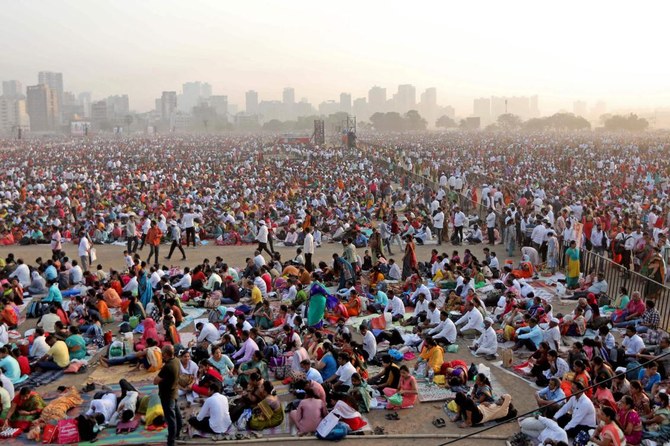
NEW DELHI: Eleven people died of heatstroke in India after an estimated one million spectators waited for hours in the sun at a government-sponsored awards ceremony, officials said on Monday.
Around 20 people were hospitalized and 300 felt ill at the event near the western city of Mumbai on Sunday, when temperatures hit close to 38 degrees Celsius (100 Fahrenheit) with high levels of humidity, local media reported.
Senior government officials attended the ceremony, including Interior Minister Amit Shah, who praised the crowd for waiting so long in the sun.
The office of Maharashtra state Chief Minister Eknath Shinde described it as a “sad and disturbing incident” and promised compensation for the victims’ relatives.
India’s ruling Bharatiya Janata Party said around a million people attended the event, the Indian Express newspaper reported.
The opposition Congress party accused the government of negligence and said it should face criminal charges.
Heatwaves have killed more than 6,500 people in India since 2010, and last year saw record temperatures in several cities across the country.
The hot spells are becoming harsher and more frequent across South Asia, spurred by climate change, according to scientists.
Authorities in the eastern state of West Bengal announced a week-long shutdown of all schools, colleges and universities from Monday due to the heat, local media reported.
Last year, India suffered coal shortages, the main source of electricity in the nation of 1.4 billion people, as electricity demand peaked in the heat.
Many parts of India rely on trains to supply water during the summer.
Scientists also believe the annual monsoon rainy season is becoming more erratic and powerful, causing greater flooding.

Heatstroke kills 11 at India awards event
https://arab.news/p5dvt
Heatstroke kills 11 at India awards event
Ethiopia accuses Eritrea of arming rebels in escalating war of words
- The charge by Ethiopia’s federal police escalates a feud between Ethiopia and Eritrea
- The two countries fought a three-year border war that broke out in 1998
ADDIS ABABA: Ethiopian police said they had seized thousands of rounds of ammunition sent by Eritrea to rebels in Ethiopia’s Amhara region, an allegation Eritrea dismissed as a falsehood intended to justify starting a war.
The charge by Ethiopia’s federal police escalates a feud between Ethiopia and Eritrea, longstanding foes who reached a peace deal in 2018 that has since given way to renewed threats and acrimony.
The police said in a statement late on Wednesday they had seized 56,000 rounds of ammunition and arrested two suspects this week in the Amhara region, where Fano rebels have waged an insurgency since 2023.
“The preliminary investigation conducted on the two suspects who were caught red-handed has confirmed that the ammunition was sent by the Shabiya government,” the statement said, using a term for Eritrea’s ruling party.
Eritrea’s Information Minister Yemane Gebremeskel told Reuters that Ethiopian Prime Minister Abiy Ahmed’s Prosperity Party (PP) was looking for a pretext to attack.
“The PP regime is floating false flags to justify the war that it has been itching to unleash for two long years,” he said.
In an interview earlier this week with state-run media, Eritrean President Isaias Afwerki said the Prosperity Party had declared war on his country. He said Eritrea did not want war, but added: “We know how to defend our nation.”
The two countries fought a three-year border war that broke out in 1998, five years after Eritrea won its independence from Ethiopia. They signed a historic agreement to normalize relations in 2018 that won Ethiopia’s Abiy the Nobel Peace Prize the following year. Eritrean troops then fought in support of Ethiopia’s army during a 2020-22 civil war in Ethiopia’s northern Tigray region.
But relations soured after Asmara was frozen out of the peace deal that ended that conflict. Since then, Eritrea has bristled at repeated public declarations by Abiy that landlocked Ethiopia has a right to sea access — comments many in Eritrea, which lies on the Red Sea, view as an implicit threat of military action.
Abiy has said Ethiopia does not seek conflict with Eritrea and wants to address the issue of sea access through dialogue.


