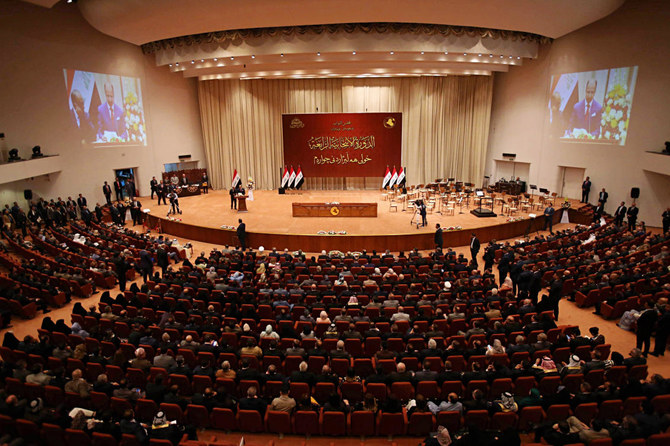
BAGHDAD: Iraq’s parliament voted Monday to restore electoral laws that were scrapped after 2019 anti-government demonstrations, sparking anger from independent lawmakers who see it benefiting larger parties.
The law, which parliament said in a statement was “adopted” without detailing the votes, revives the electoral law of 2018 and sweeps away one of the gains of the mass protest movement which shook Iraq.
After the protests, a new system favored the emergence of independent candidates, with some 70 independents winning seats in the 329-member parliament in the last legislative elections in 2021.
Parliament is dominated by the Coordination Framework, an alliance of powerful pro-Iran Shiite factions, from whose ranks Prime Minister Mohammed Shia Al-Sudani emerged.
The new law removes 83 electoral districts and creates 18 seats, one for each of Iraq’s provinces.
This “makes it easier for top party politicians to win seats,” analyst Sajad Jiyad said on Twitter.
Conversely, it will make it “harder for candidates in smaller parties and independents to compete” because they will be running at a provincial rather than a local level, he added.
During the debate, which ran from Sunday into the early hours of Monday, several angry independent lawmakers were expelled from the debating chamber, according to videos they filmed themselves.
The law also replaces a first past the post system with proportional representation.
Overall, the changes will benefit the larger parties and make it possible “for their candidates who didn’t get enough votes initially to win seats,” Jiyad added.
“Independent candidates will no longer have any hope of obtaining representation in parliament,” said Alaa Al-Rikabi, an independent lawmaker. “They will be crushed.”
But Coordination Framework lawmaker Bahaa Al-Dine Nouri welcomed the change, arguing that it will “distribute the seats according to the size of the parties.”
Nouri said this will “lead to the formation of a government within the time limits set by the constitution” to avoid the endless standoffs that followed the 2021 election.
The new law will apply to the next legislative elections, the date of which has not yet been set.
It will also apply to provincial elections slated for November 6, to be held in 15 of the 18 Iraqi provinces, excluding the three provinces in the autonomous Kurdistan region of northern Iraq.
In Iraqi Kurdistan, regional elections will take place on November 18 under a separate electoral system.


Iraq changes electoral law, sparking opposition anger
https://arab.news/ptag2
Iraq changes electoral law, sparking opposition anger

- The law revives the electoral law of 2018 and sweeps away one of the gains of the mass protest movement which shook Iraq

Syrian leader to meet Putin, Russia seeks deal on military bases
- Russia’s continued sheltering of Assad and his wife since their ouster remains a thorny issue
MOSCOW: Syrian President Ahmed Al-Sharaa will meet Russian counterpart Vladimir Putin in Moscow on Wednesday, as the Kremlin seeks to secure the future of its military bases in the country.
Putin and Sharaa struck a conciliatory tone at their previous meeting in October, their first since Sharaa’s rebel forces toppled Moscow-ally Bashar Assad in 2024.
But Russia’s continued sheltering of Assad and his wife since their ouster remains a thorny issue. Sharaa has repeatedly pushed Russia for their extradition.
Sharaa, meanwhile, has embraced US President Donald Trump, who on Tuesday praised the Syrian leader as “highly respected” and said things were “working out very well.”
Putin, whose influence in the Middle East has waned since Assad’s ouster, is seeking to maintain Russia’s military footprint in the region.
Russia withdrew its forces from the Qamishli airport in Kurdish-held northeast Syria earlier this week, leaving it with only the Hmeimim air base and Tartus naval base on Syria’s Mediterranean coast — its only military outposts outside the former Soviet Union.
“A discussion is planned on the status of bilateral relations and prospects for developing them in various fields, as well as the current situation in the Middle East,” the Kremlin said of the upcoming meeting in a statement on Tuesday.
Russia was a key ally of Assad during the bloody 14-year Syrian civil war, launching air strikes on rebel-held areas of Syria controlled by Sharaa’s Islamist forces.
The toppling of Assad dealt a major blow to Russia’s influence in the region and laid bare the limits of Moscow’s military reach amid the Ukraine war.
The United States, which cheered Assad’s demise, has fostered ever-warmer ties with Sharaa — even as Damascus launched a recent offensive against Kurdish forces long backed by the West.
Despite Trump’s public praise, both the United States and Europe have expressed concern that the offensive in Syria’s northeast could precipitate the return of Islamic State forces held in Kurdish-held jails.


