

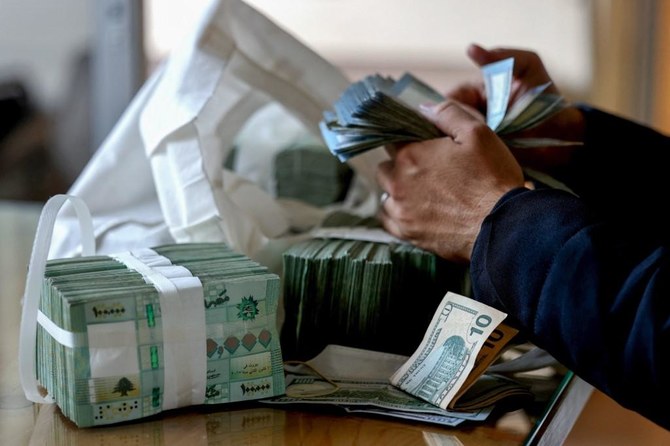
Food and fuel prices rocket as Lebanese pound hits record low

Short Url
Updated 15 March 2023
Follow

Food and fuel prices rocket as Lebanese pound hits record low

  • Currency trading at 100,000 to the US dollar
  • Banks close doors and go back on strike

BEIRUT: Food and fuel prices in Lebanon soared on Tuesday as the country’s currency plunged in value to a record low.

Officially pegged at 15,000 to the US dollar, the pound was trading at 100,000 on unofficial exchange markets — compared with 41,000 as recently as January, and 1,500 before the economic meltdown began in 2019.
Banks, which have imposed draconian withdrawal restrictions — essentially locking depositors out of their life savings — were closed on Tuesday after resuming a strike.
Lebanese resorted to black humor, complaining about having to weigh their money rather than  count it, and needing shopping bags to carry banknotes to the currency exchange. They blame the country’s political elite for causing the collapse and doing nothing to address it. Lebanon has had no president and a caretaker government since last year, mired in squabbling between rival factions.
“The platforms that manipulate the black market exchange rate have turned into a tool of blackmail and settling scores between the central bank governor, his opponents, the banks, and the judiciary,” onefinancial analyst said:

“Meanwhile, citizens and depositors pay the price. Nothing is stopping the exchange rate from reaching 150,000 pounds to the dollar during Ramadan, or even 200,000 after Easter and Eid.”

Abu Abbas, 75, who owns a small jewellery stall on Beirut’s busy Hamra Street, said he was barely making ends meet. “The lira has become completely worthless,” he said. “I used to buy medicine for my wife for 40,000 pounds, now it costs 900,000.”

Opinion

This section contains relevant reference points, placed in (Opinion field)

Mohammad Al-Rayes, 65, another shopkeeper in Beirut, said: “Ruling politicians... robbed the country and stole depositors’ money. They should leave and bring new leaders. Very tough times are coming.”

MP Ghassan Skaf said: “Before, we used to attract investments and tourists. Today we’re attracting money launderers, and we do not see any official intention to stop the collapse.”

The International Monetary Fund agreed in April last year to provide Lebanon with $3 billion in loans spread over four years, conditional on a package of sweeping reforms. But officials have failed to enact the changes demanded by international creditors in return for unlocking the emergency loans.
Meanwhile central bank governor Riad Salameh is being investigated at home and abroad for the suspected embezzlement of hundreds of millions of dollars. A Lebanese judge has asked Salameh to appear before visiting European investigators on Wednesday as part of a multinational probe into his personal wealth.
Lebanon is facing the economic meltdown largely leaderless, as the divided parliament has failed to elect a new president for months — in a country already governed by a caretaker Cabinet with limited powers.
Repeated sessions convened to elect a successor to Michel Aoun, whose term ended in October last year, have all failed to reach agreement on a consensus candidate.
The pound’s steady downfall reflects a “total loss of confidence in the policy makers of the country,” said Saeb El-Zein, a Lebanese former banker who worked with international lenders.
“You need political leadership to have economic leadership — and we don’t have political leadership.”


Volatile security blocks UN from Syria Daesh-linked camp

Updated 6 sec ago
Follow

Volatile security blocks UN from Syria Daesh-linked camp

  • Schmitt said: “UNHCR was able to reach Al-Hol for the past three days but has not yet been able to enter inside the camp due to the volatile security situation“
  • A former employee said most associations withdrew on Tuesday “due to the deteriorating security situation“

RAQQA, Syria: Poor security at a camp in Syria housing thousands of suspected relatives of Daesh group militants has prevented UN agency staff from entering, days after Kurdish forces withdrew and the army deployed at the site.
Two former employees at the Al-Hol desert camp told AFP on Friday that some of its residents had escaped during an hours-long security vacuum.
Thousands of suspected militants and their families, including foreigners, have been held in prisons and camps in northeast Syria since 2019, when the Kurdish-led Syrian Democratic Forces (SDF) defeated Daesh with the support of a US-led coalition.
This year, the SDF had to relinquish to Syrian government control swathes of territory they had seized during their fight against Daesh, and on Tuesday withdrew from Al-Hol.
In Raqqa province, Kurdish forces who formerly controlled a prison housing Daesh detainees were bussed out on Friday under a deal with the government, as a four-day truce neared expiry.

- Returning today -

Celine Schmitt, the UN refugee agency’s spokesperson in Syria, told AFP that “UNHCR was able to reach Al-Hol for the past three days but has not yet been able to enter inside the camp due to the volatile security situation.”
“UNHCR is returning to Al-Hol today, with the hope of resuming the bread delivery that had stopped for the past three days,” she said.
On Sunday, Syrian President Ahmed Al-Sharaa announced a deal with SDF chief Mazloum Abdi that included a ceasefire and the integration of the Kurds’ administration into the state, which will take responsibility for Daesh prisoners.
A former employee of a local humanitarian organization that operated in Al-Hol told AFP on condition of anonymity that most associations withdrew on Tuesday “due to the deteriorating security situation.”
Some camp residents fled during the “security vacuum” between when the SDF withdrew and the army took control, they said, without providing a number.
A former employee at another organization working there said “escapes were reported, but the exact number is unknown.”
“The camp is fenced, but without security, anyone can easily cross it and flee,” they said, also requesting anonymity.
Both ex-employees said camp residents torched centers belonging to aid organizations operating in the camp, where humanitarian conditions are dire.
Before the turmoil, the camp housed some 23,000 people — mostly Syrians but also including around 2,200 Iraqis and 6,200 other foreign women and children of various nationalities, the camp’s former administration told AFP.
Roj, a smaller camp in the northeast still under Kurdish control, holds some 2,300 people, mostly foreigners.
The Kurds and the United States have repeatedly urged countries to repatriate their citizens but foreign governments have generally allowed home only a trickle.

- Al-Aqtan prison -

The SDF has withdrawn to parts of Hasakah province, its stronghold in northeast Syria.
A fresh four-day ceasefire was announced on Tuesday, while the following day the United States said it had launched an operation that could see 7,000 Daesh militant detainees moved from Syria to Iraq, with 150 transferred so far.
US envoy Tom Barrack, who has said the purpose of Washington’s alliance with SDF has now largely expired, held talks this week with Abdi and senior Kurdish official Elham Ahmad.
On Friday, Syria transferred Kurdish fighters away from the Al-Aqtan prison on the outskirts of Raqqa city.
An AFP correspondent in Raqqa saw buses and cars heading away from the Al-Aqtan prison, escorted by government vehicles.
Syrian state television reported the transfer came “after five days of negotiations” and that the fighters would go to the Kurdish-held city of Ain Al-Arab, also known as Kobani, on the northern border with Turkiye.
The SDF later said that with coalition support, all the fighters had been transferred “to safe locations,” while the interior ministry said authorities had taken control of the facility.
A government source told state television that around 800 SDF fighters were to leave, while Daesh detainees would be managed “according to Syrian law.”
The army said the Al-Aqtan transfer was “the first step in implementing the January 18 agreement.”