

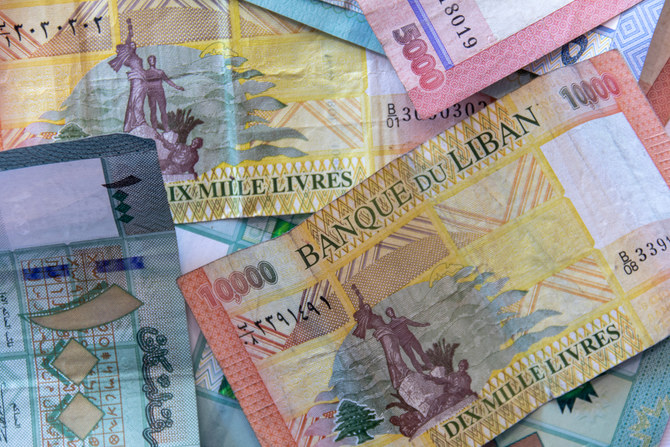
Lebanese pound hits record low of more than 24,000 per U.S. dollar

Short Url
Updated 25 November 2021
Follow

Lebanese pound hits record low of more than 24,000 per U.S. dollar

  • The crisis is widely blamed on decades of corruption and mismanagement by political elites

Lebanon's currency slid to a new low against the U.S. dollar on Thursday amid government paralysis as the country's financial meltdown deepens.

Several Beirut currency exchangers said the Lebanese pound was trading at around 24,200 per dollar, exceeding an all-time low of about 24,000 reached in July.

The currency has now lost more than 93% of its value since summer 2019, when it began to split from the rate of 1,500 pounds per dollar at which it had been pegged since 1997.

Lebanon is in the throes of an economic meltdown that the World Bank has called one of the worst depressions of modern history.

The crisis is widely blamed on decades of corruption and mismanagement by political elites.

Lebanon formed a new government in September headed by veteran politician Najib Mikati with the aim of negotiating an International Monetary Fund programme seen as key to unlocking international aid to stem the crisis.

However, it has not met in more than 40 days - an absence initiated by a push by Iran-backed Hezbollah and its allies to remove the judge investigating the August 2020 Beirut port explosion that killed more than 215 people and caused billions of dollars in damage.



Saudi delivery activity continues to grow, recording 124 million orders during the 4th quarter of 2025, an increase of 60% 

Updated 5 sec ago
Follow

Saudi delivery activity continues to grow, recording 124 million orders during the 4th quarter of 2025, an increase of 60% 

RIYADH: The delivery activity sector in the Kingdom recorded strong performance during the fourth quarter of 2025, with the total number of orders exceeding 124 million across various regions of Saudi Arabia, marking a 60 percent increase compared to the same quarter of the previous year. 

This reflects the growing demand for this sector and the expansion it has witnessed in recent periods, according to a statistical bulletin issued by the Transport General Authority. 

The authority explained that this growth comes amid the ongoing development of the delivery sector in the Kingdom, in addition to support for innovation in logistics services, the expansion in the use of technological solutions, and the increased reliance on e-commerce, all of which have contributed to the rising demand for services. 

The statistics showed that the Riyadh region accounted for the highest percentage of total orders during this quarter, at 44.45 percent, followed by the Makkah region with 22.17 percent, and then the Eastern Province with 15.90 percent. 

Furthermore, the percentage of orders in the Madinah region reached about 4.95 percent, while the Asir region recorded 3.31 percent, followed by the Qassim region with 2.62 percent, then the Tabuk region with 1.81 percent, followed by the Hail region with 1.67 percent, and then the Jazan region with 1.13 percent. 

Meanwhile, the percentages in each of the Najran, Al-Jouf, Northern Borders, and Al-Baha regions reached 0.68 percent, 0.61 percent, 0.49 percent, and 0.21 percent, respectively.
