

Magnitude 6 earthquake strikes Philippines’ Mindanao island

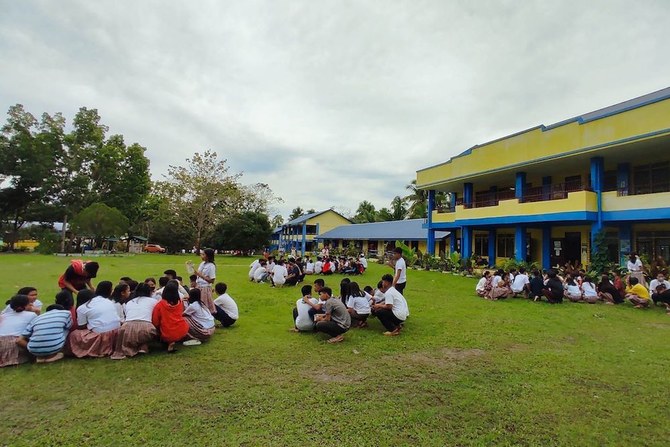
Students gather outside Buso National High School in Mati after a 6.0-magnitude earthquake jolted the southern Philippines. (Buso National High School/AFP)
Short Url
Updated 07 March 2023
Follow

Magnitude 6 earthquake strikes Philippines’ Mindanao island

  • Quake was at a depth of 8 kilometers below the earth’s surface

MANILA: A 6.0-magnitude earthquake jolted the southern Philippines on Tuesday, the US Geological Survey said, with local authorities warning of aftershocks and possible damage.

The shallow quake struck at about 2:00 p.m. (0600 GMT), a few kilometers from Maragusan municipality in the mountainous gold-mining province of Davao de Oro on Mindanao island.

Shallow earthquakes tend to cause more harm than deeper ones, but there were no immediate confirmed reports of major damage.

An employee in the Maragusan disaster office told AFP that authorities were checking reports of a landslide on a national highway.

“We have not received any reports of other damage or casualties, but we are checking the villages around the town,” he added, declining to give his name.

“Things shook at the office but there was no damage.”

The quake lasted about 30 seconds and was followed by aftershocks, said Corporal Stephanie Clemen, with police in the city of Tagum, about 40 kilometers from Maragusan.

“We immediately went said.

“We are still outside because a moderate aftershock just hit.”

While the quake did not appear to have destroyed anything, Clemen said, it was strong enough to “cause fear.”

Phoebe Alberto and her colleagues at the disaster office in New Bataan municipality, adjacent to Maragusan, fled their building as it shook.

“We are still assessing damage to our building, if any,” said Alberto.

“We are here outside now.”

Quakes are a daily occurrence in the Philippines, which sits along the Pacific “Ring of Fire,” an arc of intense seismic as well as volcanic activity that stretches from Japan through Southeast Asia and across the Pacific basin.

Most are too weak to be felt by humans, but strong and destructive ones come at random with no technology available to predict when and where they will happen.

The nation’s civil defense office regularly holds drills simulating earthquake scenarios along active fault lines.

The last major quake was in October in the northern Philippines.

The 6.4-magnitude earthquake hit the mountain town of Dolores in Abra province, injuring several people, damaging buildings and cutting power to most of the region.

A 7.0-magnitude quake in mountainous Abra last July triggered landslides and ground fissures, killing 11 people and injuring several hundred.


UN’s top court opens Myanmar Rohingya genocide case

Updated 12 January 2026
Follow

UN’s top court opens Myanmar Rohingya genocide case

  • The Gambia filed a case against Myanmar at the UN’s top court in 2019
  • Verdict expected to impact Israel’s genocide case over war on Gaza

DHAKA: The International Court of Justice on Monday opened a landmark case accusing Myanmar of genocide against its mostly Muslim Rohingya minority.

The Gambia filed a case against Myanmar at the UN’s top court in 2019, two years after a military offensive forced hundreds of thousands of Rohingya from their homes into neighboring Bangladesh.

The hearings will last three weeks and conclude on Jan. 29.

“The ICJ must secure justice for the persecuted Rohingya. This process should not take much longer, as we all know that justice delayed is justice denied,” said Asma Begum, who has been living in the Kutupalong refugee camp in Bangladesh’s Cox’s Bazar district since 2017.

A mostly Muslim ethnic minority, the Rohingya have lived for centuries in Myanmar’s western Rakhine state but were stripped of their citizenship in the 1980s and have faced systemic persecution ever since.

In 2017 alone, some 750,000 of them fled military atrocities and crossed to Bangladesh, in what the UN has called a textbook case of ethnic cleansing by Myanmar.

Today, about 1.3 million Rohingya shelter in 33 camps in Cox’s Bazar, turning the coastal district into the world’s largest refugee settlement.

“We experienced horrific acts such as arson, killings and rape in 2017, and fled to Bangladesh,” Begum told Arab News.

“I believe the ICJ verdict will pave the way for our repatriation to our homeland. The world should not forget us.”

A UN fact-finding mission has concluded that the Myanmar 2017 offensive included “genocidal acts” — an accusation rejected by Myanmar, which said it was a “clearance operation” against militants.

Now, there is hope for justice and a new future for those who have been displaced for years.

“We also have the right to live with dignity. I want to return to my homeland and live the rest of my life in my ancestral land. My children will reconnect with their roots and be able to build their own future,” said Syed Ahmed, who fled Myanmar in 2017 and has since been raising his four children in the Kutupalong camp.

“Despite the delay, I am optimistic that the perpetrators will be held accountable through the ICJ verdict. It will set a strong precedent for the world.”

The Myanmar trial is the first genocide case in more than a decade to be taken up by the ICJ. The outcome will also impact the genocide case that Israel is facing over its war on Gaza.

“The momentum of this case at the ICJ will send a strong message to all those (places) around the world where crimes against humanity have been committed,” Nur Khan, a Bangladeshi lawyer and human rights activist, told Arab News.

“The ICJ will play a significant role in ensuring justice regarding accusations of genocide in other parts of the world, such as the genocide and crimes against humanity committed by Israel against the people of Gaza.”