
Powerful 7-magnitude earthquake strikes northern Philippines

1 / 5
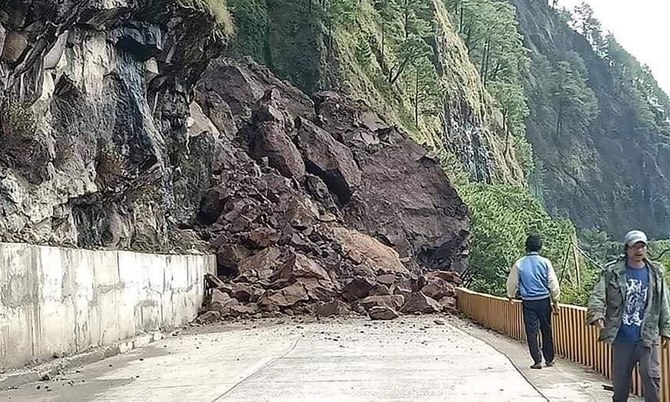
Halsema Highway in the Municipality of Bontoc, Mountain Province, is blocked following a landslide, after a 7.0-magnitude earthquake hit the northern Philippines, July 27, 2022. (AFP)
2 / 5
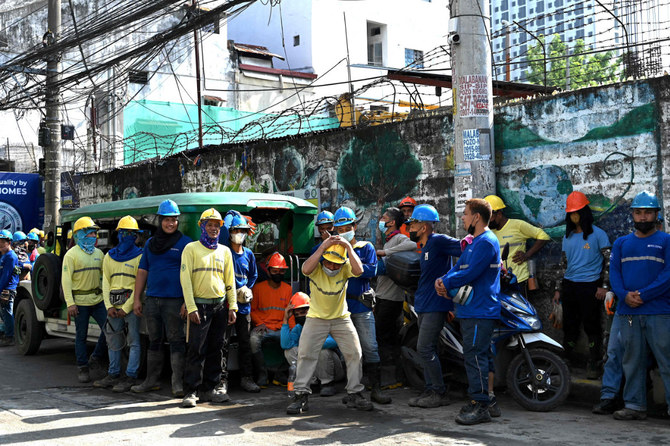
Construction workers evacuate their building after a 7.1 magnitude earthquake, some 300 kilometers away, was felt in Manila on July 27, 2022. (Jam Sta. Rosa / AFP)
3 / 5
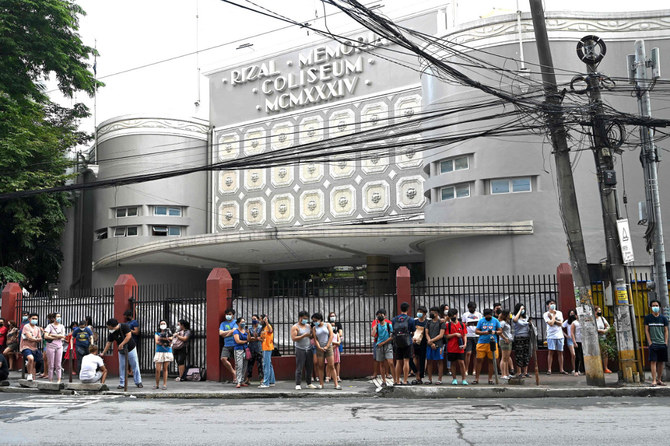
Residents evacuate their building after a 7.3 magnitude earthquake, some 300 kilometers away, was felt in Manila on July 27, 2022. (Jam Sta. Rosa / AFP)
4 / 5
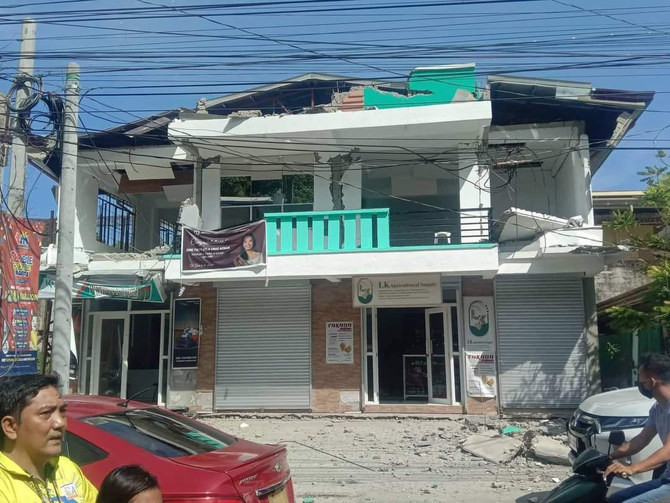
This picture shared on social media shows a building in Lagangilang, Abra province damaged by the earthquake that hit the northern Philippines early Wednesday. (Office of Rep. Ching Bernos via Facebook)
5 / 5
This picture shared on social media shows a building in Lagangilang, Abra province damaged by the earthquake that hit the northern Philippines early Wednesday. (Office of Rep. Ching Bernos via Facebook)
Short Url
Updated 27 July 2022
Follow

Powerful 7-magnitude earthquake strikes northern Philippines

  • At least 5 people killed and over 100 injured, officials say
  • Nation’s islands lie in the Pacific ‘Ring of Fire’ where most of world’s quakes occur

MANILA: A strong earthquake hit the northern Philippines on Wednesday, killing at least five people and injuring over 100 others, and causing severe damage to homes and infrastructure, officials said.

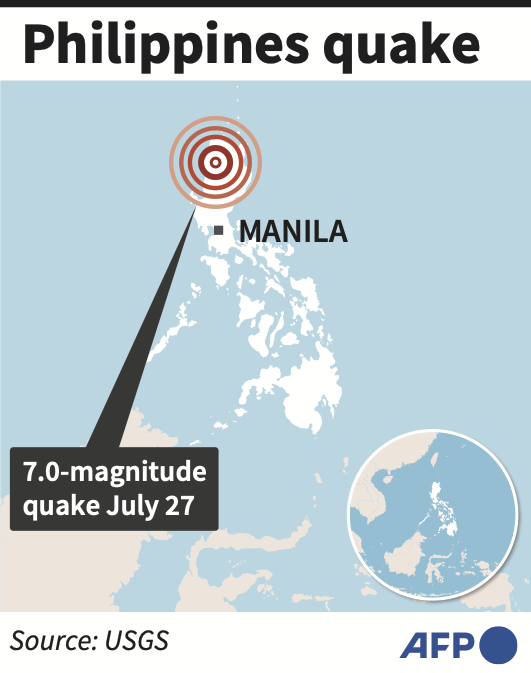
The 7-magnitude quake, which had sent strong tremors through the capital Manila, struck at 8:43 a.m. at a shallow depth of 10 kilometers, according to the Philippine Institute of Volcanology and Seismology.

The powerful earthquake was centered in the mountainous Abra province, and killed at least five people, according to the National Disaster Risk Reduction and Management Council. Police said more than 100 people were injured in the Cordillera region, which covers six provinces including Abra.

“Anything greater than seven is a major earthquake and we would expect significant effects of this event,” Renato Solidum, director at the seismology institute, said at a press briefing.

Solidum said the strong tremors had triggered landslides and caused damages to homes and buildings.

“Many of the churches and historical buildings were damaged,” he said.

The seismology institute downgraded the quake from the initial 7.3 magnitude after further analysis, and said there was no risk of a tsunami because the fault was inland.

More than 6,700 villages on Luzon island were affected by Wednesday’s tremors, with dozens of roads and at least 173 buildings damaged, Interior Secretary Benjamin Abalos Jr. said. The quake had also interrupted power and communication lines in Abra and Benguet provinces.
Philippine President Ferdinand Marcos Jr. ordered the immediate dispatch of rescue and relief teams to the affected areas, and is expected to visit the region on Thursday.

“Despite the sobering news brought by the damage caused by the earthquake, we assure the immediate response to the needs of our countrymen in areas affected by this disaster,” Marcos Jr. said on Twitter.

The Philippines, an archipelago of more than 7,000 islands, lies along the so-called Ring of Fire, an arc of faults around the Pacific Ocean where the majority of the world’s volcanic eruptions and earthquakes occur.

In 2019, an earthquake of 6.1 magnitude struck Zambales province on Luzon, killing 18 people.

One of the deadliest recorded in the Philippines occurred on July 16, 1990, when a 7.8 magnitude earthquake killed nearly 2,000 people in the country’s north.


Bangladesh sends record 750,000 workers to Saudi Arabia in 2025

Updated 56 min 35 sec ago
Follow

Bangladesh sends record 750,000 workers to Saudi Arabia in 2025

  • Latest data shows 16% surge of Bangladeshis going to the Kingdom compared to 2024
  • Bangladesh authorities are working on sending more skilled workers to Saudi Arabia

DHAKA: Bangladesh sent over 750,000 workers to Saudi Arabia in 2025, marking the highest overseas deployment to a single country on record, its labor bureau said on Friday.

Around 3.5 million Bangladeshis live and work in Saudi Arabia, sending home more than $5 billion every year. They have been joining the Saudi labor market since the 1970s and are the largest expatriate group in the Kingdom.

Last year, Saudi Arabia retained its spot as the top destination for Bangladeshi workers, with more than two-thirds of over 1.1 million who went abroad in 2025 choosing the Kingdom.

“More than 750,000 Bangladeshi migrants went to Saudi Arabia last year,” Ashraf Hossain, additional director-general at the Bureau of Manpower, Employment and Training, told Arab News.

“So far, it’s the highest number for Bangladesh, in terms of sending migrants to Saudi Arabia or any other particular country in a single year.”

The latest data also showed a 16 percent increase from 2024, when about 628,000 went to the Kingdom for work, adding to the largest diaspora community outside Bangladesh.

Authorities have focused on sending more skilled workers to Saudi Arabia in recent years, after the Kingdom launched in 2023 its Skill Verification Program in Bangladesh, which aims to advance the professional competence of employees in the Saudi labor market.

Bangladesh has also increased the number of certification centers, allowing more candidates to be verified by Saudi authorities.

“Our focus is now on increasing safe, skilled and regular migration. Skilled manpower export to Saudi Arabia has increased in the last year … more than one-third of the migrants who went to Saudi Arabia did so under the Skill Verification Program by the Saudi agency Takamol,” Hossain said.

“Just three to four months ago, we had only been to certify 1,000 skilled workers per month. But now, we can conduct tests with 28 (Saudi-approved) centers across the country, which can certify around 60,000 skilled workforces (monthly) for the Kingdom’s labor market.”

On Thursday, the BMET began to provide training in mining, as Bangladesh aims to also start sending skilled workers for the sector in Saudi Arabia.

“There are huge demands for skilled mining workers in Saudi Arabia as it’s an oil-rich country,” Hossain said.

“We are … trying to produce truly skilled workers for the Saudi labor market.”

In October, Saudi Arabia and Bangladesh signed a new employment agreement, which enhances worker protection, wage payments, as well as welfare and health services.

It also opens more opportunities in construction and major Vision 2030 projects, which may create up to 300,000 new jobs for Bangladeshi workers in 2026.