Strong quake knocks out power, sends residents fleeing homes in southern Philippines

A strong earthquake in the southern Philippines on Feb. 1, 2023, stoked fear of a 2019 temblor that damaged many buildings in Davao region. (AFP file)
Short Url
Updated 01 February 2023
Follow

Strong quake knocks out power, sends residents fleeing homes in southern Philippines

  • The quake was so strong in Montevista town of Davao de Oro province an and a witness said her house would collapse.

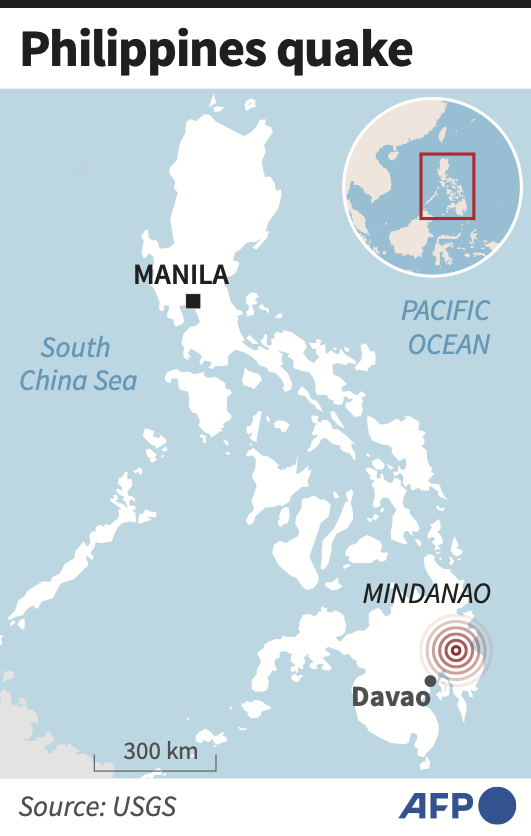
GENERAL SANTOS CITY, Philippines: A 6.0-magnitude earthquake rocked the southern Philippines on Wednesday, the US Geological Survey said, with local authorities warning of aftershocks and possible damage.
The shallow quake struck at 6:44 p.m. (1044 GMT), near Monkayo municipality in Davao de Oro province on Mindanao island.
Shallow earthquakes tend to cause more damage than deeper ones, but there were no immediate reports of major damage in the remote and mountainous gold mining region.
Monkayo police Staff Sergeant Harvey Asayas told AFP the quake was strong in the beginning but gradually weakened and stopped after 40 seconds.
“The authorities are now conducting patrols around to assess damage including the fire personnel and disaster officers,” Asayas said.
Police Corporal Edwin Mangigo, who is stationed at an outpost near Mount Diwata in Monkayo, said there had been no reports of casualties at local mining sites.
“We thought there was a landslide because our roof was shaking, we thought it was going to break,” Mangigo said.
Police Corporal Lucita Ambrocio, who is based in the nearby municipality of New Bataan, described the quake as “quick.”
“After 10 minutes, our colleagues went back to the building,” said Ambrocio, who raced outside with her colleagues when the police station started shaking.
“I checked the premises and I saw a small crack in the barracks.”
But in nearby Montevista municipality, Maricar Melgar said the quake was so strong she feared the building she was in would collapse.
“This was probably the strongest earthquake I experienced. My body is still shaking,” the 51-year-old told AFP.

In Tagum city, in Davao del Norte province, about 40 kilometers south west of the epicenter, residents also fled their homes and power was knocked out by the force of the quake.
“We were eating when (the house) began to shake — it was strong,” said Grace Jao, 40.
“We ran outside — we had to take safety measures. We did not see any damage inside the house when we got back.”
Quakes are a daily occurrence in the Philippines, which sits along the Pacific “Ring of Fire,” an arc of intense seismic as well as volcanic activity that stretches from Japan through Southeast Asia and across the Pacific basin.
Most are too weak to be felt by humans, but strong and destructive ones come at random with no technology available to predict when and where it will happen.
The nation’s civil defense office regularly holds drills simulating earthquake scenarios along active fault lines.
The last major quake was in October in the northern Philippines.
The 6.4-magnitude earthquake hit the mountain town of Dolores in Abra province, injuring several people, damaging buildings and cutting power to most of the region.
A 7.0-magnitude quake in mountainous Abra last July triggered landslides and ground fissures, killing 11 people and injuring several hundred.


Australian bushfires raze homes, cut power to tens of thousands

Updated 58 min 1 sec ago
Follow

Australian bushfires raze homes, cut power to tens of thousands

  • PM Anthony Albanese said the nation faced a ‍day of “extreme and dangerous” fire weather, especially in Victoria, where much of the state has been declared a disaster zone

SYDNEY: Thousands of firefighters battled bushfires in Australia’s southeast on Saturday that have razed homes, cut power to thousands of homes and burned swathes of bushland. The blazes have torn through more than 300,000 hectares (741,316 acres) of bushland amid a heatwave in Victoria state since the middle of the week, authorities said on Saturday, and 10 major fires were still burning statewide. In neighboring New South ‌Wales state, several ‌fires close to the Victorian border were ‌burning ⁠at ​emergency level, ‌the highest danger rating, the Rural Fire Service said, as temperatures hit the mid-40s Celsius (111 degrees Fahrenheit). More than 130 structures, including homes, have been destroyed and around 38,000 homes and businesses were without power due to the fires in Victoria, authorities said. The fires were the worst to hit the state since the Black Summer blazes of 2019-2020 that destroyed an area ⁠the size of Turkiye and killed 33 people. “Where we can fires will be being brought ‌under control,” Victoria Premier Jacinta Allan told ‍reporters, adding thousands of firefighters were ‍in the field.
Prime Minister Anthony Albanese said the nation faced a ‍day of “extreme and dangerous” fire weather, especially in Victoria, where much of the state has been declared a disaster zone.
“My thoughts are with Australians in these regional communities at this very difficult time,” Albanese said in televised remarks from ​Canberra. One of the largest fires, near the town of Longwood, about 112 km (70 miles) north of Melbourne, has burned ⁠130,000 hectares (320,000 acres) of bushland, destroying 30 structures, vineyards and agricultural land, authorities said. Dozens of communities near the fires have been evacuated and many of the state’s parks and campgrounds were closed. A heatwave warning on Saturday was in place for large parts of Victoria, while a fire weather warning was active for large areas of the country including New South Wales, the nation’s weather forecaster said. In New South Wales capital Sydney, the temperature climbed to 42.2 C, more than 17 degrees above the average maximum for January, according to data from the nation’s weather forecaster.
It predicted ‌conditions to ease over the weekend as a southerly change brought milder temperatures to the state.