SAMI’s new ‘Center of Excellence’ to be up and running by 2025

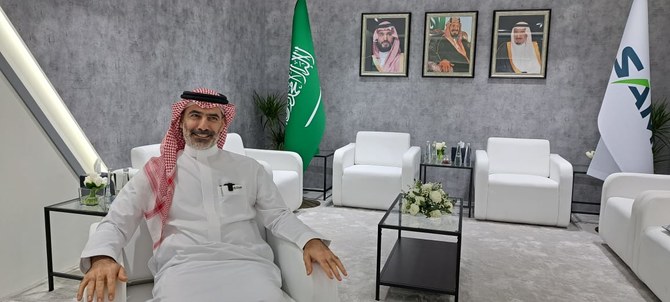
SAMI CEO Walid Abukhaled speaking to Arab News (AN)
Short Url
Updated 23 February 2023
Follow

SAMI’s new ‘Center of Excellence’ to be up and running by 2025

RIYADH: Saudi Arabia is set to create hundreds more jobs in the defense sector as Saudi Arabian Military Industries' new ‘Land System Center of Excellence’ becomes operational in the next two years, the company’s CEO told Arab News.

Speaking exclusively on the sidelines of the International Defence Exhibition in Abu Dhabi, Walid Abukhaled said the latest project by the company is designed to boost the defense industry in Saudi Arabia.

“What we announced is the design phase of the facilities. We have got board approval, we have got the support, and we are moving forward with our plan,” he said. 

The SAMI CEO said the latest center will focus on developing land system vehicles including four-by-fours, six-by-sixes, and eight-by-eights.

The center is part of the drive to make SAMI one of the top 25 defense companies globally by 2030 – an ambition that is increasingly likely thanks to the support from the leadership of the Kingdom, according to Abukhaled.

Last year, the firm joined forces with global firm Lockheed Martin to begin work on a Composites Manufacturing Center of Excellence to boost Saudi Arabia’s aerospace manufacturing capabilities.

During the interview, he expressed his gratitude to Crown Prince Mohammed bin Salman and said that his Vision 2030 is the driving factor behind SAMI’s growth. 

“Only after four years of operationalizing SAMI’s operation, we managed to be one of the top 100 defense companies in the world. We are number 96. Company number 100 is Embraer which was established in 1969. Our ultimate objective is to be a top 25 defense company by 2030,” said Abukhaled. 

He added: “We have a clear roadmap. The target is 2030, absolutely. And the challenge, can we beat it? Can we beat the date and make it happen before 2030?“ 

According to Abukhaled, the government, the military and all the armed forces are working together to help SAMI achieve this target. 

He further noted that SAMI has hired some of the best local talents, along with international experts who have first-hand knowledge about the defense sector, and this has played a crucial role in determining the success of the company in a very short period of time. 

The SAMI CEO added that the firm is eyeing 50 percent of localization in defense spending by 2030. 

He further pointed out that space is going to play a crucial role in enhancing the communication system in the defense sector. 

“Space will play a key role in communication. And under our advanced electronic divisions, we have communication systems, and that communication can happen through space, or through a normal waveform, ground to ground. So, we are working on how to communicate with satellites, and that will be under our advanced electronics division,” he said. 

Abukhaled revealed that SAMI is also working on new technologies like artificial intelligence and autonomous vehicle technology to further grow in the defense sector. 

“We have a chief technology officer. There is a function called emerging technologies, where the main objective and purpose is to look at the trends in technology and look 20 and 30 years ahead. So, absolutely there is a focus on advanced technology,” said Abukhaled. 

He added: “Autonomy is not an option any more. It is coming. That is the future. Airplane will fly without pilots. Ships will sail without a captain, and for land vehicles, you will not need drivers. The machines have proven that they can. They are more reliable and they do not make mistakes. Of course, you need to put the right option in them to make it reliable.” 


First EU–Saudi roundtable on critical raw materials reflects shared policy commitment

Updated 16 January 2026
Follow

First EU–Saudi roundtable on critical raw materials reflects shared policy commitment

RIYADH: The EU–Saudi Arabia Business and Investment Dialogue on Advancing Critical Raw Materials Value Chains, held in Riyadh as part of the Future Minerals Forum, brought together senior policymakers, industry leaders, and investors to advance strategic cooperation across critical raw materials value chains.

Organized under a Team Europe approach by the EU–GCC Cooperation on Green Transition Project, in coordination with the EU Delegation to Saudi Arabia, the European Chamber of Commerce in the Kingdom and in close cooperation with FMF, the dialogue provided a high-level platform to explore European actions under the EU Critical Raw Materials Act and ResourceEU alongside the Kingdom’s aspirations for minerals, industrial, and investment priorities.

This is in line with Saudi Vision 2030 and broader regional ambitions across the GCC, MENA, and Africa.

ResourceEU is the EU’s new strategic action plan, launched in late 2025, to secure a reliable supply of critical raw materials like lithium, rare earths, and cobalt, reducing dependency on single suppliers, such as China, by boosting domestic extraction, processing, recycling, stockpiling, and strategic partnerships with resource-rich nations.

The first ever EU–Saudi roundtable on critical raw materials was opened by the bloc’s Ambassador to the Kingdom, Christophe Farnaud, together with Saudi Deputy Minister for Mining Development Turki Al-Babtain, turning policy alignment into concrete cooperation.

Farnaud underlined the central role of international cooperation in the implementation of the EU’s critical raw materials policy framework.

“As the European Union advances the implementation of its Critical Raw Materials policy, international cooperation is indispensable to building secure, diversified, and sustainable value chains. Saudi Arabia is a key partner in this effort. This dialogue reflects our shared commitment to translate policy alignment into concrete business and investment cooperation that supports the green and digital transitions,” said the ambassador.

Discussions focused on strengthening resilient, diversified, and responsible CRM supply chains that are essential to the green and digital transitions.

Participants explored concrete opportunities for EU–Saudi cooperation across the full value chain, including exploration, mining, and processing and refining, as well as recycling, downstream manufacturing, and the mobilization of private investment and sustainable finance, underpinned by high environmental, social, and governance standards.

From the Saudi side, the dialogue was framed as a key contribution to the Kingdom’s industrial transformation and long-term economic diversification agenda under Vision 2030, with a strong focus on responsible resource development and global market integration.

“Developing globally competitive mineral hubs and sustainable value chains is a central pillar of Saudi Vision 2030 and the Kingdom’s industrial transformation. Our engagement with the European Union through this dialogue to strengthen upstream and downstream integration, attract high-quality investment, and advance responsible mining and processing. Enhanced cooperation with the EU, capitalizing on the demand dynamics of the EU Critical Raw Materials Act, will be key to delivering long-term value for both sides,” said Al-Babtain.

Valere Moutarlier, deputy director-general for European industry decarbonization, and directorate-general for the internal market, industry, entrepreneurship and SMEs at European Commission, said the EU Critical Raw Materials Act and ResourceEU provided a clear framework to strengthen Europe’s resilience while deepening its cooperation with international partners.

“Cooperation with Saudi Arabia is essential to advancing secure, sustainable, and diversified critical raw materials value chains. Dialogues such as this play a key role in translating policy ambitions into concrete industrial and investment cooperation,” she added.