

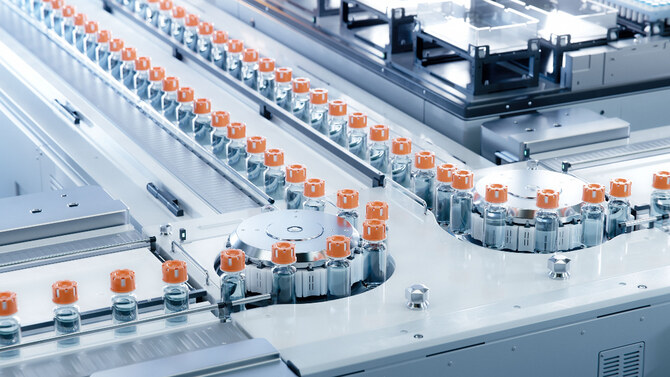
Pharmaceutical industry growth proving just the pill for Saudi Arabia’s healthcare goals

A key factor in fueling this increase is the increasing localization of the pharmaceutical industry – a strategy which plays into the Kingdom’s economic diversification strategy Vision 2030. (File/Shutterstock)
Short Url
Updated 01 September 2024
Follow

Pharmaceutical industry growth proving just the pill for Saudi Arabia’s healthcare goals

  • According to Statista, the pharmaceuticals market in the Kingdom is anticipated to achieve a revenue of $5.53 billion by 2024
  • Saudi Arabia is set to see a compound annual growth rate of 4.62 percent, resulting in a market volume of $6.93 billion by 2029

RIYADH: As the Saudi government makes substantial investments in healthcare infrastructure, there is a notable increase in the demand for pharmaceuticals in the country.

According to Statista, a German online platform that specializes in data gathering and visualization, the pharmaceuticals market in the Kingdom is anticipated to achieve a revenue of $5.53 billion by 2024.

While significantly lower than the global leader the US – poised to generate $630.3 billion in revenue in 2024 – Saudi Arabia is set to see a compound annual growth rate of 4.62 percent, resulting in a market volume of $6.93 billion by 2029.

A key factor in fueling this increase is the increasing localization of the pharmaceutical industry – a strategy which plays into the Kingdom’s economic diversification strategy Vision 2030.

“While we will have to ascertain the quantified impact of localization on the pharmaceutical industry in Saudi Arabia, we definitely expect it to increase access, reduce cost and make the local pharmaceutical industry more resilient and innovative,” Partha Basumatary, principal in Oliver Wyman’s India, Middle East and Africa Healthcare and Life Sciences Practice told Arab News.

“Localization initiatives have laid the foundation for the Kingdom to become a regional hub of manufacturing for biotech products for the entire Middle East region,” Basumatary added, noting that the Kingdom’s focus on localization for NCD drugs, particularly those targeting type-2 diabetes, is a strong start.    

“To truly maximize its impact, however, the Kingdom needs to expand these initiatives beyond NCDs and encompass other critical areas like cancer, infectious diseases, and auto-immune disorders,” Basumatary said.

According to Matthew Lawrence, director of Pharma and Life Sciences, Operations Transformation Lead at PwC Middle East, the Kingdom’s access to, cost of, and standard of healthcare services have all significantly improved thanks to Saudi Arabia’s transformation of the industry.

As a result of these current localization actions, the pharmaceutical industry in Saudi Arabia will continue to see significant change towards accessibility, quality, and economic impact, Lawrence disclosed.

In terms of accessibility, he told Arab News: “Local production ensures a sustainable economy, reducing reliance on imports, therefore, a stable supply of medications, and faster response time during health crises.”

As for quality, he explained that the Saudi Food and Drug Authority ensures that locally manufactured pharmaceuticals meet high quality standards, which leads to improved healthcare services.

With regard to economic impact, Lawrence noted that the industry’s growth has spurred job creation and attracted investments, aiding in economic diversification.

“According to the Kingdom’s National Biotechnology Strategy, there will be 11,000 job opportunities by 2030, and contribute $34.6 billion to the non-oil GDP, by 2040 - potentially positioning Saudi Arabia as one of the leading global hubs for pharmaceutical manufacturing, research, and innovation,” he said.

“This is a clear testament to the major impact Vision 2030 has created in order to improve the healthcare sector across the Kingdom,” the PwC partner added.

Key steps taken by Saudi Arabia to localize the pharmaceutical industry

In keeping with the Kingdom’s Vision 2030 drive, Saudi Arabia has taken important steps to incentivize local manufacturing.

“First and foremost, it (Saudi Arabia) has offered various incentives to the pharma companies to drive localization, including lower minimum capital requirement, tax incentives, customs duties exemptions etc,” Basumatary said.

“It has also taken steps to improve regulatory approvals for drugs in the country with the introduction of abridged verification and registration processes,” he added, before going on to explain how the Kingdom has also developed a framework to favor locally manufactured products for tenders.

The Oliver Wyman principal highlighted successful examples of localization, such as Boehringer Ingelheim’s partnership with Alpha Pharma for localization of a Type-2 diabetes product in Saudi Arabia.

“Other notable examples include MSD’s partnership with Jamjoom Pharma to localize another Type-2 diabetes drug sitagliptin phosphate. Such initiatives will help the industry to become more resilient when it comes to future outbreaks such as COVID-19,” Basumatary said, adding: “It would also sow the seeds for future innovation and growth of the domestic pharma industry, including potentially giving a positive push to the Kingdom’s aspirations of becoming a regional biotech hub.”

Government support

As expected, the Saudi government plays a pivotal role in accelerating the localisation of the pharmaceutical industry and is already investing in driving strategic programs to advance the healthcare system:

From Oliver Wyman’s perspective, Basumatary said: “As observed in other geographies, Singapore government’s stable policy framework, favorable incentives, and access to knowledge/talent motivated BionTech to establish a state-of-the-art mRNA manufacturing facility in the country.”

The principal further noted that the pharmaceutical industry expects enhanced market accessibility, support for localization, and strong IP protection when it comes to making localization decisions.

“Saudi Arabia’s involvement and support has delivered an impact as we have seen from the recent pharma localization initiatives. It will, however, be critical to continue innovating on that front, as the competition for such localization initiatives continues to increase globally and regionally,” he underlined.

PwC Middle East’s Lawrence revealed that some of the notable government efforts include favorable policies like tax incentives and labor laws to incentivize research and development as well as manufacturing.

They also entail enabling regulatory frameworks to drive life science sector growth, with measures around strong intellectual property laws, patent protection, mutual recognition agreements to facilitate market access, and competition laws.

Other initiatives include not-for-profit funding, such as targeted grants, to incentivize research, as well as public financing such as subsidies or incentives to enable long-term growth of the healthcare ecosystem.   

“The government's ongoing commitment to localization is a clear long-term strategic plan, building on Vision 2030. The alignment of government policies with Vision 2030 goals underscores their influence in driving the progress of pharmaceutical localization across the Kingdom,” Lawrence said.

“These policies and initiatives will not only attract future investment but also foster innovation, build local capabilities, and ultimately contribute to the sustainable growth of the healthcare sector,” he added.

Looking to the future

In recent years, Saudi Arabia has intensified its focus on life sciences and has made substantial advancements to align with the objectives of Vision 2030.

This has involved endeavors to enhance the overall health and well-being of individuals, promote economic expansion and diversity, reinforce the Kingdom's global leadership in the sector, stimulate innovation, and enhance patient outcomes and quality of life.

According to Lawrence, one of the key initiatives contributing to the advancements of the life science industry is national biotechnology strategy.

“This helps to develop end-to-end vaccine manufacturing, establish biotechnology platform for biologics and biosimilars, and expands genomics programs for preventative medicine,” Lawrence told Arab News.

The PwC partner also shed light on the Healthcare Sector Transformation Program, explaining that it is responsible for strategizing the Kingdom’s resilient supply chain through different initiatives that help in enabling the localization of the pharmaceutical industry.

Other key players include the Local Content and Government Procurement Authority, which works on enhancing awareness and participation in local content and provides knowledge-based policies and tools, as well as the National Industrial Development and Logistics Program which focuses on expanding the pharmaceutical manufacturing sector.

It also includes incentives for local and international companies to establish production facilities in Saudi Arabia.

The Saudi Food Drug Administration is also playing a pivotal role as it enhances regulatory frameworks to help speed up the approval process for new drugs and encourage innovation in local pharmaceutical production.

Pharmaceuticals and Vision 2030

The strategic initiatives of the pharmaceutical industry are closely aligned with the Kingdom’s Vision 2030 goals, echoing ambitions in economic diversification, job creation, and innovation, as well as technology transfer and self-sufficiency.

“Life science sector expansion is expected to create thousands of jobs, helping to reduce unemployment rates among Saudis, particularly in high-skilled areas. Encouraging partnerships and collaboration leads to technology transfer and innovation,” Lawrence said.

With regards to self-sufficiency, the PwC partner noted that localizing pharmaceutical production ensures a stable supply of essential medicines and reduces the health sector's vulnerability to global supply chain disruptions.

“These initiatives are aligned with Vision 2030 goals as they contribute to the Kingdom’s economic growth, job creation and localization initiatives for Saudi nationals, as well as the enhancement of healthcare services across the country,” he said.

“By localizing the pharmaceutical industry and expanding these initiatives, Saudi Arabia can further improve healthcare accessibility, reduce healthcare costs, and ensure sustainability in the healthcare demands of its growing population,” Lawrence said.


Vision 2030 propelling Saudi Arabia’s global reputation

Updated 11 sec ago
Follow

Vision 2030 propelling Saudi Arabia’s global reputation

  • Bold initiatives are positioning the Kingdom as a regional trailblazer in sustainability

RIYADH: Saudi Arabia’s Vision 2030 program, aimed at revolutionizing the Kingdom’s economic and social landscape, has propelled the nation’s global reputation on a large scale, experts told Arab News. 

Launched in 2016, the program is a comprehensive guide to position Saudi Arabia as a powerhouse of business, tourism and non-oil activities, both regionally and globally. 

Speaking to Arab News, Thomas Kuruvilla, managing partner of Arthur D. Little Middle East & India, said that Saudi Arabia’s Vision 2030 is the cornerstone of the Kingdom’s transformation driving diversification, investment in non-oil sectors, and reshaping its global reputation. 

“Vision 2030 is not an end point but a launchpad. The foundations being laid today from renewable energy, automotive, and tourism to digital infrastructure and advanced industries are designed to endure and evolve well beyond 2030. The Kingdom’s leadership has already signaled that future frameworks will build on this momentum, ensuring that transformation continues into the decades ahead,” said Kuruvilla. 

He added: “Vision 2030 has firmly established Saudi Arabia as a reforming nation on the world stage. Saudi Arabia is creating an economic and social model that looks past 2030, one that aims to deliver sustainable growth, global competitiveness, and opportunity for generations to come.” 

Elie Farhat, chief of external affairs for Georgetown University’s McDonough School of Business espoused similar views and said Saudi Arabia has actively courted foreign investment, tourism, and partnerships with global universities and businesses. 

“Saudi Arabia has become a market and society that is perceived as both investable and engaging. International organizations are setting up regional headquarters in Riyadh, universities are establishing partnerships, and businesses now openly discuss Saudi Arabia as a gateway to the future of the Middle East,” said Farhat. 

In October, Saudi Arabia’s Investment Minister Khalid Al-Falih, while speaking at the Fortune Global Forum Conference in Riyadh, said the Vision 2030 program is progressing steadily, with 85 percent of the targets outlined in the initiative completed or on track by the end of 2024. 

Al-Falih also added that the number of international firms licensed to establish their regional headquarters in Riyadh has reached 675.

The regional HQ program offers a 30-year corporate tax exemption, withholding tax relief, and regulatory support, reflecting efforts to position the Kingdom as a regional business hub and attract multinational corporations to the capital.

Some of the noted firms that have established regional bases in Riyadh include Northern Trust, IHG Hotels & Resorts, PwC, and Deloitte. Laura Hernandez Gonzalez, managing director of Globant for the Middle East and North Africa, said Vision 2030 has turned diversification from an aspiration into a reality, adding that programs like the regional HQ initiative and the transformation of Riyadh into a true financial hub are convincing multinationals to set up real operations, not just representative offices.

“From the technology side, the Kingdom’s commitment to AI, cloud, and sovereign digital infrastructure is equally important. It signals not only ambition, but the capacity to build future-ready capabilities at scale,” said Gonzalez. 

She added: “This is how the Kingdom is changing global perceptions: from an energy powerhouse to a hub of innovation, capital and talent.” 

Earlier in December, Rachid Boulaouine, Middle East and Saudi Arabia director at Business France, told Al-Eqtisadiah that French companies operating in Saudi Arabia are expected to increase by 30 percent to 40 percent as more small and medium-sized enterprises move to establish a presence in the Kingdom. 

The changing global image

Kuruvilla said that Saudi Arabia’s pivot toward renewable energy and sustainability is not just symbolic, but it represents a decisive strategic shift in the Kingdom’s development model. 

Bolstering renewable energy capacity is critical for Saudi Arabia as it aims to generate 130 gigawatts of clean energy by 2030 and achieve net-zero emissions by 2060.

Kuruvilla said that flagship projects such as Neom — a futuristic city designed to run entirely on renewable energy — and the world’s largest green hydrogen plant highlight Saudi Arabia’s determination to lead in climate innovation. 

This is how the Kingdom is changing global perceptions: from an energy powerhouse to a hub of innovation, capital and talent.

Laura Hernandez Gonzalez, managing director of Globant for the Middle East and North Africa

“These initiatives are positioning the Kingdom as a regional trailblazer in sustainability and earning recognition as a nation “at the forefront of the clean-energy revolution,” with few global peers matching its scale and ambition,” said the Arthur D. Little official. 

He added: “Such bold moves are strengthening Saudi Arabia’s standing among international partners that prioritize climate action, demonstrating alignment with global sustainability imperatives rather than resistance.” 

According to Farhat, it is the young generation in Saudi Arabia guided by Vision who are playing a crucial role in elevating the Kingdom’s global reputation. 

“Saudis — particularly younger generations — have opened up to the world with a readiness to learn, build, and lead for 2030. The world, in turn, has opened up to Saudi Arabia, seeing it as a dynamic partner to invest in,” said Farhat. 

Saudi Arabia’s tourism growth

Gonzalez said that the global narrative about Saudi Arabia has shifted decisively, with international travelers increasingly considering the Kingdom as a favorite destination. 

She added that the growth in tourism numbers is one of the clearest proof points that Vision 2030 is delivering, also indicating the Kingdom’s growing appeal among the international public. 

“Ranking among the top three globally for growth in international tourist arrivals, surpassing 100 million visits in 2023, and contributing over 10 percent of the gross domestic product in 2025 are extraordinary achievements in such a short period,” said Gonzalez. 

She added: “Today, when I speak with investors, partners, or peers, Saudi Arabia is framed around opportunity, innovation, and delivery.” 

Kuruvilla said that the growth in tourism has signaled to the world that Saudi Arabia is no longer just an oil-rich nation, but a fast-emerging must-visit destination. 

HIGHLIGHT

The regional HQ program offers a 30-year corporate tax exemption, withholding tax relief, and regulatory support, reflecting efforts to position the Kingdom as a regional business hub and attract multinational corporations to the capital.

The Arthur D. Little official added that media coverage has reinforced this narrative, with tourism and entertainment mentions up 60 percent in 2024, underscoring the Kingdom’s growing appeal to global travelers. 

“International surveys echo this sentiment: a recent multi-country poll found 59 percent of respondents were interested in visiting Saudi Arabia — a figure unimaginable only a decade ago,” said Kuruvilla. 

Saudi Arabia passed its 2030 target of 100 million visitors in 2023, and the following year it welcomed 115.9 million tourists.

Having already reached its goal, the Kingdom raised its target to 150 million annual visitors by 2030.

In November, the Saudi Conventions and Exhibitions General Authority announced record growth in the Kingdom’s business events infrastructure, reporting a 32 percent year-on-year increase in capacity across 923 accredited venues.

The authority added that this expansion reflects significant investment aligned with Vision 2030’s tourism and event sector priorities, driving a 320 percent increase in exhibition space since 2018 to a total of 300,520 sq. meters.

Sports and technology

According to Kuruvilla, Saudi Arabia is cultivating an image as a global hub for business, technology, and innovation by hosting high-profile international events like the Future Investment Initiative, the LEAP tech conference, and the World Defense Show. 

He said that these events draw thousands of investors, entrepreneurs, and industry leaders to the Kingdom, showcasing opportunities beyond oil. 

“The cumulative effect of these marquee gatherings and the establishment of such innovation-driving entities is a narrative that Saudi Arabia is open for business and eager to lead in future industries – a notable departure from its old image of insularity,” said Kuruvilla. 

He added: “These gatherings are translating into tangible partnerships and long-term investment opportunities, solidifying Saudi Arabia’s reputation as a hub for innovation and global business exchange.” 

According to Gonzalez, events like FII and LEAP in Saudi Arabia prove the Kingdom’s execution capacity, as well as showing the nation’s capability to “convene the world, compress partnership cycles, and set the agenda on innovation, defense, and finance.” 

Highlighting the importance of sporting events, Kuruvilla told Arab News that sports have become a cornerstone of Saudi Arabia’s effort to bolster its global reputation. 

“From hosting Formula 1 races and high-profile boxing matches to purchasing stakes in English Premier League football clubs, the Kingdom has invested heavily in sports as an avenue for soft power. The pinnacle of this strategy is Saudi Arabia securing the rights to host the 2034 FIFA World Cup — a coup that instantly thrusts the country into the international spotlight,” said Kuruvilla. 

Adding to this momentum, Saudi Arabia has also positioned itself at the forefront of digital sports by hosting the Esports World Cup in Riyadh in 2024 and 2025, with record-breaking prize pools and participation from the world’s top gaming titles. 

“By associating with beloved sports and athletes, Saudi Arabia is effectively rebranding itself, especially to younger global audiences, as a vibrant and welcoming destination. Superstars like Cristiano Ronaldo playing for Saudi clubs – and posting about life in the Kingdom – further humanize Saudi Arabia’s image abroad,” added the Arthur D. Little official.