Germany to get new Qatari LNG flows through QatarEnergy, ConocoPhillips deal

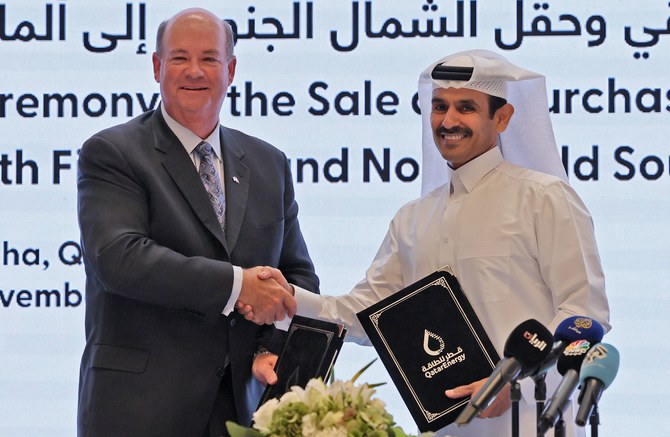
Saad Sherida al-Kaabi, Qatar's energy minister and CEO of QatarEnergy, and Ryan Lance, CEO of multinational corporation ConocoPhillips, exchange documents during a press conference in Qatar's capital Doha on November 29 (KARIM JAAFAR/AFP)
Short Url
Updated 29 November 2022
Follow

Germany to get new Qatari LNG flows through QatarEnergy, ConocoPhillips deal

  • QatarEnergy says talks for further supply to Germany ongoing
  • Two deals mark first supply from North Field expansion to Europe

DOHA: Germany is set to receive new flows of Qatari liquefied natural gas from 2026 after QatarEnergy and ConocoPhillips on Tuesday signed two sales and purchase agreements for its export covering at least a 15-year period, according to Reuters.

Since Russia’s invasion of Ukraine in February, competition for LNG has become intense, with Europe in particular needing vast amounts to help replace Russian pipeline gas that used to make up almost 40 percent of the continent’s imports.

The deal, the first of its kind to Europe from Qatar’s North Field expansion project, will provide Germany with 2 million tons of LNG annually, arriving from Ras Laffan in Qatar to Germany’s northern LNG terminal of Brunsbuettel, QatarEnergy’s CEO said.

“(The agreements) mark the first ever long-term LNG supply agreement to Germany, with a supply period that extends for at least 15 years, thus contributing to Germany’s long-term energy security,” Saad Al-Kaabi said in a joint news conference with ConocoPhillips CEO Ryan Lance.

A ConocoPhillips subsidiary will purchase the agreed quantities to be delivered to the German receiving terminal, which is currently under development.

QatarEnergy and German utility firms have been thrashing out long-term LNG deals for much of this year as Berlin looks for alternatives to Russia, which is Germany’s biggest gas supplier.

Europe’s biggest economy, which mainly relies on natural gas to power its industry, aims to replace all Russian energy imports by as soon as mid-2024.

Talks ongoing 

German Economy Minister Robert Habeck said on Tuesday the 15-year term of the deal was “great.”

ICIS head of energy analytics Andreas Schroeder said the starting date of 2026 was late, as Germany needed LNG for 2023 and 2024.

“If German players do not secure sufficient volumes at an OK price for 2023, they will have to revert to spot LNG markets, and expose themselves to global price volatility.”

Kaabi said negotiations were still taking place with other German companies for further supply.

Asked on Tuesday whether some German politicians’ criticism of Qatar hosting the soccer World Cup had had any impact on talks, Kaabi, who had previously ruled out the possibility, said QatarEnergy separated politics and business.

The deal comes a few days after QatarEnergy signed a 27-year sales and purchase agreement with China’s Sinopec. The North Field is part of the world’s biggest gas field, which Qatar shares with Iran.

QatarEnergy earlier this year signed five deals for North Field East, the first and larger of the two-phase North Field expansion plan, which includes six LNG trains that will ramp up Qatar’s liquefaction capacity to 126 million tons per year by 2027 from 77 million. 


Lebanese social entrepreneur Omar Itani recognized by Schwab Foundation

Updated 23 January 2026
Follow

Lebanese social entrepreneur Omar Itani recognized by Schwab Foundation

  • FabricAID co-founder among 21 global recipients recognized for social innovation

DAVOS: Lebanon’s Omar Itani is one of 21 recipients of the Social Entrepreneurs and Innovators of the Year Award by the Schwab Foundation for Social Entrepreneurship.

Itani is the co-founder of social enterprise FabricAID, which aims to “eradicate symptoms of poverty” by collecting and sanitizing secondhand clothing before placing items in stores in “extremely marginalized areas,” he told Arab News on the sidelines of the World Economic Forum in Davos, Switzerland.

With prices ranging from $0.25 to $4, the goal is for people to have a “dignified shopping experience” at affordable prices, he added.

FabricAID operates a network of clothing collection bins across key locations in Lebanon and Jordan, allowing people to donate pre-loved items. The garments are cleaned and sorted before being sold through the organization’s stores, while items that cannot be resold due to damage or heavy wear are repurposed for other uses, including corporate merchandise.

Since its launch, FabricAID has sold more than 1 million items, reached 200,000 beneficiaries and is preparing to expand into the Egyptian market.

Amid uncertainty in the Middle East, Itani advised young entrepreneurs to reframe challenges as opportunities.

“In Lebanon and the Arab world, we complain a lot,” he said. Understandably so, as “there are a lot of issues” in the region, resulting in people feeling frustrated and wanting to move away. But, he added, “a good portion of the challenges” facing the Middle East are “great economic and commercial opportunities.”

Over the past year, social innovators raised a combined $970 million in funding and secured a further $89 million in non-cash contributions, according to the Schwab Foundation’s recent report, “Built to Last: Social Innovation in Transition.”

This is particularly significant in an environment of geopolitical uncertainty and at a time when 82 percent report being affected by shrinking resources, triggering delays in program rollout (70 percent) and disruptions to scaling plans (72 percent).

Francois Bonnici, director of the Schwab Foundation for Social Entrepreneurship and a member of the World Economic Forum’s Executive Committee, said: “The next decade must move the models of social innovation decisively from the margins to the mainstream, transforming not only markets but mindsets.”

Award recipients take part in a structured three-year engagement with the Schwab Foundation, after which they join its global network as lifelong members. The program connects social entrepreneurs with international peers, collaborative initiatives, and capacity-building support aimed at strengthening and scaling their work.