QatarEnergy signs 27-year sales and purchase agreement with China’s Sinopec

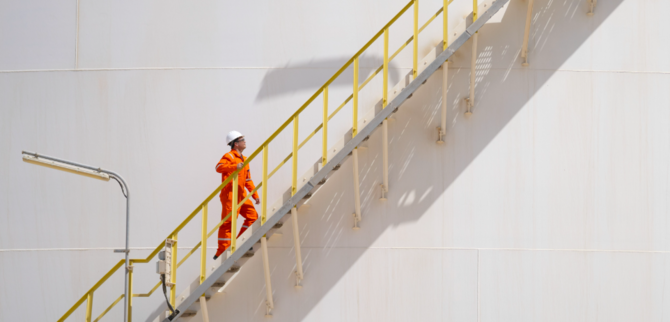
Qatar is already the world’s top LNG exporter (QatarEnergy)
Short Url
Updated 21 November 2022
Follow

QatarEnergy signs 27-year sales and purchase agreement with China’s Sinopec

DOHA: QatarEnergy has signed a 27-year deal to supply China’s Sinopec with liquefied natural gas, the longest such LNG agreement so far as volatile markets drive buyers to seek long-term deals.

Following Russia’s invasion of Ukraine in February, competition for LNG has become intense, with Europe in particular needing vast amounts to help replace Russian pipeline gas that used to make up almost 40 percent of the continent’s imports.

“Today is an important milestone for the first sales and purchase agreement for North Field East project, it is 4 million tons for 27 years to Sinopec of China,” QatarEnergy chief Saad Al-Kaabi told Reuters in Doha, shortly before the deal signing.

“It signifies long-term deals are here and important for both seller and buyer,” he said.

The North Field is part of the world’s biggest gas field that Qatar shares with Iran, which calls its share South Pars.

QatarEnergy earlier this year signed five deals for North Field East (NFE), the first and larger of the two-phase North Field expansion plan, which includes six LNG trains that will ramp up Qatar’s liquefaction capacity to 126 million tons per year by 2027 from 77 million.

It later signed contracts with three partners for North Field South (NFS), the second phase of the expansion.

Monday’s deal, confirmed by Sinopec, is the first supply deal to be announced for NFE.

“We are very happy about this deal with Sinopec because we have had a long-term relationship in the past and this takes our relationship to new heights as we have an SPA that will last into the 2050s,” Kaabi said.

Long-term supply

Kaabi said negotiations with other buyers in China and Europe that want to have security of supply were ongoing.

Qatar is already the world’s top LNG exporter and its North Field expansion project will boost that position and help guarantee long-term supplies of gas to Europe as the continent seeks alternatives to Russian flows.

“I think the recent volatility has driven buyers to understand the importance of having long-term supply,” Kaabi said.

He added negotiations for an equity stake in the Gulf country’s expansion project were ongoing with several entities.

The supply contract is a key component for an integrated partnership in the NFE, Sinopec said in a statement, indicating it could be involved in stake negotiations.

QatarEnergy has maintained a 75 percent stake overall in the expansion and could give up to a 5 percent stake from its holding to some buyers, Kaabi said.

Sources told Reuters in June that China’s national oil majors were in advanced talks with Qatar to invest in NFE.


First EU–Saudi roundtable on critical raw materials reflects shared policy commitment

Updated 16 January 2026
Follow

First EU–Saudi roundtable on critical raw materials reflects shared policy commitment

RIYADH: The EU–Saudi Arabia Business and Investment Dialogue on Advancing Critical Raw Materials Value Chains, held in Riyadh as part of the Future Minerals Forum, brought together senior policymakers, industry leaders, and investors to advance strategic cooperation across critical raw materials value chains.

Organized under a Team Europe approach by the EU–GCC Cooperation on Green Transition Project, in coordination with the EU Delegation to Saudi Arabia, the European Chamber of Commerce in the Kingdom and in close cooperation with FMF, the dialogue provided a high-level platform to explore European actions under the EU Critical Raw Materials Act and ResourceEU alongside the Kingdom’s aspirations for minerals, industrial, and investment priorities.

This is in line with Saudi Vision 2030 and broader regional ambitions across the GCC, MENA, and Africa.

ResourceEU is the EU’s new strategic action plan, launched in late 2025, to secure a reliable supply of critical raw materials like lithium, rare earths, and cobalt, reducing dependency on single suppliers, such as China, by boosting domestic extraction, processing, recycling, stockpiling, and strategic partnerships with resource-rich nations.

The first ever EU–Saudi roundtable on critical raw materials was opened by the bloc’s Ambassador to the Kingdom, Christophe Farnaud, together with Saudi Deputy Minister for Mining Development Turki Al-Babtain, turning policy alignment into concrete cooperation.

Farnaud underlined the central role of international cooperation in the implementation of the EU’s critical raw materials policy framework.

“As the European Union advances the implementation of its Critical Raw Materials policy, international cooperation is indispensable to building secure, diversified, and sustainable value chains. Saudi Arabia is a key partner in this effort. This dialogue reflects our shared commitment to translate policy alignment into concrete business and investment cooperation that supports the green and digital transitions,” said the ambassador.

Discussions focused on strengthening resilient, diversified, and responsible CRM supply chains that are essential to the green and digital transitions.

Participants explored concrete opportunities for EU–Saudi cooperation across the full value chain, including exploration, mining, and processing and refining, as well as recycling, downstream manufacturing, and the mobilization of private investment and sustainable finance, underpinned by high environmental, social, and governance standards.

From the Saudi side, the dialogue was framed as a key contribution to the Kingdom’s industrial transformation and long-term economic diversification agenda under Vision 2030, with a strong focus on responsible resource development and global market integration.

“Developing globally competitive mineral hubs and sustainable value chains is a central pillar of Saudi Vision 2030 and the Kingdom’s industrial transformation. Our engagement with the European Union through this dialogue to strengthen upstream and downstream integration, attract high-quality investment, and advance responsible mining and processing. Enhanced cooperation with the EU, capitalizing on the demand dynamics of the EU Critical Raw Materials Act, will be key to delivering long-term value for both sides,” said Al-Babtain.

Valere Moutarlier, deputy director-general for European industry decarbonization, and directorate-general for the internal market, industry, entrepreneurship and SMEs at European Commission, said the EU Critical Raw Materials Act and ResourceEU provided a clear framework to strengthen Europe’s resilience while deepening its cooperation with international partners.

“Cooperation with Saudi Arabia is essential to advancing secure, sustainable, and diversified critical raw materials value chains. Dialogues such as this play a key role in translating policy ambitions into concrete industrial and investment cooperation,” she added.