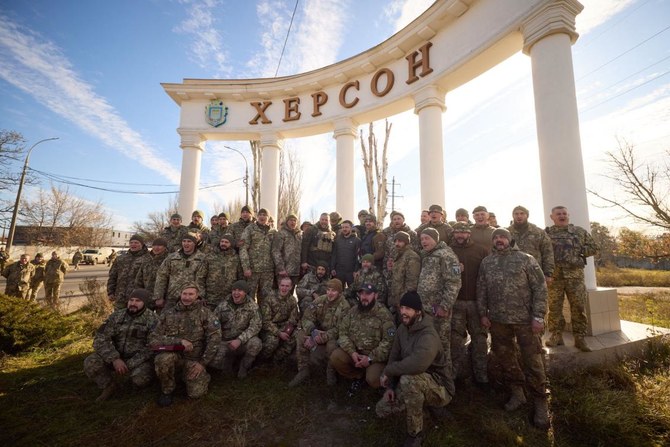
KHERSON, Ukraine: President Volodymyr Zelensky on Monday visited the newly liberated city of Kherson in southern Ukraine after Russian forces retreated from the strategic hub near the Black Sea.
The Ukrainian presidency distributed images of him singing the national anthem, holding his hand over his chest as the country’s blue and yellow flag was hoisted next to the city’s main administrative building.
Russian President Vladimir Putin’s spokesman denied, however, that the Ukrainian leader’s visit had any impact on the status of the Kherson region, which Moscow formally annexed into Russia at a ceremony last month.
“It’s important to be here,” Zelensky told reporters in the city as his office released images of him meeting Kherson residents and military officials.
“We should speak here... support the people so that they feel that we are not just talking, not just making promises but really returning and really raising our flag,” he added.
Late Sunday, Zelensky said Ukrainian forces found evidence of hundreds of new “war crimes” carried out by Russian occupiers in Kherson.
His subsequent visit came just days after Ukrainian troops entered the city — the Kherson region’s administrative center — after Russia pulled back its forces on Friday.
The takeover by Ukrainian troops is the latest in a string of setbacks for the Kremlin, which invaded Ukraine on February 24 hoping for a lightning takeover and to topple the government in days.
But Russian troops failed to capture the capital Kyiv and have since been pushed back from large portions of territory in the south and east.
Ukrainians in the liberated city expressed relief at the end of months of occupation.
“I am extremely happy we’re finally free,” Andriy, 33, a philosophy student, told AFP.
“We have no electricity in the city, no water, no central heating, no mobile signal, no Internet connection — but we have no Russians,” he said.
The city of Kherson was the first major urban hub to fall to Russian forces and the only regional capital Moscow’s troops gained control over.
Its recapture opens a gateway for Ukraine to the entire Kherson region, with access to both the Black Sea in the west and the Sea of Azov in the east.
The region was one of four that the Kremlin announced in September were annexed and part of Russia. Russian President Vladimir Putin vowed to use all available means to defend them from Ukrainian forces.
Kremlin spokesman Dmitry Peskov said Monday he would not comment on Zelensky’s visit to Kherson but added: “this territory is part of the Russian Federation.”
A self-described partisan in Kherson told AFP after the Russian withdrawal that he and his friends had spent months walking the streets observing the Russians’ every move.
“You watch closely and then come home and write it all down. And then you send the information and hide absolutely everything — phones, papers, clothes, everything,” 19-year-old aspiring musician named Volodymyr Timor said.
“We reported everything — where their equipment and ammunition sites were, where they slept and where they went out drinking,” Timor said.
Ukraine’s forces could then use the coordinates to target strikes during a counteroffensive that has seen Russia cede roughly half the land it seized in the first weeks of war.
“I was scared,” the imposing but soft-spoken guitarist said of the prospect of being caught and possibly killed.
“Believe me, I was very scared.”
Elsewhere, Ukraine’s forces were posting gains in the eastern region of Lugansk, the military and local officials said Monday.
The eastern industrial region has been held by Russian-supported separatists since 2014 but Kyiv’s forces have slowly been clawing back territory there.
“Twelve towns and villages have been liberated by the Armed Forces of Ukraine from the occupiers in the Lugansk region,” the regional governor announced on social media without specifying when the towns had been captured.


![]()
Zelensky visits Ukraine’s Kherson after Russian retreat
Short Url
https://arab.news/n5uf7
Zelensky visits Ukraine’s Kherson after Russian retreat
- Russian President Vladimir Putin’s spokesman denied that the visit had any impact on the status of Kherson


Latest updates



Recommended


© 2026 SAUDI RESEARCH & PUBLISHING COMPANY, All Rights Reserved And subject to Terms of Use Agreement.