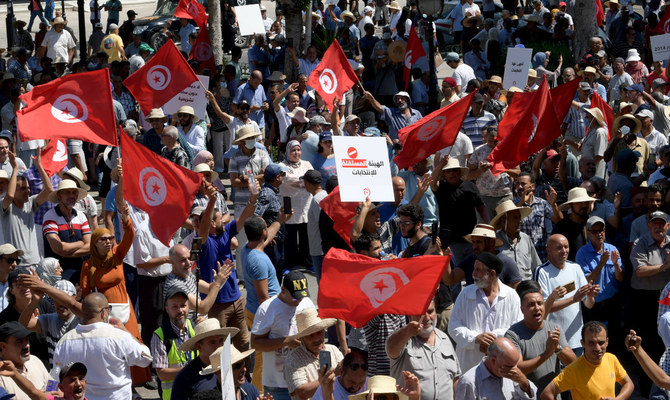
Tunisians protest against poverty, high prices and food shortages

Food shortages are worsening in Tunisia with empty shelves in supermarkets and bakeries, adding to popular discontent at high prices of many Tunisians who spend hours searching for sugar, milk, butter, cooking oil and rice. (AFP/File)
Short Url
Updated 26 September 2022
Follow

Tunisians protest against poverty, high prices and food shortages

  • Tunisia seeks to secure an IMF loan to save public finances from collapse

TUNIS: Hundreds of Tunisians protested on Sunday night in a poor neighborhood in the capital against poverty, high prices and the shortage of some foodstuff, escalating pressure on the government of President Kais Saied, as the country suffers an economic and political crisis.
Tunisia is struggling to revive its public finances as discontent grows over inflation running at nearly 9 percent and a shortage of many food items in stores because the country cannot afford to pay for some imports.
The North African nation is also in the midst of a severe political crisis since Saied seized control of the executive power last year and dissolved parliament in a move his opponents called a coup.
In the poor Douar Hicher district in the capital, some protesters lifted loaves of bread in the air. Other chanted, “Where is Kais Saied?.” Angry youths burned wheels.
Protesters chanted “Jobs, freedom and national dignity,” and “We can’t support crazy price hikes,” “Where is sugar?.”
Food shortages are worsening in Tunisia with empty shelves in supermarkets and bakeries, adding to popular discontent at high prices of many Tunisians who spend hours searching for sugar, milk, butter, cooking oil and rice.
Videos on social media showed on Sunday dozens of customers scrambling to win a kilogram of sugar in market.
Tunisia, which is suffering its worst financial crisis, is seeking to secure an International Monetary Fund loan to save public finances from collapse.
The government raised this month the price of cooking gas cylinders by 14 percent for the first time in 12 years. It also raised fuel prices for the fourth time this year as part of a plan to reduce energy subsidies, a policy change sought by the IMF.


Syrian leader to meet Putin, Russia seeks deal on military bases

Updated 7 sec ago
Follow

Syrian leader to meet Putin, Russia seeks deal on military bases

MOSCOW: Syrian President Ahmed Al-Sharaa will meet Russian counterpart Vladimir Putin in Moscow on Wednesday, as the Kremlin seeks to secure the future of its military bases in the country.
Putin and Sharaa struck a conciliatory tone at their previous meeting in October, their first since Sharaa’s rebel forces toppled Moscow-ally Bashar Assad in 2024.
But Russia’s continued sheltering of Assad and his wife since their ouster remains a thorny issue. Sharaa has repeatedly pushed Russia for their extradition.
Sharaa, meanwhile, has embraced US President Donald Trump, who on Tuesday praised the Syrian leader as “highly respected” and said things were “working out very well.”
Putin, whose influence in the Middle East has waned since Assad’s ouster, is seeking to maintain Russia’s military footprint in the region.
Russia withdrew its forces from the Qamishli airport in Kurdish-held northeast Syria earlier this week, leaving it with only the Hmeimim air base and Tartus naval base on Syria’s Mediterranean coast — its only military outposts outside the former Soviet Union.
“A discussion is planned on the status of bilateral relations and prospects for developing them in various fields, as well as the current situation in the Middle East,” the Kremlin said of the upcoming meeting in a statement on Tuesday.
Russia was a key ally of Assad during the bloody 14-year Syrian civil war, launching air strikes on rebel-held areas of Syria controlled by Sharaa’s Islamist forces.
The toppling of Assad dealt a major blow to Russia’s influence in the region and laid bare the limits of Moscow’s military reach amid the Ukraine war.
The United States, which cheered Assad’s demise, has fostered ever-warmer ties with Sharaa — even as Damascus launched a recent offensive against Kurdish forces long backed by the West.
Despite Trump’s public praise, both the United States and Europe have expressed concern that the offensive in Syria’s northeast could precipitate the return of Islamic State forces held in Kurdish-held jails.