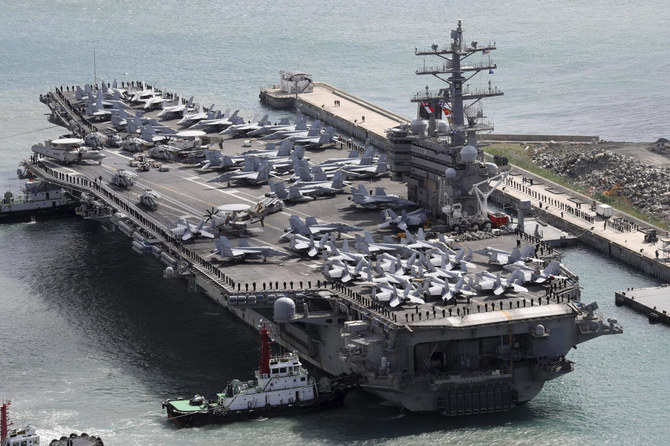
BUSAN, South Korea: A US aircraft carrier arrived in South Korea on Friday for the first time in about four years, set to join other military vessels in a show of force intended to send a message to North Korea.
USS Ronald Reagan and ships from its accompanying strike group docked at a naval base in the southern port city of Busan ahead of joint drills with South Korean forces.
Its arrival marks the most significant deployment yet under a new push to have more US “strategic assets” operate in the area to deter North Korea.
Strike group commander Rear Admiral Michael Donnelly told reporters aboard the ship that the visit was designed to build allied relations and boost interoperability between the navies.
“We are leaving messaging to diplomats,” he said, when asked about any signal to North Korea, but added that joint drills would ensure the allies were able to respond to all threats.
“It’s an opportunity for us to practice tactics and operations,” Donnelly said.
South Korean President Yoon Suk-yeol has pushed for more joint exercises and other displays of military power as a warning to North Korea, which this year conducted a record number of missile tests and appears to be preparing to resume nuclear testing for the first time since 2017.
North Korea has denounced previous US military deployments and joint drills as rehearsals for war and proof of hostile policies by Washington and Seoul. The drills have also sparked protests by peace activists who say they raise regional tensions.
Last week the United States said the carrier’s visit was a “clear demonstration” of its commitment to deploy and exercise strategic assets to deter Pyongyang and enhance regional security.
In announcing the visit, however, the US Navy made no mention of North Korea, referring only to a “regularly scheduled port visit” and emphasising crew members visiting Busan to volunteer at orphanages and explore the K-pop music scene.
Officials declined to provide details of the upcoming joint drills, but said the carrier would be in port for “several days.” Just hours after the ship docked, long lines of crewmembers formed as they took COVID-19 tests before being bussed into the city.
One crew member, who asked not to be identified because they were not authorized to speak to the media, said that they were looking forward to a break but that the geopolitical tensions were a constant presence.
“You can’t ever really forget what we’re all here for,” the crew member told Reuters.
The visit is the first to South Korea by an American aircraft carrier since 2018. Many drills were since scaled back or canceled due to diplomatic efforts with North Korea or because of the COVID-19 pandemic.
The carrier visit is useful for political signalling, reassuring Seoul, and training with South Korean forces, but likely does little to further deter North Korea, said Mason Richey, a professor at Hankuk University of Foreign Studies in Seoul.
“A carrier group visit certainly doesn’t do much — in fact, it likely does the opposite — to discourage Pyongyang from developing more nuclear weapons and delivery systems, as well as conventional capabilities,” he said.
It nevertheless underscores that under Yoon the allies see tighter military coordination and interoperability as the best way to deal with North Korea, Richey added.
Questions have risen over the role the roughly 28,500 US troops stationed in South Korea might play if conflict erupts over Taiwan.
Donnelly said such questions are for policymakers above him, but said that operating with like-minded allies such as South Korea is a key part of the US Navy’s efforts to maintain the regional security and stability that has existed for more than seven decades.


US warship arrives in South Korea as warning to Pyongyang
https://arab.news/9hrbr
US warship arrives in South Korea as warning to Pyongyang

- USS Ronald Reagan and ships from its accompanying strike group docked at a naval base in Busan
- The visit is the first to South Korea by an American aircraft carrier since 2018


WHO chief says reasons US gave for withdrawing ‘untrue’
- US Secretary of State Marco Rubio and US Health Secretary Robert F. Kennedy Jr. announced in a joint statement Thursday that Washington had formally withdrawn from the WHO
- And in a post on X, Tedros added: “Unfortunately, the reasons cited for the US decision to withdraw from WHO are untrue”
GENEVA: The head of the UN’s health agency on Saturday pushed back against Washington’s stated reasons for withdrawing from the World Health Organization, dismissing US criticism of the WHO as “untrue.”
Tedros Adhanom Ghebreyesus warned that US announcement this week that it had formally withdrawn from the WHO “makes both the US and the world less safe.”
And in a post on X, he added: “Unfortunately, the reasons cited for the US decision to withdraw from WHO are untrue.”
He insisted: “WHO has always engaged with the US, and all Member States, with full respect for their sovereignty.”
US Secretary of State Marco Rubio and US Health Secretary Robert F. Kennedy Jr. announced in a joint statement Thursday that Washington had formally withdrawn from the WHO.
They accused the agency, of numerous “failures during the Covid-19 pandemic” and of acting “repeatedly against the interests of the United States.”
The WHO has not yet confirmed that the US withdrawal has taken effect.
- ‘Trashed and tarnished’ -
The two US officials said the WHO had “trashed and tarnished” the United States, and had compromised its independence.
“The reverse is true,” the WHO said in a statement.
“As we do with every Member State, WHO has always sought to engage with the United States in good faith.”
The agency strenuously rejected the accusation from Rubio and Kennedy that its Covid response had “obstructed the timely and accurate sharing of critical information that could have saved American lives and then concealed those failures.”
Kennedy also suggested in a video posted to X Friday that the WHO was responsible for “the Americans who died alone in nursing homes (and) the small businesses that were destroyed by reckless mandates” to wear masks and get vaccinated.
The US withdrawal, he insisted, was about “protecting American sovereignty, and putting US public health back in the hands of the American people.”
Tedros warned on X that the statement “contains inaccurate information.”
“Throughout the pandemic, WHO acted quickly, shared all information it had rapidly and transparently with the world, and advised Member States on the basis of the best available evidence,” the agency said.
“WHO recommended the use of masks, vaccines and physical distancing, but at no stage recommended mask mandates, vaccine mandates or lockdowns,” it added.
“We supported sovereign governments to make decisions they believed were in the best interests of their people, but the decisions were theirs.”
- Withdrawal ‘raises issues’ -
The row came as Washington struggled to dislodge itself from the WHO, a year after US President Donald Trump signed an executive order to that effect.
The one-year withdrawal process reached completion on Thursday, but Kennedy and Rubio regretted in their statement that the UN health agency had “not approved our withdrawal and, in fact, claims that we owe it compensation.”
WHO has highlighted that when Washington joined the organization in 1948, it reserved the right to withdraw, as long as it gave one year’s notice and had met “its financial obligations to the organization in full for the current fiscal year.”
But Washington has not paid its 2024 or 2025 dues, and is behind around $260 million.
“The notification of withdrawal raises issues,” WHO said Saturday, adding that the topic would be examined during WHO’s Executive Board meeting next month and by the annual World Health Assembly meeting in May.
“We hope the US will return to active participation in WHO in the future,” Tedros said Saturday.
“Meanwhile, WHO remains steadfastly committed to working with all countries in pursuit of its core mission and constitutional mandate: the highest attainable standard of health as a fundamental right for all people.”


