SEOUL: The United States and South Korea began their biggest combined military training in years Monday as they heighten their defense posture against the growing North Korean nuclear threat.
The drills could draw an angry response from North Korea, which has dialed up its weapons testing activity to a record pace this year while repeatedly threatening conflicts with Seoul and Washington amid a prolonged stalemate in diplomacy.
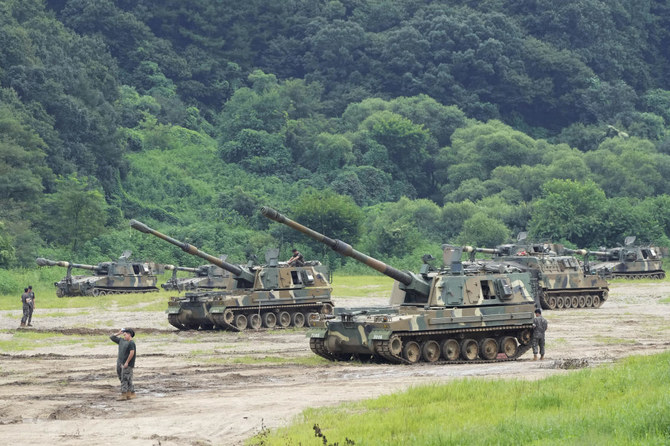
The Ulchi Freedom Shield exercises will continue through Sept. 1 in South Korea and include field exercises involving aircraft, warships, tanks and potentially tens of thousands of troops.
While Washington and Seoul describe their exercises as defensive, North Korea portrays them as invasion rehearsals and has used them to justify its nuclear weapons and missiles development.
Ulchi Freedom Shield, which started along with a four-day South Korean civil defense training program led by government employees, will reportedly include exercises simulating joint attacks, front-line reinforcements of arms and fuel, and removals of weapons of mass destruction.
The allies will also train for drone attacks and other new developments in warfare shown during Russia’s war on Ukraine and practice joint military-civilian responses to attacks on seaports, airports and major industrial facilities such as semiconductor factories.
The United States and South Korea in past years had canceled some of their regular drills and downsized others to computer simulations to create space for the Trump administration’s diplomacy with North Korea and because of COVID-19 concerns.
Tensions have grown since the collapse of the second meeting between former President Donald Trump and North Korean leader Kim Jong Un in early 2019. The Americans then rejected North Korean demands for a major release of crippling US-led sanctions in exchange for dismantling an aging nuclear complex, which would have amounted to a partial surrender of the North’s nuclear capabilities. Kim has since vowed to bolster his nuclear deterrent in face of “gangster-like” US pressure.
South Korea’s military has not revealed the number of South Korean and US troops participating in Ulchi Freedom Shield, but has portrayed the training as a message of strength. Seoul’s Defense Ministry said last week that Ulchi Freedom Shield “normalizes” large-scale training and field exercises between the allies to help bolster their alliance and strengthen their defense posture against the evolving North Korean threat.
Before being shelved or downsized, the United States and South Korea held major joint exercises every spring and summer in South Korea.
The spring drills had included live-fire drills involving a broad range of land, air and sea assets and usually involved around 10,000 American and 200,000 Korean troops. Tens of thousands of allied troops participated in the summertime drills, which mainly consisted of computer simulations to hone joint decision-making and planning, although South Korea’s military has emphasized the revival of field training this year.
The drills follow North Korea’s dismissal last week of South Korean President Yoon Suk Yeol’s “audacious” proposal of economic benefits in exchange for denuclearization steps, accusing Seoul of recycling proposals Pyongyang has long rejected.
Kim Yo Jong, the increasingly powerful sister of North Korean leader Kim Jong Un, described Yoon’s proposal as foolish and stressed that the North has no intentions to give away an arsenal her brother clearly sees as his strongest guarantee of survival.
She harshly criticized Yoon for continuing military exercises with the United States and also for letting South Korean civilian activists fly anti-Pyongyang propaganda leaflets and other “dirty waste” across the border by balloon.
She also ridiculed US-South Korean military capabilities for monitoring the North’s missile activity, insisting that the South misread the launch site of the North’s latest missile tests on Wednesday last week, hours before Yoon used a news conference to urge Pyongyang to return to diplomacy.
Kim Yo Jong’s statement came a week after she warned of “deadly” retaliation against South Korea over a recent North Korean COVID-19 outbreak, which Pyongyang dubiously claims was caused by leaflets and other objects floated by southern activists. There are concerns that the threat portends a provocation which might include a nuclear or missile test or even border skirmishes, and that the North might try to raise tensions sometime around the allied drills.
Last week’s launches of two suspected cruise missiles extended a record pace in North Korean missile testing in 2022, which has involved more than 30 ballistic launches, including the country’s first demonstrations of intercontinental ballistic missiles in nearly five years.
North Korea’s heighted testing activity underscores its dual intent to advance its arsenal and force the United States to accept the idea of the North as a nuclear power so it can negotiate economic and security concessions from a position of strength, experts say.
Kim Jong Un could up the ante soon as there are indications that the North is preparing to conduct its first nuclear test since September 2017, when it claimed to have developed a thermonuclear weapon to fit on its ICBMs.


![]()


US, South Korea open biggest drills in years amid threats from North Korea
Short Url
https://arab.news/5kas8
US, South Korea open biggest drills in years amid threats from North Korea
- Ulchi Freedom Shield exercises include field exercises involving aircraft, warships, tanks and potentially tens of thousands of troops
- North Korea portrays them as invasion rehearsals and has used them to justify its nuclear weapons and missiles development


Indonesia foreign minister says Gaza stabilization force ‘temporary’, two-state solution still end-goal
- Indonesia’s foreign minister Sugiono says international stabilization force in Gaza is a “temporary measure”
JAKARTA: The international stabilization force in Gaza is a “temporary measure” and a two-state solution remains the end-goal, Indonesia’s foreign minister Sugiono said on Wednesday.


Latest updates


© 2026 SAUDI RESEARCH & PUBLISHING COMPANY, All Rights Reserved And subject to Terms of Use Agreement.