

Fodder dries up for Pakistan's cattle as floodwaters stay high

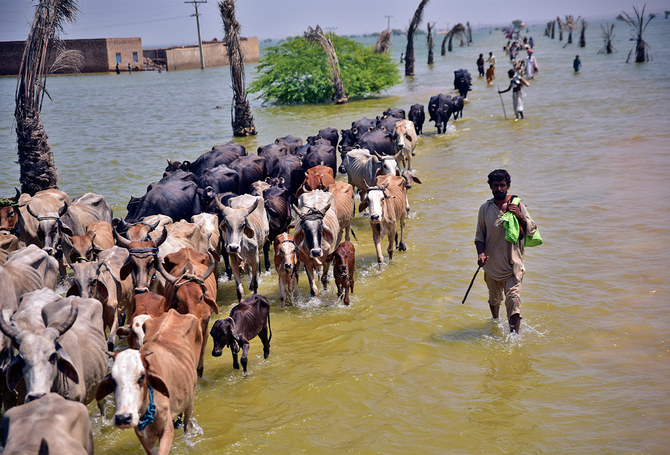
Victims of flooding from monsoon rains walk with their cattle after their flooded home in Sehwan, Sindh province, Pakistan, September 9, 2022. (AP)
Short Url
Updated 13 September 2022
Follow

Fodder dries up for Pakistan's cattle as floodwaters stay high

  • Officials estimate about 700,000 cattle have been lost in the floods nationwide
  • Situation is set to worsen as officials have warned of more rain in the next few days

DADU: Farmers stranded by unprecedented floods that have submerged huge swathes of Pakistan are running low on feed for their cattle, officials said on Tuesday, as airdropping supplies proved a difficult task.

The floods caused by record monsoon rains and glacial melt in northern mountains have affected 33 million people and killed almost 1,400, sweeping away homes, transport, crops and livestock in damage estimated at $30 billion.

In the southern province of Sindh, one of the worst affected areas, farmers in several villages have braved the rising waters to stay on and try to keep alive their remaining cattle.

"A shortage of fodder for cattle has emerged," said Syed Murtaza Ali Shah, the top government official in the key provincial district of Dadu, adding that army and navy helicopters were trying to reach the farmers.

Airdropping supplies would be difficult, however, said a military official, who sought anonymity as he was not allowed to talk to the media.

"It is a serious issue," the army official told Reuters. "Airdrops would not work, but it is important that fodder be supplied to livestock."

The situation is set to worsen as weather officials have warned of more rain in the next few days, posing a fresh threat to thousands of displaced people living in tents or in the open alongside highways.

Officials estimate about 700,000 cattle have been lost in the floods nationwide, and the rest, which form a critical asset in a poor country, are growing thin for lack of food.

Both the government and U.N. Secretary General Antonio Guterres have blamed climate change for the extreme weather that led to flooding in the South Asian nation of 220 million.

U.N. agencies are assessing Pakistan's reconstruction needs after it received 391 mm (15.4 inches) of rain, or nearly 190% more than the 30-year average, in July and August.

Sindh received 466% more rain than average and all the flood waters roll through Dadu, which has a population of 1.5 million.   


At least 15 killed, over 80 injured in blast at Islamabad mosque

Updated 7 min 8 sec ago
Follow

At least 15 killed, over 80 injured in blast at Islamabad mosque

  • Explosion strikes during Friday prayers in Tarlai area on capital’s outskirts
  • Attack follows deadly suicide bombing near Islamabad court complex last year

ISLAMABAD: At least 15 people were killed and more than 80 injured after a blast hit a mosque on the outskirts of the Pakistani capital Islamabad on Friday, the city’s district administration said. 

The explosion occurred in the Tarlai area around the time of Friday prayers, when large numbers of worshippers gather at mosques across the country, raising fears of a mass-casualty attack. 

The attack comes amid a renewed surge in militant violence in Pakistan and follows a suicide bombing outside a district court complex in Islamabad in November last year that killed at least 12 people and wounded dozens, underscoring growing security concerns even in heavily guarded urban centers.

“The death toll from the blast in the federal capital has risen to 15,” a spokesperson for the district administration said in a statement, adding that at least 80 people were injured.

Emergency measures were imposed at the Pakistan Institute of Medical Sciences (PIMS), Polyclinic Hospital and the Capital Development Authority (CDA) Hospital, the statement said, adding that assistant commissioners had been deployed to oversee treatment of the wounded.

“The site of the blast has been completely sealed,” the district administration spokesperson said.

Earlier, police spokesperson Taqi Jawad said the blast occurred at an imambargah, a place of worship for the Shiite Muslim community.

“More details will be shared in due course,” Jawad said.

No group has so far claimed responsibility for the attack.

Islamabad has historically been less affected by militant violence than Pakistan’s northwestern and southwestern regions, but the November suicide bombing near the district courts, and Friday’s explosion, have heightened concerns about the capital’s vulnerability amid a broader nationwide resurgence of militancy.