

Pakistan builds emergency embankment to protect power station in flood-hit district in south

1 / 2
Members of Pakistan Navy personnel take part in a rescue operation in flooded Mehar city after heavy monsoon rains in Dadu district, Sindh province on September 9, 2022. (AFP)
2 / 2
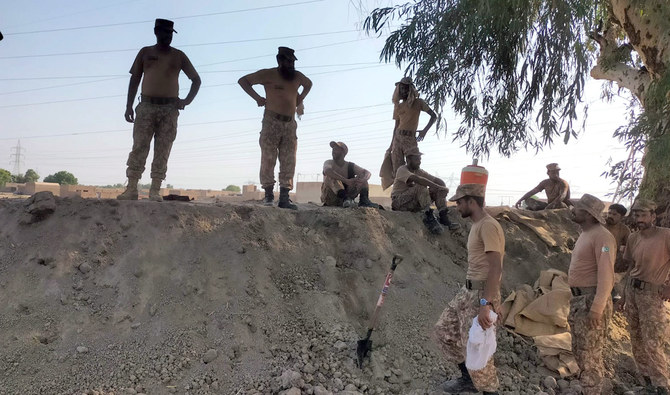
Members of Pakistan's Army guard and look after a dike to protect a power station, following rains and floods during the monsoon season, in Dadu, Pakistan on September 11, 2022. (ISPR)
Short Url
Updated 13 September 2022
Follow

Pakistan builds emergency embankment to protect power station in flood-hit district in south

  • The country’s climate change minister warns of huge water inflow in the southern Sindh province
  • Sherry Rehman says monsoon rains and floods have led to an outbreak of water-borne diseases

ISLAMABAD: After hours of hectic efforts, Pakistani authorities built an embankment in the flood-hit district of Dadu to protect a vital grid station in the southern province of Sindh, confirmed Prime Minister Shehbaz Sharif on Tuesday while applauding the team working on the project.

Sindh is one of the worst-affected areas where recent floods have swept away houses, crops, livestock and public infrastructure.

Dadu, which is located near the country’s largest freshwater lake, remains submerged in flood.

“The initiative of constructing an embankment of three kilometers within 36 hours with the cooperation of civil and military authorities to protect Dadu grid station from floods is commendable,” PM Sharif said in a Twitter post.

Pakistan’s climate change minister Sherry Rehman also warned about the flood situation in Sindh a day before, saying the Indus River was in high flood near Kotri Barrage while pointing out that heavy inflow of water was posing a serious threat to the adjoining areas.

In a statement, Rehman said rain forecasts had predicted that monsoon was likely to stretch into September, resulting in rainfall across the country and proving detrimental to the rescue and relief operations in flood-hit regions.

“Floods have brought with them the menace of water-borne diseases such as dengue and cholera,” she said. “Karachi is seeing an outbreak of dengue as hundreds and thousands of patients are reporting daily at government and private hospitals.”

The climate-induced catastrophe has displaced a huge chunk of Pakistan’s population while putting an unbearable burden on state resources.

The government has appealed the international community for help, pointing out that the problem of climate change cannot be handled by individual countries on their own.


Pakistan to promote mineral sector at Saudi forum this month with 13 companies

Updated 02 January 2026
Follow

Pakistan to promote mineral sector at Saudi forum this month with 13 companies

  • Delegation will take part in the Future Minerals Forum in Riyadh from Jan. 13-15
  • Petroleum minister will lead Pakistan, participate in a 90-minute country session

ISLAMABAD: Around 13 Pakistani state-owned and private companies will attend the Future Minerals Forum (FMF) in Saudi Arabia from Jan. 13 to 15, an official statement said on Friday, as the country seeks to ramp up global engagement to develop its mineral resources.

The FMF is an international conference and investment platform for the mining sector, hosted by mineral-rich countries to attract global investors, companies and governments.

Petroleum Minister Ali Pervaiz Malik confirmed Pakistan’s participation in a meeting with the Saudi envoy, Nawaf bin Said Al-Malki.

Pakistan hosts one of the world’s largest copper-gold zones. The Reko Diq mine in southwestern Balochistan, with an estimated 5.9 billion tons of ore, is partly owned by Barrick Gold, which calls it one of the world’s largest underdeveloped copper-gold deposits. Its development is expected to boost Pakistan’s struggling economy.

“Upon an invitation of the Government of the Kingdom of Saudi Arabia, the Federal Minister informed the Ambassador that Pakistan will fully participate in the upcoming Future Minerals Forum (FMF), scheduled to be held in Riyadh later this month,” Pakistan’s Press Information Department (PID) said in an official statement.

The Pakistani minister will lead his country’s delegation at the FMF and take part in a 90-minute country showcase session titled “Unleashing Potential: Accelerating Pakistan’s Mineral Revolution” along with local and foreign investors.

Pakistan will also establish a dedicated pavilion to highlight the vast potential of its rich geological landscape to the global mineral community.

The Saudi envoy welcomed Pakistan’s decision to participate in the forum and discussed enhancing bilateral cooperation in the minerals and energy sectors during the meeting.

According to the statement, he highlighted the potential for cooperation between Saudi Arabia and Pakistan in the minerals and energy sectors, expressing confidence that the FMF would provide a platform to expand collaboration.
Pakistan’s mineral sector, despite its rich reserves of salt, copper, gold and coal, contributes only 3.2 percent to the country’s GDP and just 0.1 percent to global mineral exports.

However, many countries, including the United States, have shown interest in Pakistan’s underdeveloped mineral sector, particularly in copper, gold and other critical resources.

In October, Pakistan dispatched its first-ever shipment of rare earth and critical minerals to the United States, according to a Chicago-based US public relations firm’s report.