Mbappe scores in record time as Ligue 1 hits red cards high

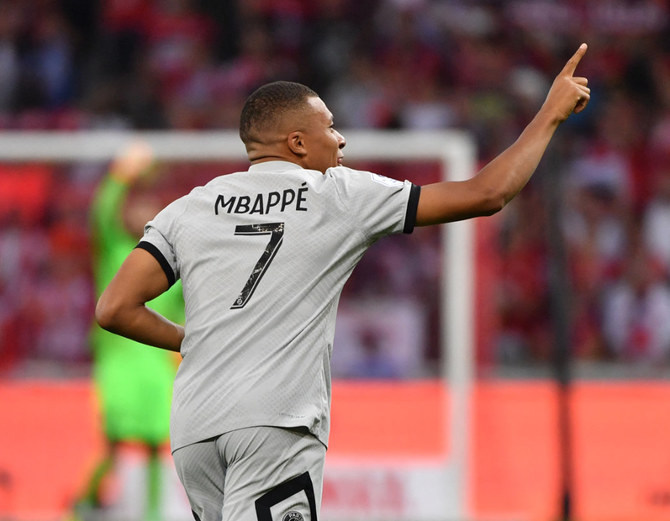
Paris Saint-Germain’s French forward Kylian Mbappe (C) celebrates scoring his team’s first goal during the French L1 football match between Lille OSC and PSG at Stade Pierre-Mauroy in Villeneuve-d’Asq, northern France on August 21, 2022. (AFP)
Short Url
Updated 22 August 2022
Follow

Mbappe scores in record time as Ligue 1 hits red cards high

  • The goal matched Michel Rio’s strike for Caen against Cannes on February 15, 1992, although statisticians MisterChip calculated that Rio was slightly faster, scoring after 7.9sec to Mbappe’s 8.3

PARIS: Hat-trick star Kylian Mbappe matched one Ligue 1 record by scoring after just eight seconds in Lille to set Paris Saint-Germain on their way to a 7-1 victory on Sunday while the division hit a modern high with 11 red cards in one weekend.
Mbappe equalled a 30-year-old record when he burst into space, collected a pass from Lionel Messi and surprised Lille goalkeeper Leo Jardim with a lob to score his second league goal of the season.
The goal matched Michel Rio’s strike for Caen against Cannes on February 15, 1992, although statisticians MisterChip calculated that Rio was slightly faster, scoring after 7.9sec to Mbappe’s 8.3.
Mbappe then hit a post when facing an open goal, but Messi, Achraf Hakimi and Neymar all scored before half time as PSG tore apart the only other club to win the French title in the last five seasons.
Stories of tensions between two of PSG’s superstars, Mbappe and Neymar, had swirled around the club this week but the Brazilian scored twice and Mbappe three times.
Neymar added a fifth early in the second half. After Jonathan Bamba replied for Lille, Mbappe struck twice, set up both times by Neymar.
The match ended a weekend when French football saw red, as referees applied a new “firmness order.”
After Vanderson of Monaco and Samuel Gigot of Marseille were sent off on Saturday, there were nine more reds on Sunday, setting a single-round high in Ligue 1 for the last 30 years, according to statistics company Opta.
There were also seven reds in Ligue 2, three of them for Saint-Etienne as they lost 6-0 at home to Le Havre.
The last two reds on Sunday came in Rennes, where, despite a warning from their coach, Ajaccio finished with 10 men as Lesley Ugochukwu, who had only come on for Ajaccio five minutes earlier, was shown red in added time.
“Seeing the matches earlier in the day, I had the feeling that the referees had received firm instructions. I warned my players,” said Ajaccio coach Olivier Pantaloni.
Hosts Rennes, who won 2-1, lost backup goalkeeper Romain Salin to two yellow cards in quick succession for arguing from the touchline.
“The spectacle was perhaps more the red cards than the play this afternoon,” complained Rennes coach Bruno Genesio.
“It’s a bit weird. It is regrettable. Because it distorts the matches,” said Genesio.
In Clermont, Saif-Eddine Khaoui scored the only goal against struggling Nice in the fifth minute.
The visitors, who have not won this season, lost Mario Lemina in the 80th minute and Jean-Clair Todibo two minutes later.
There were four red cards in Montpellier as Auxerre gained their first victory in Ligue 1 since May 2012.
Montpellier midfielder Khalil Fayad was sent off in the 46th minute and Auxerre striker M’Baye Niang in the 51st.
After Mathias Autret scored a penalty winner, Nuno Da Costa and then Montpellier midfielder Teji Savanier were sent off.
“There were four expulsions. That’s heavy in a game without extreme violence,” said Auxerre coach Jean-Marc Furlan.
“In our time, when we played, we killed each other. There was never a yellow or a red. UEFA changed all that because there were serious injuries like (Diego) Maradona or (Marco) Van Basten,” said the former defender, who played for a series of French clubs from the mid-1970s to the early 1990s.
“We lost our two center forward because of reds. We’re going to play like Barca. We’re going to play without a center forward.”
Montpellier coach Olivier Dall’Oglio agreed.
“There are red cards being shown very quickly, there are penalties being whistled very quickly,” said Dall’Oglio.
“There are always new instructions. There is always a new strictness, but it will fade as the days go by.”
Angers lost 3-1 at home to Brest after losing Halid Sabanovic to a straight red in the 35th minute.
“It was harsh,” said coach Gerald Baticle.


From Jeddah to the world stage: Bader Idrees and Saudi Arabia’s tennis rise

Updated 25 December 2025
Follow

From Jeddah to the world stage: Bader Idrees and Saudi Arabia’s tennis rise

RIYADH: As tennis continues to gain momentum throughout Saudi Arabia, several local players are beginning to emerge on the national and international scene. One of them is Saudi national team player Bader Idrees, whose journey mirrors the Kingdom’s evolving relationship with the sport.

Idrees’ first exposure to tennis came at a time when the local game was still developing. His interest began in early 2010 after watching his older sister train regularly.

“I was five years old when I used to watch my older sister playing tennis every day,” he told Arab News. “One of her coaches recommended that I try it out, and from the first hit, I fell in love with the sport.”

Now 20 years old, Idrees finds himself progressing alongside a country that is investing heavily in tennis. Over the past three months alone, Saudi Arabia has hosted the Six Kings Slam, the WTA Finals, and the Next Gen ATP Finals, an indication of its growing ambitions on the global tennis stage.

A defining moment in Idrees’ development came at the 2025 WTA Finals, where he reached a personal milestone in his role as a hitting partner for some of the world’s best players.

“It was one of the best experiences I’ve had so far,” he said. “To actually see the players and train with them was an eye-opening experience for me.”

The exposure offered by hosting elite tournaments has had a direct impact on aspiring Saudi athletes, providing valuable insight into the professional game.

“Seeing how players prepare for matches — from how they behave off the court to actually practicing on the court — was an amazing experience,” he said.

Beyond individual growth, Idrees believes the broader sporting ecosystem benefits from welcoming international events to the Kingdom.

“Hosting these events motivates every Saudi athlete,” Idrees said. “Foreign players get to know the country and the players who represent it, and it pushes us to perform better knowing that the world is watching.”

That motivation has translated into concrete goals. Idrees is planning a busy start to the year, with four international tournaments scheduled for January.

“I feel very positive about what I’ve accomplished so far, so hopefully I can kick off with a strong start in 2026.”

Despite recent progress, Idrees credits his early development at home as the foundation of his success.

“I don’t think I would be at this level if I weren’t in Saudi Arabia, and if I didn’t meet my coach Wajih there, who played a big role in my journey,” Idrees said.

To further advance his career, he later relocated to Cairo, where increased competition and exposure helped accelerate his development.

“That experience, combined with my coach’s motivation, made me believe I could truly go pro,” he said.

The journey was not without challenges. Idrees reflected on the limitations that once existed in the local tennis landscape.

“Tennis has grown massively in Saudi Arabia over the last few years,” he said. “But before that, we didn’t always have the best facilities or infrastructure. That’s why seeing the progress now makes me happy.”

Today, that transformation is happening at a rapid pace — something Idrees notices each time he returns home from international competition.

“Month by month,” as he puts it.

Whether in Riyadh, Jeddah, or Dammam, the changes are increasingly visible. Looking ahead, Idrees is optimistic about the next generation of Saudi players.

“I wouldn’t be surprised to see the kids playing at the under-10 and under-12 level find themselves in the top 500 or 300 within the next 10 years,” he said. “I see the discipline and motivation in them, and it truly is something special.”

He is also realistic about his own development compared with today’s young talents.

“I wasn’t at this level at 10, 12 years old,” he admitted. “Training with kids at that age now, I’m genuinely impressed. It’s why I’m feeling very positive about their future.”

With growing infrastructure, elite-level exposure, and rising ambition, Idrees’ story represents more than personal achievement. It highlights how Saudi Arabia’s expanding role as a host of global sporting events is reshaping its tennis landscape — and how a new generation of players may be poised to make an impact on the world stage in the years ahead.