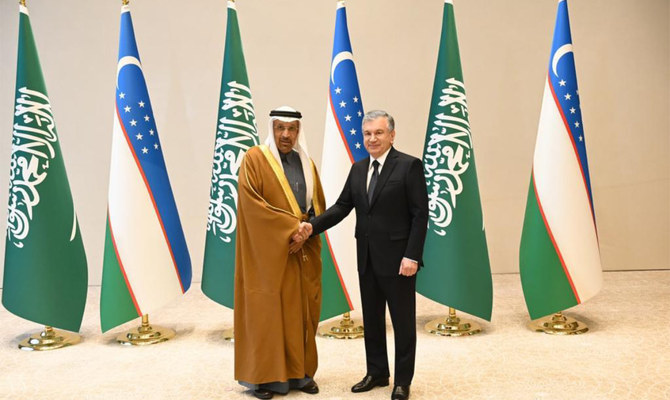

RIYADH: The mutual trade between Saudi Arabia and the Republic of Uzbekistan reached $95 million in the first half of 2022, a substantial increase considering that bilateral trade barely exceeded $17 million last year.
According to a joint news statement, the value is expected to grow rapidly by the end of 2022. The numbers assume significance in the aftermath of the pandemic.
In fact, the number of Uzbek companies running on Saudi funds increased from about nine to 38 in the last five years. Of the 38, 19 are sole proprietors, and the rest are joint ventures.
The two nations will bolster the ties further by signing 12 new agreements on Wednesday and Thursday when Uzbekistan President Shavkat Mirziyoyev visits the Kingdom.
According to an Uzbek state agency, high-level talks will take place in Jeddah, where the two nations will discuss opportunities to enhance multilateral cooperation further.
The discussion will focus on the green economy, technology and digitalization, innovations, small business and entrepreneurship.
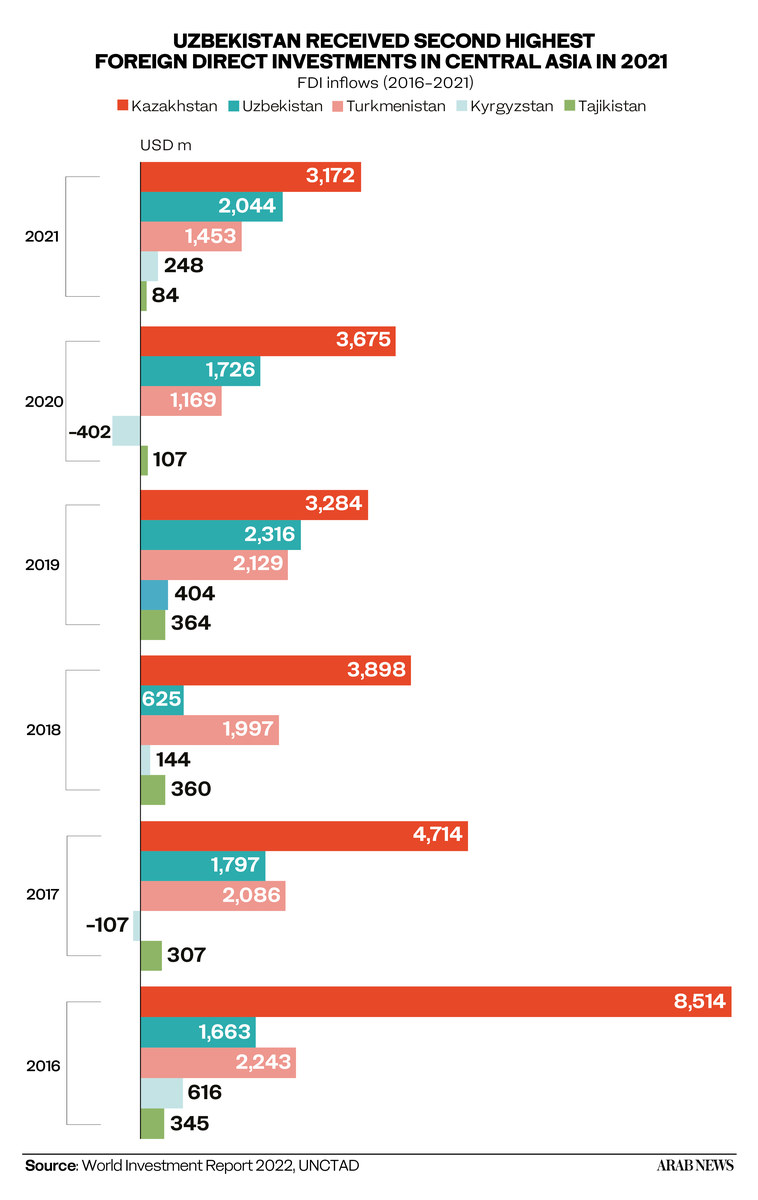
Following the meeting, new agreements are expected to be signed in the energy, telecommunications, agriculture, chemical and petrochemical industries, besides encouraging ties in culture, sports and education.
The Kingdom has become one of the largest foreign investors in energy infrastructure and one of Uzbekistan’s most significant developers of green energy projects.
ACWA Power’s Uzbek interests
Recently, the Ministry of Energy of Uzbekistan and Saudi energy company ACWA Power signed several investment agreements for about $3 billion.
ACWA Power will develop and operate a wind energy project with a production capacity of 1,500 MW in the Karakalpakstan region of Uzbekistan.
When commissioned, the plant will become the largest of its kind in Central Asia and one of the largest wind power plants in the world.
FASTFACTS
• The number of Uzbek companies running on Saudi funds increased from about nine to 38 in the last five years.
• Recently, the Ministry of Energy of Uzbekistan and Saudi energy company ACWA Power signed several investment agreements for about $3 billion.
• The Saudi Fund for Development has contributed to the implementation of many projects in Uzbekistan, including funding the Samarkand-Gozar Road project, with a total value of $30 million.
ACWA Power also signed an agreement to establish the 100MW Nokus wind farm project, the first renewable energy project to be implemented in partnership with Uzbekistan’s public and private sectors.
The power generating company also won a $108 million wind contract after proposing a tariff of 2.56 cents per kilowatt-hour, the lowest in Uzbekistan.
Additionally, the Ministry of Energy of Uzbekistan signed a 25-year power purchase agreement with ACWA Power to establish a combined-cycle gas turbine power plant in Shirin, located in Syrdarya, Uzbekistan. The deal amounts to $1.2 billion.
According to the statement, these projects will contribute to achieving Uzbekistan’s national goal of raising the total renewable energy generation capacity to 30 percent by 2030.
Saudi Fund for Development
Moreover, the Saudi Fund for Development has contributed to the implementation of many projects in Uzbekistan, including funding the Samarkand-Gozar Road project, with a total value of $30 million.
The fund also contributed to 20 projects in the republic, including building pumping stations and other projects involving sewage, chemicals, mining, building materials, water and agriculture.
According to the Ministry of Agriculture of Uzbekistan, the Saudi and Uzbek delegations have discussed issues of cooperation in agriculture, including the prospects for enhancing mutual trade in agricultural products.
Both parties will likely sign memorandums of cooperation in agriculture, veterinary medicine and livestock development at the meeting.
They also agreed to deepen cooperation in the agricultural sector to enhance trade in farming, livestock and other products between the countries.
After signing the memoranda, action plans will be prepared, including specific measures and areas for developing cooperation and joint projects.
The Saudi side invited the Uzbekistan delegation to attend its most prominent exhibition of the agro-industrial complex, which will be held at the end of October in Riyadh.