

Russia launches widespread shelling ahead of new assault, says Ukraine

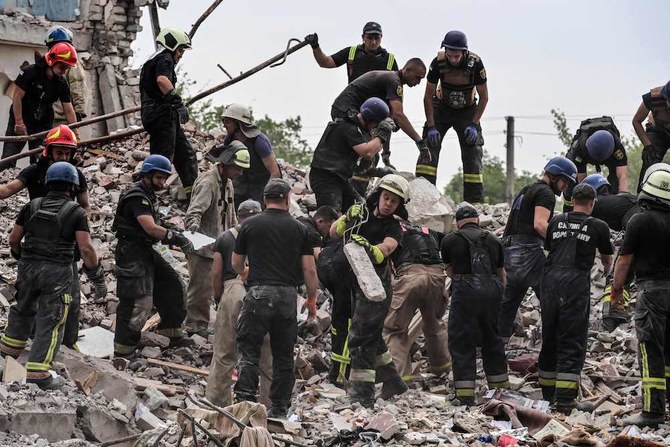
A rocket strike on a five-story apartment building in the eastern town of Chasiv Yar on Saturday night killed 15 people and left two dozen people feared trapped in the rubble. (AFP)
Short Url
Updated 11 July 2022
Follow

Russia launches widespread shelling ahead of new assault, says Ukraine

CHASIV YAR/KYIV, Ukraine: Russia opened fire with artillery, multiple rocket launchers and tanks around Ukraine’s second-largest city Kharkiv and shelled cities in the east, where an earlier strike killed 15 people in an apartment building, Ukraine’s general staff said on Monday.

An apartment building in Kharkiv was hit by a missile overnight, but no casualties have been reported, authorities said.

A rocket strike on a five-story apartment building in the eastern town of Chasiv Yar on Saturday night killed 15 people and left two dozen people feared trapped in the rubble.

President Volodymyr Zelensky’s chief of staff, Andriy Yermak, said the strike was “another terrorist attack” and that Russia should be designated as a state sponsor of terrorism.

Moscow denies it targets civilians, but Ukrainian cities, towns and villages have been left in ruins after Russian shelling, with basements and bomb shelters the only safe place for those who remain.

On Sunday, rescuers in Chasiv Yar used a crane to lift a concrete slab and their hands to dig through the debris, while dazed residents who survived the attack retrieved personal belongings and told stories of their escape.

One woman was seen walking out of the destroyed building carrying an ironing board under her arm, an umbrella and a plastic shopping bag. Others simply watched rescue efforts, fearing the worst as the dead were removed.

“We ran to the basement, there were three hits, the first somewhere in the kitchen,” said a resident who gave her name as Ludmila.

“The second, I do not even remember, there was lightning, we ran toward the second entrance and then straight into the basement. We sat there all night until this morning.”

Another survivor, who gave her name as Venera, said she had wanted to save her two kittens.

“I was thrown into the bathroom, it was all chaos, I was in shock, all covered in blood,” she said, crying. “By the time I left the bathroom, the room was full up of rubble, three floors fell down. I never found the kittens under the rubble.”

Russian President Vladimir Putin invaded Ukraine on Feb. 24, calling the conflict a “special military operation” to demilitarise Ukraine and rid it of nationalists.

Ukraine and its Western allies say Putin’s war is an imperial land grab and has accused his forces of war crimes. Moscow denies attacking civilians.

The biggest conflict in Europe since World War Two has killed thousands, left cities and towns in ruins and seen more than 5.5 million Ukrainians flee their country.

Ukraine’s general staff said on Monday that Russian forces had launched a wave of bombardments in the east as they seek to take control of the Donbas industrial heartland.

It said the widespread shelling was preparations for an intensification of hostilities.

The Kremlin has declared victory in the Donbas’ Luhansk province and its troops are now concentrating on seizing control of neighboring Donetsk.

Putin has promised to hand control of the Donbas to pro-Russian separatists who have declared independence from Kyiv.

Russia abandoned an early advance on the capital Kyiv in the face of fierce resistance bolstered by Western arms.

Ukrainian Deputy Prime Minister Iryna Vereshchuk warned civilians in the Russian-occupied Kherson region on Sunday to urgently evacuate as Ukraine’s armed forces were preparing a counter-attack there, not giving a timeframe for action.

“I know for sure that there should not be women and children there, and that they should not become human shields,” she said on national television.

Reuters was unable to independently verify the battlefield reports.


Starmer arrives in China to defend ‘pragmatic’ partnership

Updated 28 January 2026
Follow

Starmer arrives in China to defend ‘pragmatic’ partnership

  • British Prime Minister Keir Starmer arrived in Beijing on Wednesday to meet with Chinese leader Xi Jinping, hoping to restore long fraught relations

BEIJING: British Prime Minister Keir Starmer arrived in Beijing on Wednesday to meet with Chinese leader Xi Jinping, hoping to restore long fraught relations.
It is the first visit to China by a UK prime minister since 2018 and follows a string of Western leaders courting Beijing in recent weeks, pivoting from a mercurial United States.
Starmer, who is also expected to visit Shanghai on Friday, will later make a brief stop in Japan to meet with Prime Minister Sanae Takaichi.
For Xi, the trip is an opportunity to show Beijing can be a reliable partner at a time when President Donald Trump’s policies have rattled historic ties between Washington and its Western allies.
Starmer is battling record low popularity polls and hopes the visit can boost Britain’s beleaguered economy.
The trip has been lauded by Downing Street as a chance to boost trade and investment ties while raising thorny issues such as national security and human rights.
Starmer will meet with Xi for lunch on Thursday, followed by a meeting with Premier Li Qiang.
The British leader said on Wednesday this visit to China was “going to be a really important trip for us,” vowing to make “some real progress.”
There are “opportunities” to deepen bilateral relations, Starmer told reporters traveling with him on the plane to China.
“It doesn’t make sense to stick our head in the ground and bury in the sand when it comes to China, it’s in our interests to engage and not compromise on national security,” he added.
China, for its part, “is willing to take this visit as an opportunity to enhance political mutual trust,” foreign ministry spokesman Guo Jiakun reiterated Wednesday during a news briefing.
Starmer is the latest Western leader to be hosted by Beijing in recent months, following visits by Canadian Prime Minister Mark Carney and French President Emmanuel Macron.
Faced with Trump’s threats to impose tariffs on Canada for signing a trade agreement with China, and the US president’s attempts to create a new international institution with his “Board of Peace,” Beijing has been affirming its support for the United Nations to visiting leaders.
Reset ties 
UK-China relations plummeted in 2020 after Beijing imposed a sweeping national security law on Hong Kong, which severely curtailed freedoms in the former British colony.
They soured further since with both powers exchanging accusations of spying.
Starmer, however, was quick to deny fresh claims of Chinese spying after the Telegraph newspaper reported Monday that China had hacked the mobile phones of senior officials in Downing Street for several years.
“There’s no evidence of that. We’ve got robust schemes, security measures in place as you’d expect,” he told reporters on Wednesday.
Since taking the helm in 2024, Starmer has been at pains to reset ties with the world’s second-largest economy and Britain’s third-biggest trade partner.
In China, he will be accompanied by around 60 business leaders from the finance, pharmaceutical, automobile and other sectors, and cultural representatives as he tries to balance attracting vital investment and appearing firm on national security concerns.
The Labour leader also spoke to Xi on the sidelines of the G20 summit in Brazil in November 2024.
Jimmy Lai
The prime minister is also expected to raise the case of Hong Kong media mogul and democracy supporter Jimmy Lai, 78, a British national facing years in prison after being found guilty of collusion charges in December.
When asked by reporters about his plans to discuss Lai’s case, Starmer avoided specifics, but said engaging with Beijing was to ensure that “issues where we disagree can be discussed.”
“You know my practice, which is to raise issues that need to be raised,” added Starmer, who has been accused by the Conservative opposition of being too soft in his approach to Beijing.
Reporters Without Borders urged Starmer in a letter to secure Lai’s release during his visit.
The British government has also faced fierce domestic opposition after it approved this month contentious plans for a new Chinese mega-embassy in London, which critics say could be used to spy on and harass dissidents.
At the end of last year, Starmer acknowledged that China posed a “national security threat” to the UK, drawing flak from Chinese officials.
The countries also disagree on key issues including China’s close ties with Russian President Vladimir Putin amid the war in Ukraine, and accusations of human rights abuses in China.