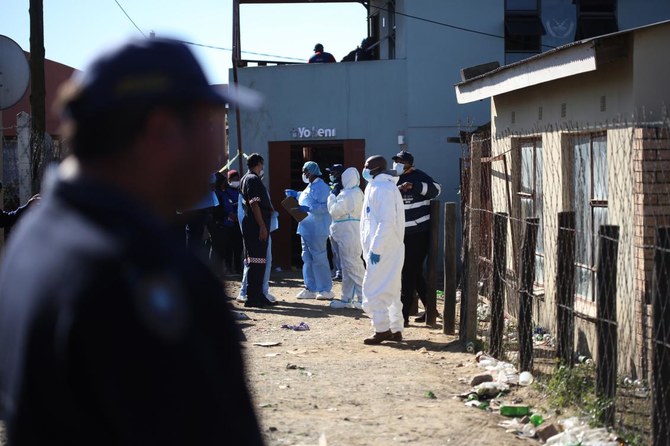
EAST LONDON, South Africa: South African police were on Monday combing a township tavern where 21 teenagers mysteriously died as survivors described a battle to escape the jam-packed premises and one reported a suffocating smell.
Most of the victims, some as young as 13 years, were found dead inside a popular bar in the southern city of East London.
Seventeen were died inside the bar, while four died in hospital.
Thirty-one others were hospitalized with symptoms including backache, tight chests, vomiting and headache, official said.
Most were discharged on Sunday, leaving two in hospital, they said.
The fatalities bore no visible signs of injury, sparking initial speculation among local officials and politicians that this was a case of under-age drinking that went tragically wrong.
But new details emerged Monday as survivors spoke of a strong and suffocating smell in the jam-packed double-story building.
Sinovuyo Monyane, 19, who was hired by the bar to promote an alcohol brand, said she was still “confused” but felt lucky to be alive.
She said she struggled to escape through a door gridlocked with people.
“We tried moving through the crowd, shouting ‘please let us through,’ and others were shouting ‘we are dying, guys,’ and ‘we are suffocating’ and ‘there are people who can’t breathe’,” she said.
“I passed out at that moment. I was running out of breath and there was a strong smell of some type of spray on in the air. We thought it was pepper spray,” she said.
She later regained her consciousnesses after someone sprayed water on her.
“I got up and realized that there were bodies lying around. I saw people being poured water, but those people did not even move,” she said in a phone interview.
“I could have died.”
Special investigators from Pretoria have been rushed to the scene.
“The detectives will be resuming their work at the crime scene today,” regional police spokesman Thembinkosi Kinana said.
Many of the victims are thought to have been students celebrating the end of their high-school exams, officials said.
Autopsies are being conducted to see if the deaths could be linked to poisoning.
“Post-mortems (were) completed by last night and the bodies will be released to their families today,” said Yonela Dekeda, provincial spokeswoman for the health department.
Forensic analysis will be conducted this week.
“Samples were taken and were on first flight today to Cape Town, where the tests will be conducted,” said Unathi Binqose, a government official on safety.
Drinking in South Africa is permitted for over-18s.
But in township taverns which are often located cheek-by-jowl with family homes, safety regulations and drinking-age laws are not always enforced.
President Cyril Ramaphosa is among those who have voiced concern.
The teenagers reportedly “gathered at a venue which, on the face of it, should be off-limits to persons under the age of 18,” he said.
A resident DJ, who was also celebrating his birthday on the night, spoke of a rush of revellers who forced their way into an already packed venue.
“We tried to close the door but people kept pushing. The bouncers could not handle the crowd that was pushing from outside the entrance door. There were so many people,” the DJ said.
He turned off the music to try discourage revellers, but to no avail.
The crowd was just “unruly and could not be managed,” he said, adding he was “traumatized.”
In a tweet, African Union Commission chief Moussa Faki Mahamat expressed his thoughts and prayers “during this time of unspeakable grief and sorrow.”


![]()

South African police search bar for clues after 21 teens die
Short Url
https://arab.news/z6wbg
South African police search bar for clues after 21 teens die
- The fatalities bore no visible signs of injury, sparking initial speculation among local officials and politicians
- Many of the victims are thought to have been students celebrating the end of their high-school exams


Latest updates


© 2026 SAUDI RESEARCH & PUBLISHING COMPANY, All Rights Reserved And subject to Terms of Use Agreement.