

US to phase out single-use plastic on public lands, national parks by 2032

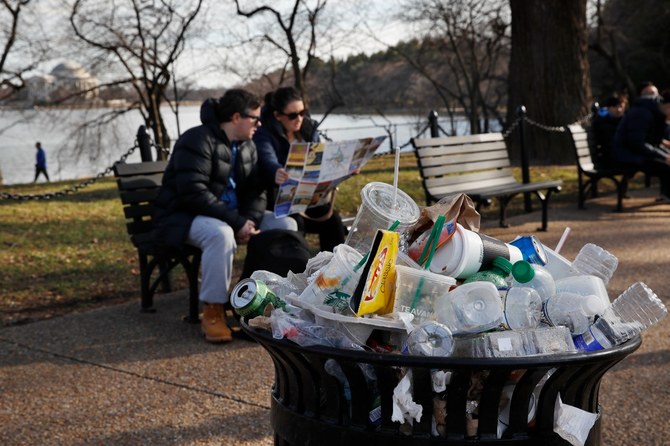
The US recycling rate has fallen close to 5 percent as some countries stopped accepting US waste exports and as plastic waste generation surged to new highs. AP
Short Url
Updated 08 June 2022
Follow

US to phase out single-use plastic on public lands, national parks by 2032

WASHINGTON: The US Interior Department said on Wednesday it will phase out single-use plastic products on public lands by 2032, including in national parks, in a move aimed at tackling a major source of US plastic waste as recycling efforts falter.

Interior Secretary Deb Haaland issued a secretarial order that calls for the agency to reduce the procurement, sale and distribution of single-use plastic products and packaging on 480 million acres (1.9 million sq. km) of Interior Department-managed lands by 2032.

The announcement came as part of a broader package of announcements from the Biden administration to recognize World Ocean Day.

The administration also announced it has initiated the designation process for a new national marine sanctuary to conserve Hudson Canyon in the Atlantic Ocean off New York and New Jersey, reinstated an inter-tribal stewardship partnership of the Northern Bering Sea off Alaska and launched the country's first Ocean Climate Action Plan that will “guide significant ocean-based climate mitigation and adaptation actions, including green shipping, ocean-based renewable energy.” 

The ocean ends up taking in a vast amount of plastic pollution taking in more than 14 million tons of plastic per year. Plastic makes up 80 percent of all marine debris found from surface, the Interior Department said.

The department produced nearly 80,000 tons of municipal solid waste in fiscal year 2020. The US recycling rate has fallen close to 5 percent as some countries stopped accepting US waste exports and as plastic waste generation surged to new highs.

“The Interior Department has an obligation to play a leading role in reducing the impact of plastic waste on our ecosystems and our climate,” Haaland said in a statement.

Earlier this year, UN member states agreed on a draft blueprint for a global plastics treaty that could curb the amount of single-use plastics countries produce and use. 


Saudi Arabia opens January ‘Sah’ sukuk sale with 4.73% return 

Updated 5 sec ago
Follow

Saudi Arabia opens January ‘Sah’ sukuk sale with 4.73% return 

RIYADH: Saudi Arabia has opened subscriptions for its January issuance of the government-backed “Sah” savings sukuk, offering an annual return of 4.73 percent, up from 4.68 percent in the previous month. 

In a post on X, the Kingdom’s National Debt Management Center said the subscription window opened at 10 a.m. Saudi time on Jan. 4 and will close at 3 p.m. on Jan. 6. 

The latest offering forms part of the NDMC-managed 2026 issuance calendar and reflects Saudi Arabia’s ongoing efforts to promote financial inclusion and encourage personal savings. 

Launched under the Financial Sector Development Program, a key pillar of the Vision 2030 agenda, “Sah” aims to raise the national savings rate to 10 percent by 2030, up from about 6 percent currently. 

The NDMC said the minimum subscription amount for the January offering is SR1,000 ($266.56), while the maximum is capped at SR200,000 per investor. 

The sukuk carries a one-year maturity and offers fixed returns paid at redemption. 

Sukuk are Shariah-compliant financial instruments that grant investors partial ownership in an issuer’s underlying assets, serving as a popular alternative to conventional bonds. 

Subscriptions are available exclusively to Saudi nationals aged 18 and above through approved investment platforms, including SNB Capital, Aljazira Capital and Alinma Investment, as well as SAB Invest and Al-Rajhi Capital. 

Unlike conventional bonds, the sukuk’s returns are structured to comply with Shariah principles. Designed as a secure, low-risk savings instrument, it carries no fees and offers easy redemption, with returns aligned to prevailing market benchmarks. 

Earlier this month, the NDMC announced the successful arrangement of a seven-year syndicated loan amounting to $13 billion, aimed at supporting power, water and public utilities projects. 

Last month, the center revealed it raised SR7.01 billion through its December sukuk issuance. 

The December issuance was divided into five tranches. The first, valued at SR1.23 billion, is set to mature in 2027. The second tranche amounted to SR335 million and will mature in 2029. 

The third tranche was valued at SR1.18 billion and will mature in 2032, while the fourth tranche, worth SR1.69 billion, is set to expire in 2036. 

The fifth tranche was valued at SR2.57 billion and will mature in 2039.