

Gunmen kill three traffic police officers in northwest Pakistan

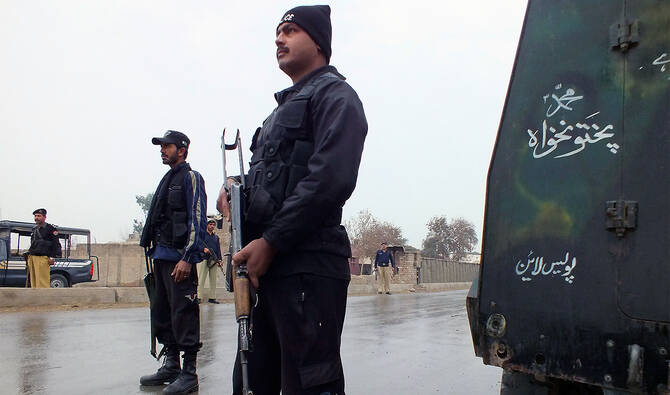
Policemen stand guard as they cordon the road leading to an isolated army checkpoint after it was attacked by militants at Lakki Marwat in the outskirts of Dera Ismail Khan February 2, 2013. (Reuters/File)
Short Url
Updated 04 January 2026
Follow

Gunmen kill three traffic police officers in northwest Pakistan

  • Gunmen opened indsicriminate fire at traffic police personnel in Lakki Marwat district, say police
  • Pakistan has suffered a surge in militant attacks in northwestern Khyber Pakhtunkhwa since 2022

Peshawar: Unidentified gunmen shot dead three traffic police personnel in Pakistan’s northwestern Khyber Pakhtunkhwa (KP), a police official said on Sunday amid a surge in militant attacks in the province. 

The attack took place in KP’s restive Lakki Marwat district on Sunday at 9:40 am within the jurisdiction of the Sarai Naurang police station, District Police Officer (DPO) Nazir Khan said. 

“The assailants fired indiscriminately at the traffic police [personnel], killing Traffic Police In-charge Jalal Khan and constables Azizullah and Abdullah at the scene,” Khan told Arab News. 

He said a large-scale search operation has been launched in the surrounding rugged terrain to track down the attackers.

KP Chief Minister Sohail Afridi strongly condemned the killings, referring to the incident as “deeply tragic.”

He said the sacrifices of the police officers would not go in vain, vowing that such acts would not deter the government’s resolve to battle “terrorism.”

“The police are making frontline sacrifices in the fight against terrorism,” Afridi said, reaffirming his support for the provincial police force.

Pakistan has been grappling with a surge in militant attacks recently. As per statistics released by the Pakistan Institute for Conflict and Security Studies (PICSS) last month, combat-related deaths in 2025 rose 73 percent to 3,387, compared with 1,950 in 2024. 

These deaths included 2,115 militants, 664 security forces personnel, 580 civilians and 28 members of pro-government peace committees (combatants), the think tank said.

Most of the attacks took place in KP’s Pashtun-majority districts and southwestern Balochistan province, the PICSS noted. 

No group has claimed responsibility for the latest attack in Lakki Marwat. However, similar attacks in the recent past targeting security forces and police personnel have been claimed by the Pakistani Taliban or Tehreek-e-Taliban Pakistan (TTP) militant group. 

The TTP has carried out some of the deadliest attacks against Pakistani law enforcers since 2008 in its bid to impose its strict brand of Islamic law across the country. 

Islamabad blames Afghanistan’s government for providing sanctuaries to TTP fighters on its soil and facilitating their attacks against Pakistan. The Afghan Taliban deny the charges and say they cannot be held responsible for Pakistan’s security lapses. 

Pakistan partners with Swiss firm to provide free cancer treatment to patients

Updated 7 sec ago
Follow

Pakistan partners with Swiss firm to provide free cancer treatment to patients

  • In Pakistan, more than 185,000 new cancer cases and over 125,000 deaths are reported annually
  • Under the agreement, Roche Pakistan will bear 70% cost of cancer medicines, government will pay 30%

ISLAMABAD: Pakistan has partnered with a leading Swiss pharmaceutical firm, Roche, to provide costly cancer treatment to Pakistani patients free of cost, the country’s health minister said on Friday, as the two sides signed an agreement in this regard.

Cancer is an insidious disease, alarmingly shaping the global health crisis as it claims millions of lives each year. Responsible for one in six deaths worldwide, cancer cases are projected to reach 26 million annually by 2030, with developing countries shouldering 75% of this burden.

Over 70% of cancer deaths occur in low- and middle-income countries (LMICs), where survival rates hover at just 30%. The reasons are manifold, including inadequate access to early detection and treatment services, lack of awareness, and societal taboos, to name a few.

In Pakistan alone, more than 185,000 new cases and more than 125,000 deaths are reported annually. Breast cancer is the most common, accounting for 16.5% of cases, followed by lip and oral cavity cancers (8.6%) and lung cancer (5.1%), according to Aga Khan University Hospital (AKUH).

“Roche Pakistan has proposed to the government many years ago that the cure for this cancer is only with them... and they want to do a partnership with the Government of Pakistan. They want to give 70% of the price of the medicine,”

Health Minister Mustafa Kamal said, adding the government would bear the rest of the 30% cost of treatment.

“And whoever is given this medicine should be given it free of cost.”

Kamal shared that cancer treatment in Pakistan costs around Rs9.8 million ($34,588) in five years on an average.

“[Most] people don’t have this (amount). So, this was a very important project,” he said.

Citing a World Health Organization (WHO) report, the health minister said millions of Pakistanis, who were not born poor, had fallen below the poverty line after falling sick.

“Houses were sold, plots were sold, jewelry was sold, everything was sold and illness made them poor,” he said, praising Roche Pakistan for its support.

Speaking at the agreement-signing ceremony, Roche Pakistan Managing Director Hafsa Shamsie called it “just the first step.”

“We will enhance the number of patients, we will enhance the disease areas, and God willing, we will go into other parts of the patient journey, like awareness and diagnosis,” she said.

Pakistan last year vaccinated over 10 million adolescent girls against a virus that causes cervical cancer as part of a continuing national campaign that has overcome early setbacks fueled by skeptics online.

Cervical cancer is the third most common cancer among Pakistani women after breast and ovarian cancers. Globally, it is the fourth most common. Each year, between 18,000 and 20,000 women in Pakistan die of the disease, according to health authorities.

The girls targeted in the initial campaign were in Punjab and Sindh provinces and in Azad Kashmir. The country plans to expand the coverage to additional areas by 2027, hoping to eliminate cervical cancer as a public health problem by 2030. It became the 149th country to add the HPV vaccine to its immunization schedule.