

‘Palestine 36’ set for Saudi cinemas in January

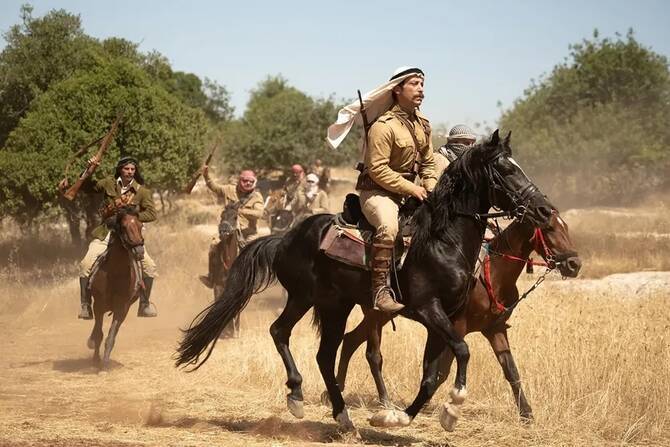
A still from the film that has made the longlist for the 2026 Best International Feature Film award at the Oscars. (Supplied)
Short Url
Updated 04 January 2026
Follow

‘Palestine 36’ set for Saudi cinemas in January

DUBAI: Filmmaker Annemarie Jacir’s “Palestine 36,” which screened at Jeddah’s Red Sea International Film Festival, is scheduled for release in Saudi cinemas on Thursday.

The sweeping historical epic — Palestine’s official entry to the Oscars this year, which made it to the official longlist — is a deep exploration of resistance, resilience and the struggle of the Palestinian people. 

“Palestine 36” is set during the 1936 Arab Revolt and follows five interconnected narratives as villages across Palestine confront British colonial rule.

With rising numbers of Jewish immigrants escaping antisemitism in Europe, and the Palestinian population uniting against Britain’s 30-year dominion, all sides spiral toward inevitable collision in a decisive moment for the British Empire and the future of the entire region. 

The film won the Best Film award at the Tokyo International Film Festival.

Jacir — whose three previous feature films “Salt of this Sea,” “When I Saw You,” and “Wajib” were also official Palestinian Oscar entries — hopes “Palestine 36” will provide a mirror for audiences, particularly those from colonized or war-affected countries.  

“I hope people see themselves in the film,” she told Arab News in December. “I don’t want to teach anyone anything. There’s a lot of history in the film and there’s a lot of history that’s been erased. I hope that’s something that comes through.” 

The film features an ensemble cast, including Oscar-winner Jeremy Irons, “Game of Thrones” star Liam Cunningham, and Tunisian actor Dhafer L’Abidine, alongside Palestinian talents Hiam Abbass, Yasmine Al-Massri, Kamel El Basha, and Saleh Bakri.

At the Red Sea International Film Festival premiere of the film in December, Jacir walked the red carpet with Palestinian Jordanian designer Reema Dahbour, who dressed the director for the event.

Dahbour created a custom piece titled “From the River to the Sea,” which she described on social media as “a dress born from our narrative, our symbols, and our enduring connection to the land. A garment that mirrors the spirit showcased so powerfully in the film.”


Riyadh exhibition to trace the origins of Saudi modern art

Updated 07 January 2026
Follow

Riyadh exhibition to trace the origins of Saudi modern art

  • Features painting, sculpture and archival documents
  • Open from Jan. 27-April 11 at Saudi national museum

DUBAI: A new exhibition in Riyadh is focusing on the origins of Saudi Arabia’s modern art scene, examining how a generation of artists helped shape the Kingdom’s visual culture during a period of rapid change.

The “Bedayat: Beginnings of Saudi Art Movement” show reportedly traces the emergence of creative practices in Saudi Arabia from the 1960s to the 1980s, an era that laid the groundwork for today’s art ecosystem.

On view from Jan. 27 until April 11 at the National Museum of Saudi Arabia, it includes works and archival material that document the early years of modern and abstract art in the Kingdom, according to the organizers.

It will examine how artists responded to shifting social, cultural and economic realities, often working with limited infrastructure but a strong sense of purpose and experimentation.

The exhibition is the result of extensive research led by the Visual Arts Commission, which included dozens of site visits and interviews with artists and figures active during the period.

These firsthand accounts have helped to reconstruct a time when formal exhibition spaces were scarce, art education was still developing, and artists relied heavily on personal initiative to build communities and platforms for their work.

Curated by Qaswra Hafez, “Bedayat” will feature painting, sculpture, works on paper and archival documents, many of which will be shown publicly for the first time.

The works will reveal how Saudi artists engaged with international modernist movements while grounding their practice in local heritage, developing visual languages that spoke to both global influences and lived experience.

The exhibition will have three sections, beginning with the foundations of the modern art movement, and followed by a broader look at the artistic concerns of the time.

It will conclude with a focus on four key figures: Mohammed Al-Saleem, Safeya Binzagr, Mounirah Mosly and Abdulhalim Radwi.

A publication, documentary film and public program of talks and workshops will accompany the exhibition, offering further insight into a pivotal chapter of Saudi art history and the artists who helped define it.