

Bangladesh to demand T20 World Cup matches be moved outside India

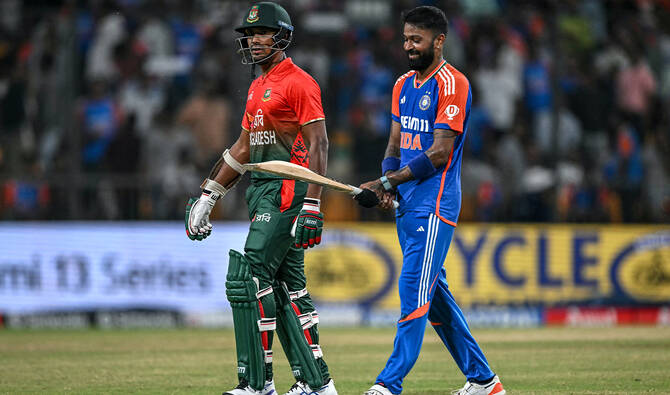
India's Hardik Pandya checks the bat of Bangladesh's Mustafizur Rahman (L) during the first Twenty20 cricket match between India and Bangladesh at the Shrimant Madhavrao Scindia Cricket Stadium in Gwalior on October 6, 2024. (AFP/File)
Short Url
Updated 04 January 2026
Follow

Bangladesh to demand T20 World Cup matches be moved outside India

  • Move to take place after India forced Bangladeshi player to quit Indian Premier League over political tensions
  • Bangladesh are scheduled to play four of their T20 World Cup 2026 group matches in India starting February 

DHAKA: Bangladesh will request their matches at next month’s T20 World Cup be played in Sri Lanka, after India forced a Bangladeshi player to quit the Indian Premier League.

“We will not accept any insult to Bangladeshi cricket, cricketers and Bangladesh under any circumstances,” said Asif Nazrul, Youth and Sports Adviser in the interim government, in a statement carried by the state-run BSS news agency Sunday.

“The days of slavery are over.”

Bangladesh fast bowler Mustafizur Rahman was on Saturday released by the Kolkata Knight Riders after the IPL team were “advised” by Board of Control for Cricket in India (BCCI) to do so, following tensions between the neighboring nations.

Nazrul said he had ordered the Bangladesh Cricket Board (BCB) to write to the International Cricket Council (ICC).

“The board should inform that, where a Bangladeshi cricketer cannot play in India despite being contracted, the entire Bangladeshi cricket team cannot feel safe going to play in the World Cup,” he wrote.

“I have also instructed the board to request that Bangladesh’s World Cup matches should be held in Sri Lanka.”

The T20 World Cup begins on February 7, co-hosted by India and Sri Lanka. Bangladesh are scheduled to play their four group matches in India.

Pakistan will play all their matches in Sri Lanka, part of a deal that allows both India and Pakistan to play at neutral venues in multi-nation tournaments.

Political relations between India and Bangladesh soured after a mass uprising in Dhaka in 2024 toppled then prime minister Sheikh Hasina, a close ally of New Delhi.

India’s foreign ministry last month condemned what it called “unremitting hostility against minorities” in Muslim-majority Bangladesh.

Bangladesh’s interim leader, Nobel Peace Prize winner Muhammad Yunus, has accused India of exaggerating the scale of the violence.

BCB president Aminul Islam Bulbul said the board will hold an emergency meeting later on Sunday.
“The dignity and security of our cricketers are our top priorities, and we will take a decision at the appropriate time keeping these in mind,” he told reporters late Saturday.

Mustafizur, who has previously played in the IPL for other teams, was snapped up at auction in December by Kolkata for more than $1 million.

But BCCI secretary Devajit Saikia said that “considering recent developments” Kolkata had been “advised to release” the 30-year-old.

The 2026 IPL season begins on March 26.

Nazrul said he would also ask that the IPL be blocked from Bangladeshi broadcasters.

“I have requested the Information and Broadcasting Adviser to stop the broadcasting of the IPL tournament in Bangladesh,” he said.

Kolkata, majority-owned by Bollywood superstar Shah Rukh Khan, subsequently said that Mustafizur’s “release has been carried out following due process and consultations.”


Islamabad says surge in aircraft orders after India standoff could end IMF reliance

Updated 06 January 2026
Follow

Islamabad says surge in aircraft orders after India standoff could end IMF reliance

  • Pakistani jets came into the limelight after Islamabad claimed to have shot down six Indian aircraft during a standoff in May last year
  • Many countries have since stepped up engagement with Pakistan, while others have proposed learning from PAF’s multi-domain capabilities

ISLAMABAD: Defense Minister Khawaja Asif on Tuesday said Pakistan has witnessed a surge in aircraft orders after a four-day military standoff with India last year and, if materialized, they could end the country’s reliance on the International Monetary Fund (IMF).

The statement came hours after a high-level Bangladeshi defense delegation met Pakistan’s Air Chief Marshal Zaheer Ahmed Baber Sidhu to discuss a potential sale of JF-17 Thunder aircraft, a multi-role fighter jointly developed by China and Pakistan that has become the backbone of the Pakistan Air Force (PAF) over the past decade.

Fighter jets used by Pakistan came into the limelight after Islamabad claimed to have shot down six Indian aircraft, including French-made Rafale jets, during the military conflict with India in May last year. India acknowledged losses in the aerial combat but did not specify a number.

Many countries have since stepped up defense engagement with Pakistan, while delegations from multiple other nations have proposed learning from Pakistan Air Force’s multi-domain air warfare capabilities that successfully advanced Chinese military technology performs against Western hardware.

“Right now, the number of orders we are receiving after reaching this point is significant because our aircraft have been tested,” Defense Minister Asif told a Pakistan’s Geo News channel.

“We are receiving those orders, and it is possible that after six months we may not even need the IMF.”

Pakistan markets the Chinese co-developed JF-17 as a lower-cost multi-role fighter and has positioned itself as a supplier able to offer aircraft, training and maintenance outside Western supply chains.

“I am saying this to you with full confidence,” Asif continued. “If, after six months, all these orders materialize, we will not need the IMF.”

Pakistan has repeatedly turned to the IMF for financial assistance to stabilize its economy. These loans come with strict conditions including fiscal reforms, subsidy cuts and measures to increase revenue that Pakistan must implement to secure disbursements.

In Sept. 2024, the IMF approved a $7 billion bailout for Pakistan under its Extended Fund Facility (EFF) program and a separate $1.4 billion loan under its climate resilience fund in May 2025, aimed at strengthening the country’s economic and climate resilience.

Pakistan has long been striving to expand defense exports by leveraging its decades of counter-insurgency experience and a domestic industry that produces aircraft, armored vehicles, munitions and other equipment.

The South Asian country reached a deal worth over $4 billion to sell military equipment to the Libyan National Army, Reuters report last month, citing Pakistani officials. The deal, one of Pakistan’s largest-ever weapons sales, included the sale of 16 JF-17 fighter jets and 12 Super Mushak trainer aircraft for basic pilot training.