

Pakistan FM discusses developments in Asia, Middle East with Bangladeshi, Malaysian counterparts

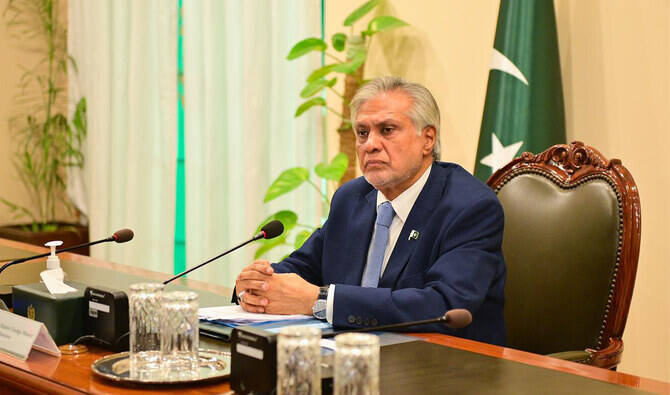
Ishaq Dar, Deputy Prime Minister of Pakistan, attends a meeting in Islamabad, Pakistan, on January 1, 2025. (Ministry of Foreign Affairs/File)
Short Url
Updated 04 January 2026
Follow

Pakistan FM discusses developments in Asia, Middle East with Bangladeshi, Malaysian counterparts

  • Ishaq Dar speaks to foreign ministers of both countries amid tensions in Yemen, strained ties between Delhi, Dhaka
  • Dar reaffirms commitment to enhance cooperation with Bangladesh, Malaysia in telephone call with both counterparts 

ISLAMABAD: Pakistan’s Foreign Minister Ishaq Dar discussed evolving developments in the Asia and Middle East regions with his counterparts from Bangladesh and Malaysia, the foreign office said on Sunday, reaffirming Islamabad’s resolve to enhance cooperation with both states. 

Tensions escalated in Yemen this week after a Saudi-led coalition carried out a “limited” airstrike targeting weapons shipments from the UAE to the port city of Mukalla in southern Yemen. 

The coalition forces spokesperson said the weapons were meant to support the Southern Transitional Council (STC) forces, backed by the UAE, in Yemen’s Hadramaut and Al-Mahra “with the aim of fueling the conflict.”

Pakistan has expressed solidarity with Saudi Arabia and called on regional powers to resolve tensions with dialogue and diplomacy. 

“DPM/FM Senator Mohammad Ishaq Dar held a telephone conversation with FM of Malaysia, Mohamad bin Hajji Hasan,” Pakistan’s foreign office said in a statement. 

“They also exchanged views on recent regional developments, including the evolving situation in Asia and the Middle East.”

In a separate statement, the foreign office said Dar held a telephonic conversation with Bangladesh’s Foreign Adviser Touhid Hossain. 

The two leaders also discussed developments in the Middle East and Asia, agreeing to remain in close contact. 

“The two leaders reviewed Pakistan–Bangladesh relations and reaffirmed their commitment to enhancing cooperation across various sectors,” the statement said. 

The developments also take place in light of Bangladesh’s rising political tensions with Pakistan’s arch-rival India. 

Tensions between the two countries have surged in recent weeks after a 25-year-old Hindu man was lynched and burned publicly in Bangladesh following allegations of blasphemy. India’s foreign ministry last month condemned what it called “unremitting hostility against minorities” in Bangladesh.

A few days later, Hindutva activists tried to storm the Bangladesh High Commission in New Delhi, rallying against the neighboring nation for what they said was Dhaka’s failure to protect its Hindu minorities.

Ties between Dhaka and New Delhi have remained strained ever since the ouster of former Bangladeshi PM Sheikh Hasina in 2024, when she fled to India after her ouster in violent protests in the country. 

India has so far not accepted Bangladesh’s request to extradite Hasina, further stoking tensions between the countries. 


Pakistan Railways targets $3.6 billion revenue amid track expansion, service upgrades

Updated 07 January 2026
Follow

Pakistan Railways targets $3.6 billion revenue amid track expansion, service upgrades

  • Government plans new railway lines and modern trains with security cameras, Wi-Fi and dining cars
  • Revival of a robust railway system is seen as key as Pakistan pushes to become a regional trade hub

ISLAMABAD: Pakistan Railways has set a target of generating Rs 1 trillion ($3.6 billion) in revenue by June as the government expands railway tracks and upgrades passenger services with amenities such as Wi-Fi and modern dining cars, Federal Minister for Railways Hanif Abbasi said on Tuesday.

Pakistan Railways was once the backbone of long-distance travel and freight movement across the country, connecting major cities and ports soon after independence. However, decades of underinvestment, aging infrastructure and competition from road transport led to a steady decline in services and reliability.

As Pakistan seeks to position itself as a regional trade and transit hub, the government has renewed focus on rebuilding a robust rail network for both passengers and cargo.

“Pakistan Railways has set a target of achieving Rs 1 trillion in revenue by June 2026,” Abbasi said, according to an official statement. “Pakistan Railways will be transformed into a modern, safe and profitable organization,” he added.

The minister said work has already begun on digitization, outsourcing, construction of new railway tracks and improvement of passenger facilities.

He said the Asian Development Bank has approved a $2 billion loan for the construction of a 480-kilometer new railway track between Karachi and Rohri, a project expected to cut travel time by at least five hours.

Groundbreaking for the project is planned for July 2026, with completion expected within two and a half to three years.

Under the Reko Diq project, Abbasi said work is underway on a 900-kilometer railway track from Rohri to Nokundi, including construction of 500 kilometers of new track and upgrading of 400 kilometers of existing track.

The 87-kilometer Nokundi–Taftan line has also been included to strengthen rail connectivity with Iran.

The minister said a 54-kilometer People’s Train route is being launched in Balochistan at a cost of Rs 4 billion ($14.4 million), while eight regional routes will be developed in Punjab.

Provinces have also been offered the option to operate branch lines, with Punjab, Sindh and Balochistan allocating funds and consultations underway with Khyber Pakhtunkhwa.

Abbasi said Pakistan is also advancing rail connectivity with Kazakhstan, Uzbekistan and Iran and that the Islamabad–Tehran–Istanbul railway service will be launched after security clearance.

Passenger services are being upgraded alongside infrastructure expansion, he continued.

“Cleanliness and improvement work at Rawalpindi Railway Station has been completed, while three prime trains have already been upgraded, and more trains will be upgraded by June 30,” the minister said. “By December 31, all major trains will be upgraded, featuring security cameras, Wi-Fi, hostesses and modern dining cars.”

He added that Wi-Fi routers have been installed at railway stations, ticket booking has been enabled through the Rabta mobile application and a 1,700-kilometer fiber-optic network is being laid.

Karachi and Lahore railway stations are being upgraded for security, while progress is underway on a Rs 8.9 billion ($32 million) digital systems agreement with the Frontier Works Organization and a $85 million project with DP World at Pipri Yard.

Abbasi said 155 railway stations have been shifted to solar energy and Pakistan Railways recently recorded its highest-ever daily revenue of Rs 300 million ($1.1 million).

The minister also said a new Lahore–Rawalpindi track, backed by provincial funding, will cut travel time between the two cities to about two and a half hours once completed.