


WASHINGTON: The World Bank on Tuesday slashed its global growth forecast by nearly a third to 2.9 percent for 2022, warning that Russia’s invasion of Ukraine has compounded the damage from the COVID-19 pandemic, and many countries now faced recession.
The war in Ukraine had magnified the slowdown in the global economy, which was now entering what could become “a protracted period of feeble growth and elevated inflation,” the World Bank said in its Global Economic Prospects report, warning that the outlook could still grow worse.
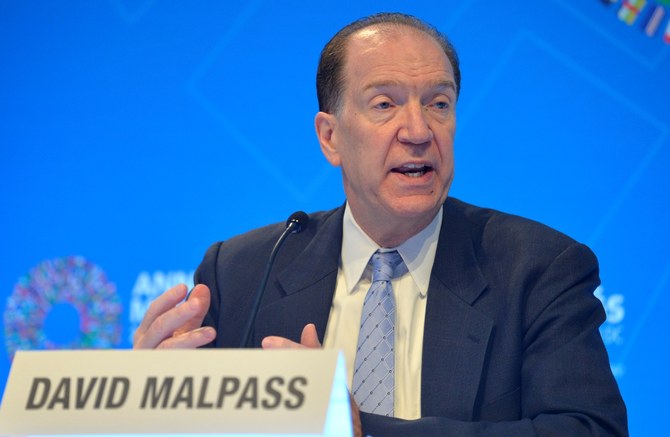
In a news conference, World Bank President David Malpass said global growth could fall to 2.1 percent in 2022 and 1.5 percent in 2023, driving per capita growth close to zero, if downside risks materialized.
Malpass said global growth was being hammered by the war, fresh COVID-19 lockdowns in China, supply chain disruptions and the rising risk of stagflation — a period of weak growth and high inflation last seen in the 1970s.
“The danger of stagflation is considerable today,” Malpass wrote in the foreword to the report. “Subdued growth will likely persist throughout the decade because of weak investment in most of the world. With inflation now running at multi-decade highs in many countries and supply expected to grow slowly, there is a risk that inflation will remain higher for longer.”
Between 2021 and 2024, the pace of global growth is projected to slow by 2.7 percentage points, Malpass said, more than twice the deceleration seen between 1976 and 1979.
The report warned that interest rate increases required to control inflation at the end of the 1970s were so steep that they touched off a global recession in 1982, and a string of financial crises in emerging market and developing economies.
Ayhan Kose, director of the World Bank unit that prepares the forecast, told reporters there was “a real threat” that faster than expected tightening of financial conditions could push some countries into the kind of debt crisis seen in the 1980s.
To reduce the risks, Malpass said, policymakers should work to coordinate aid for Ukraine, boost production of food and energy, and avoid export and import restrictions that could lead to further spikes in oil and food prices.
The danger of stagflation is considerable today.
David Malpass, World Bank president
He also called for efforts to step up debt relief, warning that some middle-income countries were potentially at risk; strengthen efforts to contain COVID; and speed the transition to a low-carbon economy.
The bank forecast a slump in global growth to 2.9 percent in 2022 from 5.7 percent in 2021, a drop of 1.2 percentage points from its January forecast, and said growth was likely to hover near that level in 2023 and 2024.
It said global inflation should moderate next year but would likely remain above targets in many economies.
Growth in advanced economies was projected to decelerate sharply to 2.6 percent in 2022 and 2.2 percent in 2023 after hitting 5.1 percent in 2021.
US growth was seen dropping to 2.5 percent in 2022, down from 5.7 percent in 2021, with the eurozone to see growth of 2.5 percent after 5.4 percent.
Emerging market and developing economies were seen achieving growth of just 3.4 percent in 2022, down from 6.6 percent in 2021, and well below the annual average of 4.8 percent seen in 2011-2019.
HIGHLIGHTS
- The bank forecast a slump in global growth to 2.9 percent in 2022 from 5.7 percent in 2021.
- Growth in advanced economies is projected to decelerate sharply to 2.6 percent in 2022 and 2.2 percent in 2023 after hitting 5.1 percent in 2021.
- South Asia likely to see growth of 6.8 percent this year and 5.8 percent in 2023.
China’s economy was seen expanding by just 4.3 percent in 2022 after growth of 8.1 percent in 2021.
Negative spillovers from the war in Ukraine would more than offset any near-term boost reaped by commodity exporters from higher energy prices, with 2022 growth forecasts revised down in nearly 70 percent of emerging markets and developing economies.
The regional European and Central Asian economy, which does not include Western Europe, was expected to contract by 2.9 percent after growth of 6.5 percent in 2021, rebounding slightly to growth of 1.5 percent in 2023. Ukraine’s economy was expected to contract by 45.1 percent and Russia’s by 8.9 percent.
Growth was expected to decelerate sharply in Latin America and the Caribbean, reaching just 2.5 percent this year and slowing further to 1.9 percent in 2023, the bank said.
The Middle East and North Africa would benefit from rising oil prices, with growth seen reaching 5.3 percent in 2022 before slowing to 3.6 percent in 2023, while South Asia would see growth of 6.8 percent this year and 5.8 percent in 2023.
Sub-Saharan Africa’s growth was expect to slow somewhat to 3.7 percent in 2022 from 4.2 percent in 2021, the bank said.


