Ukraine’s president said Russia is trying to starve his country’s cities into submission but warned Saturday that continuing the invasion would exact a toll on Russia for “generations.” The remarks came after Moscow held a mass rally in support of its bogged-down forces.
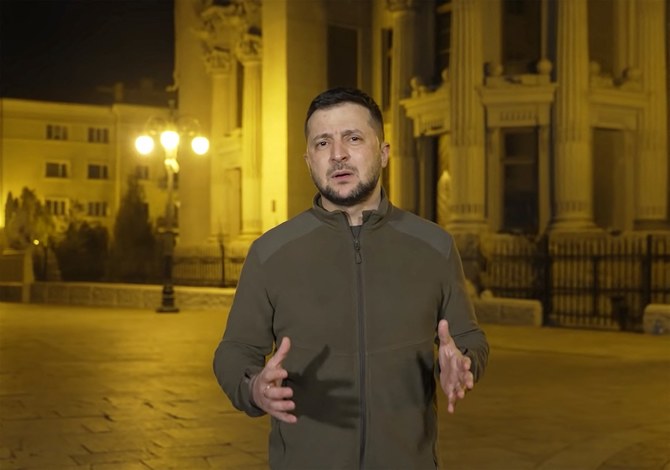
Ukrainian President Volodymyr Zelenskyy accused the Kremlin in an overnight video address of deliberately creating “a humanitarian catastrophe ” and appealed again for Russian President Vladimir Putin to meet with him to prevent more bloodshed.
Noting that the 200,000 people reported to have attended the rally was similar to the number of Russian forces deployed to Ukraine, Zelenskyy said Friday’s event in Moscow illustrated the stakes of the largest ground conflict in Europe since World War II.
“Picture for yourself that in that stadium in Moscow there are 14,000 dead bodies and tens of thousands more injured and maimed,” the Ukrainian leader said, standing outside the presidential office in the capital, Kyiv. “Those are the Russian costs throughout the invasion.”
Putin lavished praised on his country’s military forces during Friday’s flag-waving rally, which took place on the anniversary of Russia’s 2014 annexation of Crimea from Ukraine. The event included patriotic songs such as “Made in the USS.R.,” with the opening lines “Ukraine and Crimea, Belarus and Moldova, it’s all my country.”
“We have not had unity like this for a long time,” Putin told the cheering crowd.
Taking to the stage where a sign read “For a world without Nazism,” he railed against his foes in Ukraine with a baseless claim that they are “neo-Nazis” and insisted his actions were necessary to prevent “genocide” — an idea flatly rejected by leaders around the globe.
The rally took place as Russia has faced heavier-than-expected losses on the battlefield and increasingly authoritarian rule at home. There were suspicions the event was a Kremlin-manufactured display of national pride. Russian police have detained thousands of antiwar protesters.
Fighting continued on multiple fronts in Ukraine. In the besieged port city of Mariupol, the site of some of the war’s greatest suffering, Ukrainian and Russian forces battled over the Azovstal steel plant, one of the biggest in Europe, Vadym Denysenko, adviser to Ukraine’s interior minister, said Saturday.
“I can say that we have lost this economic giant,” Denysenko said in televised remarks. “In fact, one of the largest metallurgical plants in Europe is actually being destroyed.”
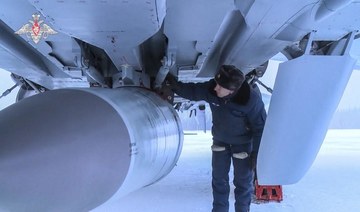
The Russian military reported Saturday that it has used its latest hypersonic missile for the first time in combat. A spokesman for the Russian Defense Ministry, Maj. Gen. Igor Konashenkov, said Kinzhal missiles destroyed an underground warehouse storing Ukrainian missiles and aviation ammunition in the western Ivano-Frankivsk region of Ukraine.
Russia says the Kinzhal, carried by MiG-31 fighter jets, has a range of up to 2,000 kilometers (about 1,250 miles) and flies at 10 times the speed of sound.
Konashenkov said Russian forces also used the anti-ship Bastion missile system to strike Ukrainian military facilities near the Black Sea port of Odesa. Russia first used the weapon during its military campaign in Syria in 2016.
Ukrainian and Russian officials agreed to establish 10 humanitarian corridors for bringing aid in and residents out — one from Mariupol and several around Kyiv and in the eastern Luhansk region, Ukrainian Deputy Prime Minister Iryna Vereshchuk said Saturday.
She also announced plans to deliver humanitarian aid to the southern city of Kherson, which was seized by Russian forces.
In a separate development, Norway said four US service members died in a plane crash during NATO drills in that country’s north. The annual exercise, “Cold Response,” is unrelated to the war in Ukraine.
In his nightly video address, Zelenskyy said Russian forces were blockading the largest cities with the goal of creating such miserable conditions that Ukrainians will surrender. But he warned that Russia would pay the ultimate price.
“The time has come to restore territorial integrity and justice for Ukraine. Otherwise, Russia’s costs will be so high that you will not be able to rise again for several generations,” he said.
In the wake of the invasion, the Kremlin has clamped down harder on dissent and the flow of information, banning sites such as Facebook and Twitter, and instituting tough prison sentences for what is deemed to be false reporting on the war, which Moscow refers to as a “special military operation.”
High above the conflict, three Russian cosmonauts arrived Friday at the International Space Station wearing bright yellow flight suits with blue accents matching the colors of the Ukrainian flag. But cosmonaut Oleg Artemyev said every crew chooses its own suits, and they had a lot of yellow material they needed to use, “so that’s why we had to wear yellow.”
Vladimir Medinsky, who has led Russian negotiators in several rounds of talks with Ukraine, said the two sides have moved closer to agreement on the issue of Ukraine dropping its bid to join NATO and adopting a neutral status. In remarks carried by Russian media, he said the sides are now “halfway” on issues regarding the demilitarization of Ukraine.
However, Mikhailo Podolyak, an adviser to Zelenskyy, said that assessment was intended “to provoke tension in the media.” He tweeted: “Our positions are unchanged. Cease-fire, withdrawal of troops & strong security guarantees with concrete formulas.”
US Defense Secretary Lloyd Austin, during a Saturday visit to NATO ally Bulgaria, condemned Russia’s invasion as “reckless and ruthless.” He said the US has not yet seen Russia mobilize additional forces to compensate for its significant battlefield losses.
“Because of the fact that they’ve stalled on a number of fronts there, it makes sense that (Putin) would want to increase his capabilities going forward,” Austin said. “We’ve just not seen that yet.”
Around Ukraine, hospitals, schools and buildings where people sought safety have been attacked. Ludmyla Denisova, the Ukrainian Parliament’s human rights commissioner, said at least 130 people had survived Wednesday’s bombing of a Mariupol theater that was being used a shelter but that another 1,300 are still inside.
“We pray that they will all be alive, but so far there is no information about them,” Denisova told Ukrainian television.
Satellite images on Friday from Maxar Technologies showed a long line of cars leaving Mariupol as people tried to evacuate. Zelenskyy said more than 9,000 people were able to leave the city in the past day along a route that leads 227 kilometers (141 miles) northwest to the city of Zaporizhzhia.
The governor of the Zaporizhzhia region, Oleksandr Starukh, announced a 38-hour curfew in the southeastern city of the same name after two missile strikes on its suburbs killed nine people Friday.
Early morning barrages that hit a residential building in the Podil neighborhood of Kyiv killed at least one person. Emergency services said 98 people were evacuated from the building and Kyiv Mayor Vitali Klitschko said 19 were wounded.
Maj. Gen. Oleksandr Pavlyuk, who is leading the defense of the region around Ukraine’s capital, said his forces are well-positioned to defend the city and vowed: “We will never give up. We will fight until the end. To the last breath and to the last bullet.”
The British Department of Defense said in its latest intelligence assessment that the Kremlin “has been surprised by the scale and ferocity of Ukrainian resistance” and “is now pursuing a strategy of attrition” after being forced to switch gears.
“This is likely to involve the indiscriminate use of firepower resulting in increased civilian casualties, destruction of Ukrainian infrastructure, and intensify the humanitarian crisis,” the UK ministry said.


![]()

Ukraine’s leader warns war will cost Russia for generations
Short Url
https://arab.news/8ycv4
Ukraine’s leader warns war will cost Russia for generations
- Fighting continued on multiple fronts in Ukraine
- Zelenskyy said Russian forces were blockading the largest cities with the goal of creating such miserable conditions that Ukrainians will surrender

Latest updates


Recommended


© 2026 SAUDI RESEARCH & PUBLISHING COMPANY, All Rights Reserved And subject to Terms of Use Agreement.