DR Congo city residents forced to adapt during year of M23 rule

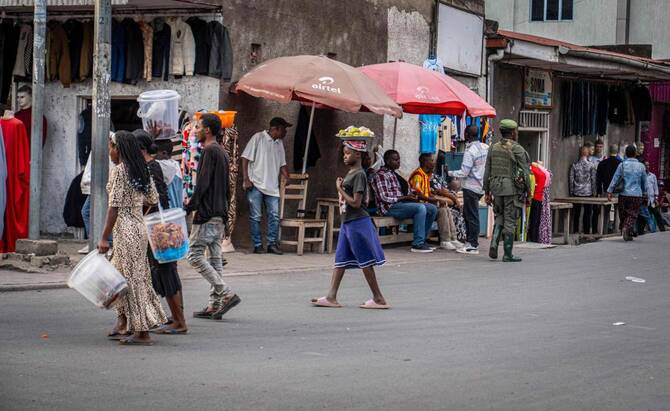
A soldier from the M23 armed group on patrols in Goma, capital of North Kivu province in eastern Democratic Republic of Congo on Jan. 15, 2026. (AFP)
Short Url
Updated 23 January 2026
Follow

DR Congo city residents forced to adapt during year of M23 rule

  • Around one million Goma residents were holed up in their homes on Jan. 26, 2025, when the Congolese army and its allies were forced to pull out of the provincial capital

GOMA, DR Congo: They were caught under a barrage of fire and became trapped with “nowhere to go” after their city in the eastern Democratic Republic of Congo fell under the M23 armed group’s control a year ago.
Around one million Goma residents were holed up in their homes on January 26, 2025, when the Congolese army and its allies were forced to pull out of the provincial capital.
Hundreds of Rwandan soldiers had just poured across the border to fight alongside the M23 in a lightning offensive to seize the lakeside city.
Thousands of people were killed in the intense clashes.
Janvier Kamundu, whose name has been changed for security reasons, was sheltering from the fighting at home with his wife and children.
“Suddenly I heard my wife cry out. She fell, hit by a stray bullet,” he recalled.
Neighbors braved the gunfire to come and help, and a vehicle was found to transport his wife to hospital, ultimately saving her life.
Hospitals were overwhelmed with the wounded and bodies covered in white bags piled up at the morgues.
“She is slowly recovering, but it isn’t easy — she has a lot of wounds around her stomach,” Kamundu said.
Oppressive quiet
A year on, Goma residents endure “constant oppression” by the M23 group, government spokesman Patrick Muyaya said.
In the weeks that followed its capture, the streets emptied out at nightfall and the buzz evaporated from the bars that had once offered some respite in a region scarred by three decades of conflict.
Escaped prisoners, militia fighters and soldiers who had evaded capture roamed the city after dark, breaking into homes and threatening residents.
With the police and court system no longer functioning, the M23 eventually began to systematically cordon off neighborhoods in search of criminals.
By late May, several hundred men were sitting on the dark volcanic gravel covering the streets of Murambi village on Goma’s northern outskirts, watched over by members of the M23.
Local leaders and families are ordered to identify those they recognize as upstanding citizens. The others are detained.
Rough justice
But on the street, anyone deemed suspicious looking drew the M23’s ire.
People spoke of those who had been hauled off to the city sports stadium serving as an open-air prison for wearing dirty clothes or having an untidy beard.
An M23 spokesman invited reporters on several occasions to view the results of the operation — detainees separated into categories.
Desperate families crowded at the entrance, pleading to get their relatives released.
Those not cleared by testimony deemed reliable ended up at secret detention sites. NGO reports denounced torture and summary executions.
But, in time, residents and observers agreed that Goma’s streets were returning to relative safety.
With no independent justice system in place, opponents of the M23 faced repression, some accused of being in cahoots with the pro-government militia.
In October, the armed group — whose declared aim is to overthrow the government and end corruption — began appointing magistrates, but observers indicated there was little impartiality.
Despite parallel peace efforts backed by the United States and Qatar, the M23 launched a new offensive on the strategic town of Uvira near the Burundi border in December.
“These events have shown that the Rwandan president is not at all comfortable with peace processes,” Muyaya, the government spokesman, said.
‘Ideological training’
Most civil society representatives and rights campaigners had fled Goma before the M23 entered.
Civilians and former government combatants were forcibly recruited by the M23, which announced it had 7,000 new members in its ranks in September.
At the same time, the group began to impose taxes to finance its war effort but the city, already on its knees, has had no functioning banks for a year after the government ordered their closure to cut off the rebellion’s funding.
The airport remains inaccessible and trade between Goma and areas under government control has dwindled.
Civil servants were among the first to feel the blow of such cuts.
“There were about 200 agents here; around 20 left to work” in government-held areas, urban planning officer Claude Mumbere said.
“The others are here doing nothing,” added the officer, whose name has also been modified for security reasons.
Some had to undergo “ideological training” provided by the M23.
Mother-of-three Madeleine Mubuto’s husband lost his job.
“We had set aside a small amount of money at home that helped us at first, but after a year almost all of it is used up,” she said.
In the absence of cash, Rwanda’s currency is now used at Goma’s markets.
“Many are wondering how long this situation is going to last,” Kamundu said, adding: “We adapt because we have nowhere to go.”


UK cyclists to ride 550km in Saudi Arabia to save children with heart defects

Updated 3 sec ago
Follow

UK cyclists to ride 550km in Saudi Arabia to save children with heart defects

  • The H&K Cycle Club was the first team to take the Hejaz route, and their endeavour has since 2022 inspired hundreds of other cyclists to follow suit
  • The cyclists expect to face scorching heat, brutal headwinds, sandstorms, and long no-U-turn stretches of roads, along with physical and mental exhaustion

LONDON: A cycling team from London set out on Sunday on a 550km journey from Makkah to Madinah in Saudi Arabia to raise funds for children in developing countries with congenital heart defects.

This is the fifth year that Shamsul Abdin, the head of the H&K Cycle Club, and 40 riders aged between 18 and 65, are taking on the challenge through the Hejaz region.

Abdin told Arab News that the “Hijrah Ride” was a replication of the journey made by Prophet Muhammad over 1,400 years ago, when he migrated from Makkah to Madinah, where he established the first city-state of Islam. This migration, known as Hijrah, also marked the beginning of the Islamic Hijri calendar.

The H&K Cycle Club has expanded from just six riders 14 years ago to more than 40 members from various cities across the UK, including London, Manchester, Oxford, and Birmingham. In November, they began their training in the freezing temperatures of the UK, aiming to cycle over 100 kilometers each day within 6 to 7 hours for a 4-day ride in Saudi Arabia. On Wednesday, they are expected to arrive in Madinah.

Riders from the H&K Cycle Club are expected to arrive in Madinah on Wednesday. (Muntada Aid)

They have cycled throughout the UK and parts of Europe, riding from London to Istanbul to raise funds for various causes through Muntada Aid, a charity that works on projects in developing countries and organizes the “Hijrah Ride”.

They were also the first cycling team to take the Hejaz route, and their endeavour has since inspired hundreds of other cyclists to follow suit. Abdin has seen Saudi Arabia become more bike-friendly over the past five years, with cycling lanes integrated into city development, while drivers, locals, and authorities are now more aware of cyclists on the roads.

The cyclists expect to face scorching heat, brutal headwinds, sandstorms, and long no-U-turn stretches of roads, along with physical and mental exhaustion. For many riders, this will be their fifth ride in Hejaz. Some of them include Uber and bus drivers, business analysts, and even entrepreneurs, according to Abdin.

“The headwind feels like climbing a mountain; it’s a constant resistance. To overcome this challenge, we ride in a peloton, taking turns at the front. One person heads into the wind while the others line up behind, shielded from the gusts. After a while, we rotate, allowing everyone a chance to lead,” Abdin explained.

Almost £923,000 has been raised by the “Hijrah Ride” since its inception, to reach a target of one million pounds this year. Some of the money went into emergency aid programs in Gaza and Sudan. Muntada Aid aims to raise about £250,000 for its flagship project, “Little Hearts,” which will fund 150 surgeries for children with congenital heart defects in Pakistan and Bangladesh this year.

“I fell in love with this project, which gives children the opportunity to live up to their potential as adults, truly,” said Abdin, who was awarded the MBE (Member of the Order of the British Empire) in December for his contribution to charitable fundraising.

Shamsul Abdin, the head of the H&K Cycle Club. (Muntada Aid)

The riders will be escorted by two vehicles, one in front and one in the rear, carrying paramedics and media staff, along with food and water. They will split into two groups based on their cycling powers. Along the route, they will pass several locations, including Jeddah on the Red Sea, King Abdullah Economic City, Rabigh, Masturah, and Badr, before reaching the elevated roads of Madinah, where their journey, which started with performing Umrah in Makkah, will end.

Muntada Aid is a part of Al-Muntada Trust, which was founded in 1986 by a group of Middle Eastern students, including individuals from Qatar and Saudi Arabia, to address the famine crisis in Ethiopia. Since then, the organization has assisted children in 17 countries, including Somalia, Sudan, Chad, Kosovo, Bosnia, Bangladesh, Pakistan, Mali, and Niger. They focus on developing infrastructure in education, health, water and sanitation sectors.

Nasrun Mir, the marketing director of Muntada Aid, told Arab News that they support “Hijrah Ride” with financial backing and logistics, and that they have obtained permits through communication with the Saudi Ministry of Transport, the Ministry of Foreign Affairs, the Saudi embassy in London, and the British Consulate in Jeddah.

Muntada Aid is a part of Al-Muntada Trust, which was founded in 1986 by a group of students, including individuals from Qatar and Saudi Arabia. (Muntada Aid)

Mir, who is joining the journey as part of the media team this week, said that the reception in Saudi Arabia could not be friendlier.

“People offer us free food and drinks. They want to have conversations with us. They want to know what we do. In the Middle East, there is still no concept of using sports as a tool for charity. The general idea is that if I want to give money to the charity, I’ll give it to them. You don’t need to run. You don’t need to cycle,” Mir said.

In one incident, a local community prevented the riders from passing through their village unless they disembarked and sat down to eat with them. In particular sections of the road near Madinah, a Saudi police vehicle has escorted the riders for a few kilometers, he added.

“There have been incidents where people have stopped us from eating our own food during the break. 
They literally took our food and said, ‘No, you come to our village; you cannot eat your food. You have to have food, which we will prepare.’ This delayed ride for a couple of hours,” Mir said.