

Karachi mayor says city focused on rescue, identification after mall fire kills 67 

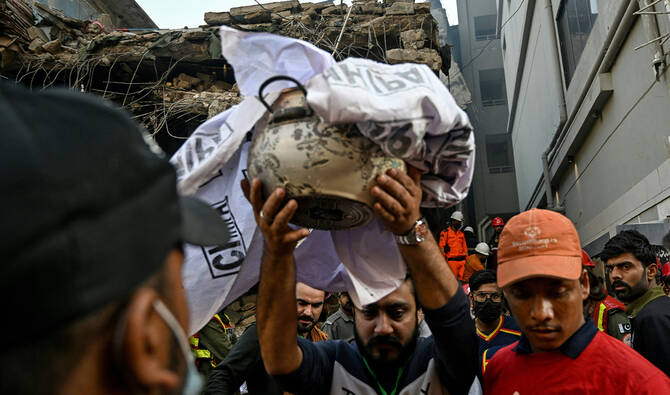
Rescue workers extract remains of a victim after a massive fire broke out at a shopping mall in Karachi on January 21, 2026. (AFP/File)
Short Url
Updated 23 January 2026
Follow

Karachi mayor says city focused on rescue, identification after mall fire kills 67 

  • Blaze broke out on Jan. 17 at Gul Plaza, trapping workers and shoppers inside and burning for more than 24 hours 
  • Authorities say identification has been significantly slowed by the condition of the bodies recovered from the site

ISLAMABAD: Authorities in Karachi are focused on ongoing rescue operations and the identification of victims and handover of remains to families, the city’s mayor said on Friday, after a deadly fire at a shopping plaza killed at least 67 people this month.

The blaze broke out on Jan. 17 at Gul Plaza, a densely packed commercial building in the heart of the city, trapping workers and shoppers inside and burning for more than 24 hours before being brought under control. Recovery operations are still underway as teams sift through unstable debris at the site.

Karachi Mayor Murtaza Wahab said in a statement the city administration remained focused on retrieving remains and returning them to families as quickly as possible. His remarks came after he visited the homes of several victims, according to a statement from his office.

“Rescue personnel of the Karachi Metropolitan Corporation are still engaged in the rescue operation, while the administration is making every effort to hand over [remains] of the victims, loved ones to their families at the earliest,” Wahab was quoted as saying.
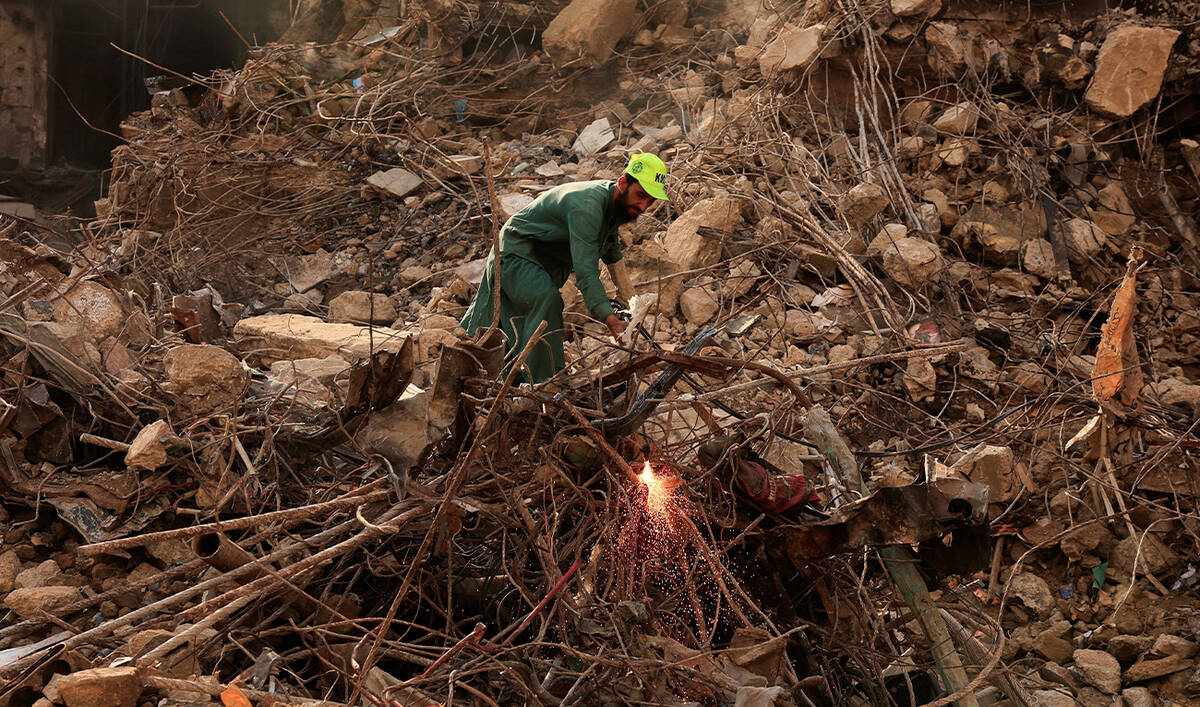


A worker uses a blowtorch to cut the iron amid rubble, following a massive fire that broke out in the Gul Plaza Shopping Mall in Karachi, Pakistan, January 22, 2026. (Reuters)

Identification has been complicated by the condition of the remains, Karachi Police Surgeon Dr. Summaiya Syed told reporters.

Most of the bodies recovered so far were discovered in fragments, she said, making forensic identification extremely difficult and prolonging the process for families waiting for confirmation.

Relatives of more than a dozen missing persons have remained near the destroyed plaza and at hospitals even after submitting DNA samples for testing. Some families have voiced frustration over the pace of recovery and identification efforts.

Wahab said the provincial government stood with affected families and had committed to long-term support.

“The Sindh government would also not sit back until the victims are fully rehabilitated and that all possible support would be provided [to them],” he said.
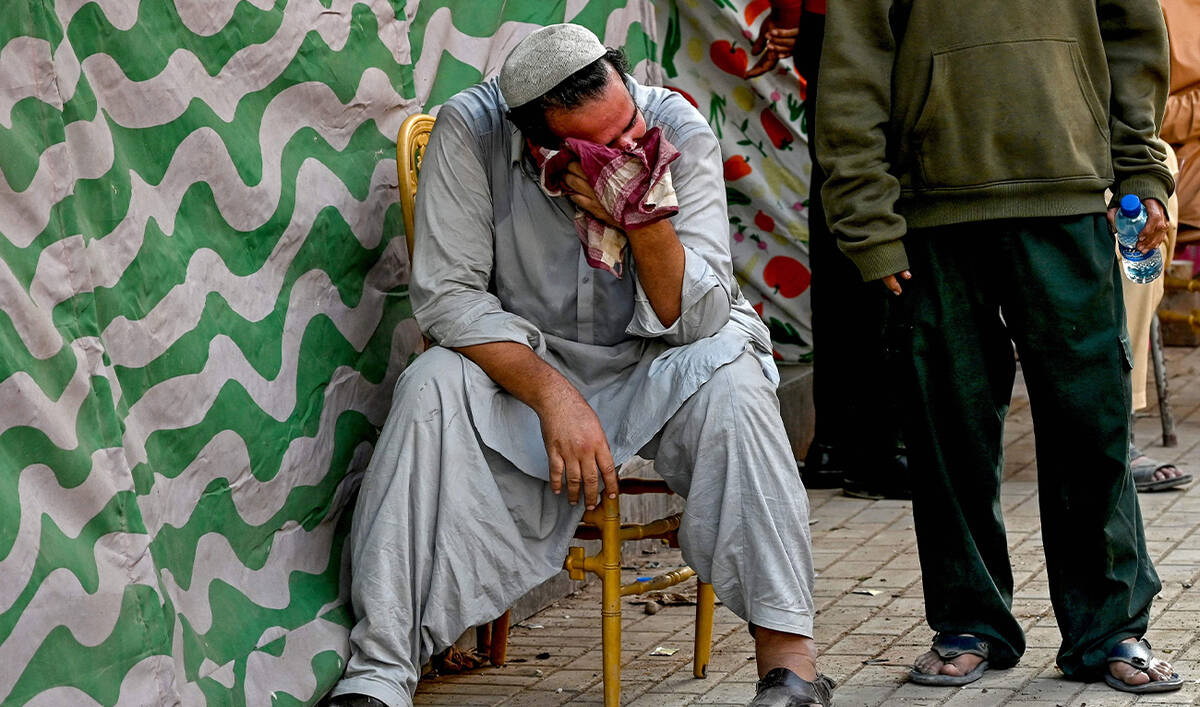


A man mourns for his relative who died after a massive fire at a shopping mall in Karachi on January 21, 2026. (AFP)

Authorities have yet to determine the cause of the fire. Police have said preliminary indications point to a possible electrical short circuit in the plaza which houses over 1,200 shops, though officials stress that conclusions will only be drawn after investigations are completed.

Deadly fires are a recurring problem in Karachi, a city of more than 20 million people, where overcrowded markets, aging infrastructure, illegal construction and weak enforcement of safety regulations frequently contribute to disasters. 

Officials say a blaze of this scale is rare.

The Sindh government has announced compensation of Rs10 million ($35,720) for each person killed in the fire and said all affected shopkeepers would also be compensated.


Tens of thousands flee northwest Pakistan over fears of military operation

Updated 28 January 2026
Follow

Tens of thousands flee northwest Pakistan over fears of military operation

  • More than 70,000 people, mostly women and children, have fled remote Tirah region bordering Afghanistan 
  • Government says no military operation underway or planned in Tirah, a town in Khyber Pakhtunkhwa province

BARA, Pakistan: More than 70,000 people, mostly women and children, have fled a remote region in northwestern Pakistan bordering Afghanistan over uncertainty of a military operation against the Pakistani Taliban, residents and officials said Tuesday.

Pakistan’s Defense Minister Khawaja Mohammad Asif has denied the claim by residents and provincial authorities. He said no military operation was underway or planned in Tirah, a town in Khyber Pakhtunkhwa province.

Speaking at a news conference in Islamabad, he said harsh weather, rather than military action, was driving the migration. His comments came weeks after residents started fleeing Tirah over fears of a possible army operation.

The exodus began a month after mosque loudspeakers urged residents to leave Tirah by Jan. 23 to avoid potential fighting. Last August, Pakistan launched a military operation against Pakistani Taliban in the Bajau r district in the northwest, displacing hundreds of thousands of people.

Shafi Jan, a spokesman for the provincial government in Khyber Pakhtunkhwa, posted on X that he held the federal government responsible for the ordeal of the displaced people, saying authorities in Islamabad were retracting their earlier position about the military operation.

Khyber Pakhtunkhwa Chief Minister Suhail Afridi, whose party is led by imprisoned former Prime Minister Imran Khan, has criticized the military and said his government will not allow troops to launch a full-scale operation in Tirah.

The military says it will continue intelligence-based operations against Pakistani Taliban, who are known as Tehrik-e-Taliban Pakistan, or TTP. Though a separate group, it has been emboldened since the Afghan

Taliban returned to power in 2021. Authorities say many TTP leaders and fighters have found sanctuary in Afghanistan and that hundreds of them have crossed into Tirah, often using residents as human shields when militant hideouts are raided.

Caught in the middle are the residents of Tirah, who continued arriving in Bara.

So far, local authorities have registered roughly 10,000 families — about 70,000 people — from Tirah, which has a population of around 150,000, said Talha Rafiq Alam, a local government administrator overseeing the relief effort. He said the registration deadline, originally set for Jan. 23, has been extended to Feb. 5.

He said the displaced would be able to return once the law-and-order situation improves.

Among those arriving in Bara and nearby towns was 35-year-old Zar Badshah, who said he left with his wife and four children after the authorities ordered an evacuation. He said mortar shells had exploded in villages in recent weeks, killing a woman and wounding four children in his village. “Community elders told us to leave. They instructed us to evacuate to safer places,” he said.

At a government school in Bara, hundreds of displaced lined up outside registration centers, waiting to be enrolled to receive government assistance. Many complained the process was slow.

Narendra Singh, 27, said members of the minority Sikh community also fled Tirah after food shortages worsened, exacerbated by heavy snowfall and uncertain security.

“There was a severe shortage of food items in Tirah, and that forced us to leave,” he said.

Tirah gained national attention in September, after an explosion at a compound allegedly used to store bomb-making materials killed at least 24 people. Authorities said most of the dead were militants linked to the TTP, though local leaders disputed that account, saying civilians, including women and children, were among the dead.