EU investments in Saudi Arabia to prosper over next 5 years, says ambassador

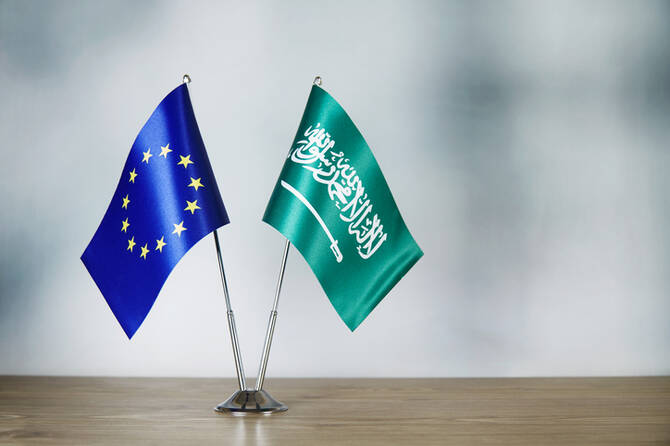
Economic relations between Saudi Arabia and the EU are no longer limited to traditional trade exchange but have transformed into a multi-sector partnership. Getty
Short Url
Updated 23 January 2026
Follow

EU investments in Saudi Arabia to prosper over next 5 years, says ambassador

RIYADH: European investments in Saudi Arabia are set to see notable growth over the next five years, encompassing green energy, metals, critical raw materials, advanced industry, and the digital sector.

Christophe Farnaud, the EU Ambassador to Saudi Arabia, confirmed to Al-Eqtisadiah that an anticipated memorandum of understanding with the Kingdom in the energy field will provide an organized framework for cooperation in energy transition and sustainability, boosting investor confidence in the long-term partnership between the two sides.

The volume of trade in goods and services between Saudi Arabia and the EU amounts to €90 billion ($105.6 billion), according to the latest data from 2024, making the EU the Kingdom’s second-largest trading partner, according to Farnaud. 

Currently, 2,500 European companies operate within the Saudi market, highlighting the depth of economic relations between the two sides.

A qualitative development in relations

Farnaud affirmed that Saudi-European relations are witnessing qualitative development, especially since the EU’s adoption in 2022 of its strategy towards Gulf Cooperation Council countries, which is based on enhancing political, security, and economic cooperation, in addition to cultural and humanitarian exchange. 

He noted that Saudi Arabia’s Vision 2030 constitutes an attractive framework for strengthening this partnership.

The ambassador also pointed out that the launch of the European Chamber of Commerce in the Kingdom of Saudi Arabia during 2024 represented an important step to support cooperation between European and Saudi companies and enhance mutual investments, reflecting a positive outlook for the future of economic relations. 

Economic relations are no longer limited to traditional trade exchange but have transformed into a multi-sector partnership, including investment, services, manufacturing, energy, and sustainability, according to Farnaud.


Christophe Farnaud, the EU Ambassador to Saudi Arabia meeting Crown Prince Mohammed bin Salman in 2025. X/@EUAmbGCC

Relaunching Free Trade Agreement negotiations

The ambassador revealed ongoing discussions to relaunch negotiations for a Free Trade Agreement between the EU and GCC countries, which have been stalled since 2008, aiming to reach a modern agreement covering investment, services, intellectual property protection, technical standards, and government procurement.

He also indicated readiness to launch negotiations for a bilateral strategic partnership agreement with Saudi Arabia, including industrial cooperation, critical raw materials, energy, and sustainability, alongside working to sign a memorandum of understanding in the energy field in the coming period.

The EU, according to Farnaud, is the largest foreign investor in Saudi Arabia, holding 29 percent of the total foreign direct investment stock, which amounted to 30.7 billion euros in 2023. 

Investments are concentrated in the transport, energy, industry, tourism, education, and training sectors, with major European companies participating in strategic projects like the Riyadh Metro.

Sectors of common priority

The ambassador explained that the energy sector, especially renewable energy and green hydrogen, represents a common priority, amidst the global shift towards sustainability, in addition to significant opportunities in the high-tech manufacturing sector, industrial localization, and knowledge transfer.

He pointed to the growing interest of European investors in Saudi Arabia’s tourism sector, driven by Vision 2030’s targets to raise tourism’s contribution to the gross domestic product to 10 percent.

Wide opportunities stand out in areas of hospitality, tourist destination management, cultural tourism, transport, and sustainability, especially in major projects like NEOM, AlUla, the Red Sea Project, and Diriyah.

Farnaud cited existing partnerships with leading European companies such as Accor and Kempinski, in addition to French cooperation in developing AlUla as a global heritage and tourist site.


Saudi investment pipeline active as reforms advance, says Pakistan minister

Updated 08 February 2026
Follow

Saudi investment pipeline active as reforms advance, says Pakistan minister

ALULA: Pakistan’s Finance Minister Mohammed Aurangzeb described Saudi Arabia as a “longstanding partner” and emphasized the importance of sustainable, mutually beneficial cooperation, particularly in key economic sectors.

Speaking to Arab News on the sidelines of the AlUla Conference for Emerging Market Economies, Aurangzeb said the relationship between Pakistan and Saudi Arabia remains resilient despite global geopolitical tensions.

“The Kingdom has been a longstanding partner of Pakistan for the longest time, and we are very grateful for how we have been supported through thick and thin, through rough patches and, even now that we have achieved macroeconomic stability, I think we are now well positioned for growth.”

Aurangzeb said the partnership has facilitated investment across several sectors, including minerals and mining, information technology, agriculture, and tourism. He cited an active pipeline of Saudi investments, including Wafi’s entry into Pakistan’s downstream oil and gas sector.

“The Kingdom has been very public about their appetite for the country, and the sectors are minerals and mining, IT, agriculture, tourism; and there are already investments which have come in. For example, Wafi came in (in terms of downstream oil and gas stations). There’s a very active pipeline.”

He said private sector activity is driving growth in these areas, while government-to-government cooperation is focused mainly on infrastructure development.

Acknowledging longstanding investor concerns related to bureaucracy and delays, Aurangzeb said Pakistan has made progress over the past two years through structural reforms and fiscal discipline, alongside efforts to improve the business environment.

“The last two years we have worked very hard in terms of structural reforms, in terms of what I call getting the basic hygiene right, in terms of the fiscal situation, the current economic situation (…) in terms of all those areas of getting the basic hygiene in a good place.”

Aurangzeb highlighted mining and refining as key areas of engagement, including discussions around the Reko Diq project, while stressing that talks with Saudi investors extend beyond individual ventures.

“From my perspective, it’s not just about one mine, the discussions will continue with the Saudi investors on a number of these areas.”

He also pointed to growing cooperation in the IT sector, particularly in artificial intelligence, noting that several Pakistani tech firms are already in discussions with Saudi counterparts or have established offices in the Kingdom.

Referring to recent talks with Saudi Minister of Economy and Planning Faisal Alibrahim, Aurangzeb said Pakistan’s large freelance workforce presents opportunities for deeper collaboration, provided skills development keeps pace with demand.

“I was just with (Saudi) minister of economy and planning, and he was specifically referring to the Pakistani tech talent, and he is absolutely right. We have the third-largest freelancer population in the world, and what we need to do is to ensure that we upscale, rescale, upgrade them.”

Aurangzeb also cited opportunities to benefit from Saudi Arabia’s experience in the energy sector and noted continued cooperation in defense production.

Looking ahead, he said Pakistan aims to recalibrate its relationship with Saudi Arabia toward trade and investment rather than reliance on aid.

“Our prime minister has been very clear that we want to move this entire discussion as we go forward from aid and support to trade and investment.”