

Illegal gold miners run residents out of South African settlement

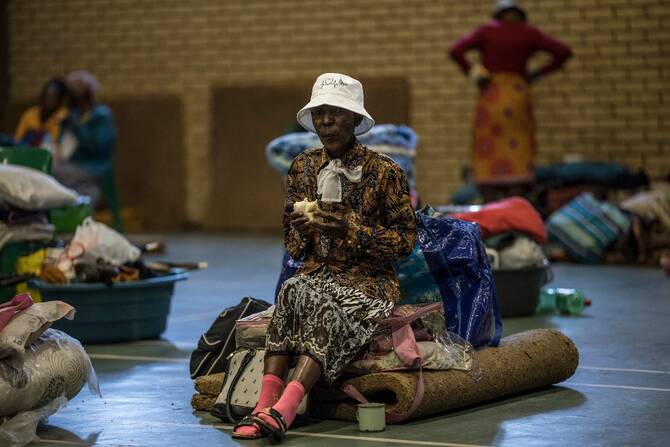
Maria Modikwa, 60, a displaced woman from the informal settlement of Sporong by the ongoing unrest between the community and a group of artisanal miners commonly referred to as "zama zamas" in Randfontein, South Africa. (AFP)
Short Url
Updated 23 January 2026
Follow

Illegal gold miners run residents out of South African settlement

  • More than 30,000 people have been arrested and over 4,000 illegal firearms seized, police said last month

RANDFONTEIN: On crutches and with a bullet lodged in his leg, Miami Chauke is among the few people who did not flee the gun attacks that emptied South Africa’s once-bustling settlement of Sporong, where abandoned tin shacks bake in the sun.
Hundreds of other residents of the area just west of Johannesburg fled two weeks ago, terrorized by violence, extortion and threats they blame on increasingly brazen illegal gold miners.
Taking refuge in a community hall 11 kilometers (seven miles) from their homes, the displaced people of Sporong are among several communities living in fear of the several thousand illegal miners estimated to be operating in South Africa.
“They all had guns and we were running but they kept shooting,” 32-year-old Chauke told AFP of the battle one November night that left a bullet in his left leg.
“I am still in pain. I can’t walk even for 200 meters,” he said.
His plastered leg also prevents him from getting in a car to reach the others, who include his wife and three-year-old daughter.
“We don’t have money but they still shoot at us. They just take even the little that we have,” Chauke said.
Sporong is an informal settlement about 50 kilometers from Johannesburg, South Africa’s economic capital that was built on a gold rush 140 years ago.
The illegal miners — known as “zama zamas” — are after the riches that lie in the ground beneath their humble homes, said Julian Mameng, one of the residents who opted to leave.
“The zamas zamas say our place is rich in gold, we are staying on top of money, and that is why they are killing us, using the gun to scare us away,” the 49-year-old told AFP in the community hall, where families share a cramped space.
In one incident, at least seven people were shot in a bar, he said.

- Terrorizing communities -

The clandestine artisanal miners, many from neighboring countries, have become an entrenched presence in the shantytowns that ring Johannesburg and its satellite settlements along the gold reef.
Driven by poverty and unemployment, the zama zamas — which means “those who try” in the Zulu language — descend deep into still gold-bearing shafts abandoned by mining companies or dig out new ones.
The sector has been linked to organized crime, assassinations, extortion and other illegal activities, leading the government to launch a nationwide crackdown in December 2023.
More than 30,000 people have been arrested and over 4,000 illegal firearms seized, police said last month.
In December, nine people were killed when gunmen opened fire in a tavern in the same municipality as Sporong, an attack that was reportedly linked to a running turf war over abandoned gold mine shafts.
“That place is not good,” said Maria Modikwa, 60;
She escaped with her family of six, including a 10?month?old grandchild, carrying little more than two blankets and clothes to last a few days.
“They shot at us every day, terrorized us, always demanded money, took our phones and bank cards,” she told AFP at the Randfontein hall.
Most of the people sheltering there sleep on the floor, with thin mattresses for the lucky few.
Plastic sheets black out the windows. Food, donated by well?wishers, is cooked on a single gas stove.
Police said on Thursday they would step up operations to flush out illegal miners at Sporong, including deploying two armored trucks.
Local leaders have called for the army to be sent in.
But the promises are little reassurance for Modikwa, who says she will only consider returning if an officer is posted to “protect me day and night.”


Judge bars federal prosecutors from seeking the death penalty against Luigi Mangione

Updated 02 February 2026
Follow

Judge bars federal prosecutors from seeking the death penalty against Luigi Mangione

  • Judge Margaret Garnett’s Friday ruling foiled the Trump administration’s bid to see Mangione executed
  • Garnett dismissed a federal murder charge against Mangione, finding it technically flawed. She left in place stalking charges that could carry a life sentence

NEW YORK: Federal prosecutors can’t seek the death penalty against Luigi Mangione in the killing of UnitedHealthcare CEO Brian Thompson, a federal judge ruled Friday, foiling the Trump administration’s bid to see him executed for what it called a “premeditated, cold-blooded assassination that shocked America.”
Judge Margaret Garnett dismissed a federal murder charge that had enabled prosecutors to seek capital punishment, finding it technically flawed. She wrote that she did so to “foreclose the death penalty as an available punishment to be considered by the jury” as it weighs whether to convict Mangione.
Garnett also dismissed a gun charge but left in place stalking charges that carry a maximum punishment of life in prison. To seek the death penalty, prosecutors needed to show that Mangione killed Thompson while committing another “crime of violence.” Stalking doesn’t fit that definition, Garnett wrote in her opinion, citing case law and legal precedents.
In a win for prosecutors, Garnett ruled they can use evidence collected from his backpack during his arrest, including a 9mm handgun and a notebook in which authorities say Mangione described his intent to “wack” an insurance executive. Mangione’s lawyers had sought to exclude those items, arguing the search was illegal because police hadn’t yet obtained a warrant.
During a hearing Friday, Garnett gave prosecutors 30 days to update her on whether they’ll appeal her death penalty decision. A spokesperson for the US attorney’s office in Manhattan, which is prosecuting the federal case, declined to comment.
Garnett acknowledged that the decision “may strike the average person — and indeed many lawyers and judges — as tortured and strange, and the result may seem contrary to our intuitions about the criminal law.” But, she said, it reflected her “committed effort to faithfully apply the dictates of the Supreme Court to the charges in this case. The law must be the Court’s only concern.”
Mangione, 27, appeared relaxed as he sat with his lawyers during the scheduled hearing, which took place about an hour after Garnett issued her written ruling. Prosecutors retained their right to appeal but said they were ready to proceed to trial.
Outside court afterward, Mangione attorney Karen Friedman Agnifilo said her client and his defense team were relieved by the “incredible decision.”
Jury selection in the federal case is set for Sept. 8, followed by opening statements and testimony on Oct. 13. The state trial’s date hasn’t been set. On Wednesday, the Manhattan district attorney’s office urged the judge in that case to schedule a July 1 trial date.
“That case is none of my concern,” Garnett said, adding that she would proceed as if the federal case is the only case unless she hears formally from parties involved in the state case. She also said the federal case will be paused if the government appeals her death penalty ruling.
Thompson, 50, was killed on Dec. 4, 2024, as he walked to a midtown Manhattan hotel for UnitedHealth Group’s annual investor conference. Surveillance video showed a masked gunman shooting him from behind. Police say “delay,” “deny” and “depose” were written on the ammunition, mimicking a phrase used by critics to describe how insurers avoid paying claims.
Mangione, an Ivy League graduate from a wealthy Maryland family, was arrested five days later at a McDonald’s in Altoona, Pennsylvania, about 230 miles (about 370 kilometers) west of Manhattan.
Following through on Trump’s campaign promise to vigorously pursue capital punishment, Attorney General Pam Bondi ordered Manhattan federal prosecutors last April to seek the death penalty against Mangione.
It was the first time the Justice Department sought the death penalty in President Donald Trump’s second term. He returned to office a year ago with a vow to resume federal executions after they were halted under his predecessor, President Joe Biden.
Garnett, a Biden appointee and former Manhattan federal prosecutor, ruled after hearing oral arguments earlier this month.
Besides seeking to have the death penalty rejected on the grounds Garnett cited, Mangione’s lawyers argued that Bondi’s announcement flouted long-established Justice Department protocols and was “based on politics, not merit.”
They said her remarks, followed by posts to her Instagram account and a TV appearance, “indelibly prejudiced” the grand jury process resulting in his indictment weeks later.
Prosecutors urged Garnett to keep the death penalty on the table, arguing that the charges were legally sound and Bondi’s remarks weren’t prejudicial, as “pretrial publicity, even when intense, is not itself a constitutional defect.”
Prosecutors argued that careful questioning of prospective jurors would alleviate the defense’s concerns about their knowledge of the case and ensure Mangione’s rights are respected at trial.
“What the defendant recasts as a constitutional crisis is merely a repackaging of arguments” rejected in previous cases, prosecutors said. “None warrants dismissal of the indictment or categorical preclusion of a congressionally authorized punishment.”
