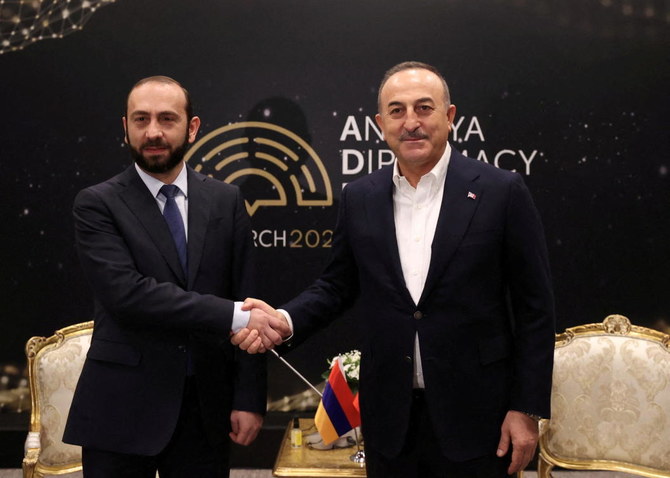
Turkey and Armenia have pledged to pursue the normalization of ties in what the Turkish foreign minister Mevlut Cavusoglu described as a “productive and constructive” meeting on Saturday.
After talks with his Armenian counterpart, Ararat Mirzoyan, Cavusoglu said that Azerbaijan also “supports the process” of normalization.
Armenia and Turkey have no diplomatic relations, a closed land border and a deep-seated hostility rooted in the mass killing of Armenians under the Ottoman Empire during World War I.
But in December, the two countries appointed special envoys to normalize relations, spurred by support from regional powerbroker Russia and Armenia’s arch-foe Azerbaijan.
The push came a year after Azerbaijan used the help of Turkish combat drones to recapture most of the territory it lost to ethnic Armenians in a 1990s war in the disputed region of Nagorno-Karabakh.
A Russian-brokered truce that ended the second conflict removed Turkey’s main objection to talking to Armenia — namely, Yerevan’s support for the local Nagorno-Karabakh government’s claim of independence from Azerbaijan.
The first commercial flights for two years resumed in early February between Turkey and Armenia, but the land border between the two countries has remained closed since 1993, forcing trucks to transit through Georgia or Iran.

Turkey, Armenia vow to continue normalizing relations
Short Url
https://arab.news/jkk9y
Turkey, Armenia vow to continue normalizing relations
- Armenia and Turkey have no diplomatic relations, a closed land border and a deep-seated hostility
Sudan paramilitary advances near Ethiopia border
KHARTOUM: Sudanese paramilitary forces have advanced on army positions near the southeastern border with Ethiopia, according to the group and an eyewitness who spoke to AFP Wednesday.
Control over Sudan’s southeastern Blue Nile State, bordering both Ethiopia and South Sudan, is split between the army and a faction of the Sudan People’s Liberation Movement-North, allies of the paramilitary Rapid Support Forces.
In a statement released Tuesday, the SPLM-N, led by Abdelaziz Al-Hilu, said they had “liberated the strategic city of Deim Mansour and areas of Bashir Nuqu and Khor Al-Budi.”
Since April 2023, the Sudanese army has been at war with the RSF. In February of last year, the RSF announced a surprise alliance with the SPLM-N, securing experienced fighters, land and border access.
Deim Mansour lies between the SPLM-N stronghold Yabus, birthplace of their deputy commander Joseph Tuka, and the army-held town of Kurmuk, which hosts a large army contingent.
Babiker Khaled, who fled to Kurmuk, told AFP that SPLM-N fighters began amassing in the forests around Deim Mansour on Sunday.
“The shelling began on Monday, they entered the city on Tuesday,” he said, adding that “some people fled into Ethiopia, others arrived in Kurmuk.”
From its foothold in the southern Blue Nile, a thin strip of land jutting south between Ethiopia and South Sudan, the SPLM-N maintains reported supply lines from both countries, building on decades-old links.
Close to three years of war in Sudan have left tens of thousands dead and around 11 million displaced, creating the world’s largest hunger and displacement crises.
It has also torn the country apart, with the army holding the center, north and east of Sudan while the RSF and its allies dominate the west and parts of the south.
Sudan’s Kordofan region, where the SPLM-N has its other foothold in the Nuba Mountains, is currently the war’s fiercest battleground.
On Tuesday, the army broke a paramilitary siege on South Kordofan state capital Kadugli, days after breaking another on the nearby city of Dilling.
Control over Sudan’s southeastern Blue Nile State, bordering both Ethiopia and South Sudan, is split between the army and a faction of the Sudan People’s Liberation Movement-North, allies of the paramilitary Rapid Support Forces.
In a statement released Tuesday, the SPLM-N, led by Abdelaziz Al-Hilu, said they had “liberated the strategic city of Deim Mansour and areas of Bashir Nuqu and Khor Al-Budi.”
Since April 2023, the Sudanese army has been at war with the RSF. In February of last year, the RSF announced a surprise alliance with the SPLM-N, securing experienced fighters, land and border access.
Deim Mansour lies between the SPLM-N stronghold Yabus, birthplace of their deputy commander Joseph Tuka, and the army-held town of Kurmuk, which hosts a large army contingent.
Babiker Khaled, who fled to Kurmuk, told AFP that SPLM-N fighters began amassing in the forests around Deim Mansour on Sunday.
“The shelling began on Monday, they entered the city on Tuesday,” he said, adding that “some people fled into Ethiopia, others arrived in Kurmuk.”
From its foothold in the southern Blue Nile, a thin strip of land jutting south between Ethiopia and South Sudan, the SPLM-N maintains reported supply lines from both countries, building on decades-old links.
Close to three years of war in Sudan have left tens of thousands dead and around 11 million displaced, creating the world’s largest hunger and displacement crises.
It has also torn the country apart, with the army holding the center, north and east of Sudan while the RSF and its allies dominate the west and parts of the south.
Sudan’s Kordofan region, where the SPLM-N has its other foothold in the Nuba Mountains, is currently the war’s fiercest battleground.
On Tuesday, the army broke a paramilitary siege on South Kordofan state capital Kadugli, days after breaking another on the nearby city of Dilling.
© 2026 SAUDI RESEARCH & PUBLISHING COMPANY, All Rights Reserved And subject to Terms of Use Agreement.


