

Lebanon sends congratulations on Saudi Arabia’s Founding Day

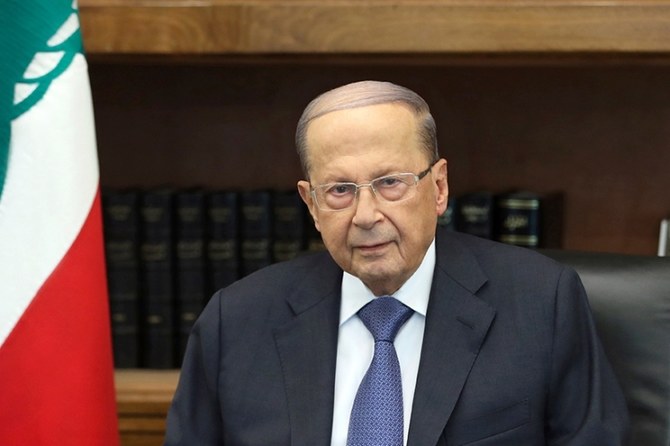
Lebanese President Michel Aoun sent a cable of congratulations Friday to King Salman on the occasion of Saud Arabia’s Founding Day. (Reuters/File Photo)
Short Url
Updated 26 February 2022
Follow

Lebanon sends congratulations on Saudi Arabia’s Founding Day

  • Lebanese fear crisis since country imports most of its wheat from war-hit Ukraine

BEIRUT: Lebanese President Michel Aoun sent a cable of congratulations Friday to King Salman on the occasion of Saud Arabia’s Founding Day.

“This occasion holds many bright milestones in the Kingdom’s history, which, with its vision and efforts, has managed to reserve an advanced position among the modern countries striving for broader horizons. Saudi Arabia has never spared any effort to defend the just humanitarian and Arab causes, and to preserve the unified Arab world despite all the circumstances in the region,” Aoun said.

He further praised the Kingdom’s support for Lebanon and the Lebanese, hoping “bilateral ties will recover for the good of the two brotherly peoples.”

Aoun also sent a cable of congratulations to Crown Prince Mohammed bin Salman, stressing the importance of this occasion, which “is one of the brightest milestones in the history of Saudi Arabia that overcame many challenges in order to build a brighter tomorrow.”

Speaking before a delegation of Arab justice ministers in Lebanon on Friday, Aoun stressed “Lebanon’s full desire to cooperate with Arab countries and show solidarity in all issues that help develop and strengthen laws and unify legislation in these countries.”

He hoped that the delegation would contribute to alleviating the problems that sometimes arise between the Arab brothers.

“Beirut's doors are open to everyone, especially to the Arab brothers,” Aoun said.

Arab League Secretary-General Ahmed Aboul Gheit and Assistant Secretary-General Hossam Zaki arrived in Beirut on Friday to participate in a ceremony to honor three winners of the award for the best doctoral thesis in the Arab World in the field of law and justice.

Meanwhile, several pro-Syrian regime and Hezbollah figures objected to the position expressed by the Lebanese Foreign Ministry condemning the Russian invasion of Ukraine.

Foreign Minister Abdullah Bou Habib met the ambassadors of France and Germany to Lebanon, who thanked Lebanon for its stance. They requested Lebanon’s participation in “adopting the resolution submitted to the UN Security Council on the crisis and voting on it in the General Assembly.”

Bou Habib’s media office reported that he assured the two ambassadors that “Lebanon stands firm in its position which stems from its keenness to adhere to the principles of international legitimacy and international law, which constitute the basic guarantee to protecting international peace, order and the territorial integrity of small countries, especially since Lebanon has suffered greatly from the Israeli occupation and its continuous violations.”

However, he said, “Lebanon will abstain from adopting the resolution submitted to the Security Council and the Lebanese position regarding the vote will be considered later on in the event that the resolution is referred to the General Assembly.”

Bou Habib said that he met the Russian ambassador to Lebanon on Thursday and informed him that Lebanon was about to issue “a statement condemning the Russian military operation, but this position is not directed against Russia and we do not want it to affect the solid bilateral relationship.”

Lebanon’s Mills Association feared a wheat crisis since “Lebanon imports the majority of its wheat from Ukraine and all wheat sale deals have been canceled due to force majeure, leading to an increase in the price of a ton of wheat by $45 to $50.”

Economy Minister Amin Salam revealed: “Negotiations have been underway for about three months with several countries, including India and the US, in search of alternative sources of wheat. If the situation develops in Ukraine and it becomes impossible to import from it, we will of course resort to other sources.”

Salam explained: “There are five ships in the port of Beirut and other ships are arriving soon, and the Central Bank has approved transferring funds to cover imported wheat. This stock is sufficient for more than a month, and we will work to secure more. We assure the Lebanese that there is no problem in this field.”


Lebanon approves financial gap draft law despite opposition from Hezbollah and Lebanese Forces

Lebanon's Prime Minister Nawaf Salam speaking during a press conference after a cabinet session in Beirut on December 26, 2025.
Updated 26 December 2025
Follow

Lebanon approves financial gap draft law despite opposition from Hezbollah and Lebanese Forces

  • Legislation aims to address the fate of billions of dollars in deposits that have been inaccessible to Lebanese citizens during the country’s financial meltdown

BEIRUT: Lebanon’s Cabinet on Friday approved a controversial draft law to regulate financial recovery and return frozen bank deposits to citizens. The move is seen as a key step in long-delayed economic reforms demanded by the International Monetary Fund.

The decision, which passed with 13 ministers voting in favor and nine against, came after marathon discussions over the so-called “financial gap” or deposit recovery bill, stalled for years since the banking crisis erupted in 2019. The ministers of culture and foreign affairs were absent from the session.

The legislation aims to address the fate of billions of dollars in deposits that have been inaccessible to Lebanese citizens during the country’s financial meltdown.

The vote was opposed by three ministers from the Lebanese Forces Party, three ministers from Hezbollah and the Amal Movement, as well as the minister of youth and sports, Nora Bayrakdarian, the minister of communications, Charles Al-Hajj, and the minister of justice, Adel Nassar.

Finance Minister Yassin Jaber broke ranks with his Hezbollah and Amal allies, voting in favor of the bill. He described his decision as being in line with “Lebanon’s supreme financial interest and its obligations to the IMF and the international community.”

The draft law triggered fierce backlash from depositors who reject any suggestion they shoulder responsibility for the financial collapse. It has also drawn strong criticism from the Association of Banks and parliamentary blocs, fueling fears the law will face intense political wrangling in Parliament ahead of elections scheduled in six months.

Prime Minister Nawaf Salam confirmed the Cabinet had approved the bill and referred it to Parliament for debate and amendments before final ratification. Addressing public concerns, he emphasized that the law includes provisions for forensic auditing and accountability.

“Depositors with accounts under $100,000 will be repaid in full with interest and without any deductions,” Salam said. “Large depositors will also receive their first $100,000 in full, and the remainder will be issued as negotiable bonds backed by the assets of the Central Bank, valued at around $50 billion.”

He said further that bondholders will receive an initial 2 percent payout after the first tranche of repayments is completed.

The law also includes a clause requiring criminal accountability. “Anyone who smuggled funds abroad or benefited from unjustified profits will be fined 30 percent,” Salam said.

He emphasized that Lebanon’s gold reserves will remain untouched. “A clear provision reaffirms the 1986 law barring the sale or mortgaging of gold without parliamentary approval,” he said, dismissing speculation about using the reserves to cover financial losses.

Salam admitted that the law was not perfect but called it “a fair step toward restoring rights.”

“The banking sector’s credibility has been severely damaged. This law aims to revive it by valuing assets, recapitalizing banks, and ending Lebanon’s dangerous reliance on a cash economy,” he said. “Each day of delay further erodes people’s rights.”

While the Association of Banks did not release an immediate response after the vote, it previously argued during discussions that the law would destroy remaining deposits. Bank representatives said lenders would struggle to secure more than $20 billion to cover the initial repayment tier and accused the state of absolving itself of responsibility while effectively granting amnesty for decades of financial mismanagement and corruption.

The law’s fate now rests with Parliament, where political competition ahead of the 2025 elections could complicate or delay its passage.

Lebanon’s banking sector has been at the heart of the country’s economic collapse, with informal capital controls locking depositors out of their savings and trust in state institutions plunging. International donors, including the IMF, have made reforms to the sector a key condition for any financial assistance.