

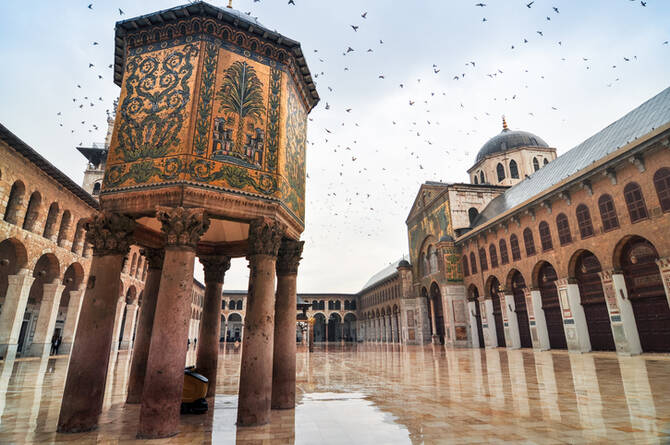

RIYADH: Syria’s tourism sector posted a sharp rebound in 2025, with Arab and foreign arrivals rising 80 percent as improved security and policy shifts helped revive cross-border travel and investment interest, official data showed.
Total visitor numbers, including Syrians, increased 18 percent year on year to 3.56 million between January and November, according to the Ministry of Tourism.
This comes after more than a decade in which conflict, damaged infrastructure, and security concerns hollowed out what had been a major pre-war visitor economy, with Syria’s tourism rebound now emerging against a shifting regional and policy backdrop.
Tourism Minister Mazen Al-Salhani said the increase reflects more than a cyclical recovery, describing it as “not only the re-activation of tourism flows, but a deeper strategic recovery extending beyond the economic domain.”
He added that renewed interest from Arab travelers in particular “signals a transition to organized, civilian-driven mobility and a restored perception of Syria as a safe, attractive, and culturally rich destination.”
Reports from 2010 indicate that Syria drew about 8.5 million visitors that year, underscoring the scale of the market the country is seeking to rebuild as arrivals now recover from a far lower base.
UN Tourism said the Middle East remained the world’s strongest-performing region in 2025 relative to 2019 levels, underscoring the wider return of cross-border travel and airline capacity in the region.
Data from Syria’s tourism ministry showed that arrivals from non-Arab countries reached 377,000 during the first 11 months of 2025, up 79 percent from 2024.
Growth was led by visitors from Turkiye, up 1,063 percent, followed by Germany at 174 percent, the UK at 155 percent, and Norway at 151 percent.
Al-Salhani said the return of Western and Northern European travelers indicates “a shift from regional dynamics to a truly international demand,” creating a foundation for new investment in hospitality, aviation, and sustainable tourism infrastructure.
Arab tourist arrivals rose from 273,000 to 491,000, representing an 80 percent increase, with the strongest growth coming from Jordan, Gulf Cooperation Council countries, and Egypt.
The ministry noted that this rise coincided with a decline in non-touristic, border-related entries, pointing to a move toward purpose-driven travel and a growing role for tourism in Syria’s broader economic recovery.

Syrian Tourism Minister Mazen Al-Salhani. Supplied
Tourism performance in 2025 also showed a more balanced seasonal pattern. Average monthly arrivals in the first quarter stood at 54,000 Arab and foreign visitors, followed by a 40 percent increase between April and June.
August accounted for 14 percent of total annual arrivals, while October recorded a 15 percent increase over September, extending activity beyond the traditional summer peak.
Domestic tourism also strengthened throughout the year, supported by improved perceptions of safety, expanded hospitality capacity, and the revival of cultural and heritage programming.
The ministry said this momentum helped sustain hotel occupancy rates across multiple governorates and positioned domestic travel as a stabilizing pillar for the sector.
Financial indicators reflected the recovery. Hotel revenues from international establishments owned by the ministry increased 170 percent by the end of October.
Under revised investment frameworks, partnerships now require a minimum 70 percent local workforce, with priority given to graduates of tourism and hospitality institutions affiliated with the ministry, a policy aimed at strengthening national human capital.
The rebound is being anchored by a longer-term policy framework. The ministry has adopted a 2026–2030 Tourism Strategy focused on balancing economic growth with social and environmental considerations, identifying priority investment opportunities, and modernizing sector governance.

Archeological treasures like Palmyra are key heritage assets that experts say could attract tourists from across the globe. Getty
Implementation began in 2025 with new tourism projects, the signing of investment agreements and memoranda of understanding, and the resolution of stalled developments.
As part of diversification efforts, the ministry expanded into cultural, medical, educational, and historical tourism segments.
In coordination with the Ministry of Health, officials are developing medical tourism, which the ministry projects could generate up to $500 million annually by 2030 and create more than 20,000 direct and indirect jobs.
Post-liberation investment activity has included the design of integrated tourism circuits in each governorate and the conclusion of 17 memoranda of understanding alongside 10 strategic partnership agreements with regional and international entities.
New boutique hotels, heritage restoration projects, and mixed-use tourism complexes have entered phased operation, underscoring what the ministry described as growing investor confidence.
According to official data, 1,468 tourism establishments across Syria require redevelopment or reactivation, representing a significant pipeline for local, regional, and international investors as demand continues to rise.
Syria has also re-engaged with international tourism institutions, participating in the 26th UN Tourism General Assembly, the Tourize Summit in Riyadh and Jeddah, and signing an executive program with the Arab Tourism Organization.
Read more: Can Syria harness its untapped tourism potential?
The country has reactivated its membership in the Arab Tourism Investment Guarantee Scheme in cooperation with the Islamic Development Bank and took part in the Mediterranean Exchange for Archaeological Tourism in Naples and Salerno, as well as World Tourism Day in Malaysia.
The ministry’s topline figures were backed by border-entry data from the Directorate of Immigration and Passports, which showed Arab and foreign arrivals rising to 867,743 by the end of November, up from 483,029 a year earlier.
Foreign visitors increased to 376,726 from 210,185, while Arab visitors rose to 491,028 from 272,844. The same dataset showed Syrian visitors climbing six percent to 2,692,388, from 2,528,392 in 2024.
Within the Arab market, Jordan remained the dominant source of visitors, rising 93 percent year on year to 394,871.
Several smaller corridors expanded faster in percentage terms, including Qatar, up 436 percent to 536; Oman, up 228 percent to 2,705; Egypt, up 182 percent to 20,497; and Saudi Arabia, up 159 percent to 6,186. Bahrain was a notable outlier, falling 62 percent to 7,342.
Among foreign source markets, directorate data showed Turkiye posting the steepest jump, with arrivals rising to 94,012 from 8,083, while Germany increased to 78,907 from 28,762.
The UK more than doubled to 16,541 from 6,481, and the Netherlands rose to 22,845 from 11,000, while the US increased to 26,105 from 18,853. Sweden and Canada also recorded gains, reaching 31,326 and 16,721, respectively.


