

Saudi interior minister in Pakistan to discuss prisoner repatriation, regional security

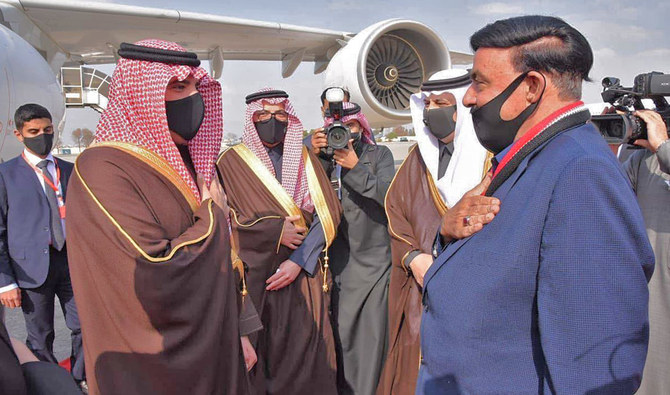
Pakistan Interior Minister Sheikh Rashid Ahmed, right, receives his Saudi counterpart Prince Abdulaziz bin Saud bin Naif in Islamabad, Pakistan, on February 7, 2022. (Photo courtesy: Pakistan Ministry of Interior)
Short Url
Updated 07 February 2022
Follow

Saudi interior minister in Pakistan to discuss prisoner repatriation, regional security

  • Islamabad and Riyadh last May signed a prisoner transfer agreement
  • Saudi leader to meet Pakistani interior minister, prime minister and president

ISLAMABAD: Saudi Interior Minister Prince Abdulaziz bin Saud bin Naif arrived in Islamabad on Monday, with the repatriation of Pakistani prisoners and regional security at the top of the agenda for discussions, the Pakistani interior ministry said.
Islamabad and Riyadh last May signed a prisoner transfer agreement to repatriate over 2,000 Pakistanis jailed in Saudi Arabia.
“They will discuss the release of Pakistanis imprisoned in Saudi Arabia and other important issues, including the regional situation,” the interior ministry said in a statement. 
Pakistani Interior Minister Sheikh Rashid Ahmed received his Saudi counterpart and his delegation at the Noor Khan Air Base Rawalpindi.

Ahmed and Naif will hold a meeting at the interior ministry later in the day, after which the Saudi leader will meet President Dr. Arif Ali and Prime Minister Imran Khan.
"We are inviting interior ministers of different countries where our people are in prisons,” Ahmed told reporters on Sunday. “It is as per instructions of the prime minister." 

The minister said the government was making all efforts to bring back Pakistanis jailed in brotherly Muslim countries for minor offences and unable to afford fines.  
"We are taking this to the cabinet that people who are languishing in our brotherly Islamic countries due to fines, their release should be managed by paying their fines," he said. 
Ahmed said Pakistan had already secured the release of many prisoners from Turkey, adding that officials from Qatar, Bahrain and Kuwait would also be visiting the country soon.


Pakistan offloads wheat stocks, boosts provincial supply to stabilize prices

Updated 28 January 2026
Follow

Pakistan offloads wheat stocks, boosts provincial supply to stabilize prices

  • ECC approves sale of 500,000 tons of wheat, allocates 300,000 tons to Punjab
  • Cabinet body also clears utility arrears and approves vaccine and fertilizer funding

KARACHI: Pakistan’s top economic decision-making body on Wednesday approved the disposal of surplus government wheat stocks and a major inter-provincial allocation to stabilize domestic flour prices, as Islamabad seeks to manage food security risks while containing fiscal pressures.

The decisions come as Pakistan grapples with food inflation sensitivity, climate-related supply disruptions and the fiscal burden of carrying large public stocks. Wheat, the country’s staple food, is politically and economically critical because flour prices directly affect household inflation and living costs, and past volatility has triggered public unrest and costly emergency imports.

On Wednesday, the Economic Coordination Committee (ECC) of the Cabinet authorized the sale of 500,000 metric tons of wheat held by the Pakistan Agricultural Storage and Services Corporation (PASSCO), the federal grain procurement agency, through competitive bidding. It also approved the release of 300,000 metric tons to the Punjab government to ensure uninterrupted supplies to flour mills, according to an official statement issued by the Finance Division.

“The disposal of 500,000 metric tons of PASSCO wheat stock through competitive bidding aims at managing surplus stocks, reducing carrying and storage costs, and ensuring price stability in the domestic wheat market while safeguarding food security considerations,” the Finance Division said in a statement following the ECC meeting.

In a related move, the committee approved the provision of PASSCO wheat to Punjab, the country’s most populous province and a key driver of national wheat consumption, to help maintain adequate supplies for flour mills and prevent supply chain disruptions, the statement said.

Beyond food security, the ECC approved a technical supplementary grant - an off-budget allocation used to meet urgent funding needs - of Rs 10.98 billion ($39 million) to clear long-standing liabilities owed by the Pakistan Post Office Department to utility companies, part of broader efforts to address inter-government arrears that have strained public sector finances.

In the health sector, the committee authorized Rs 29.66 billion ($106 million) for the Federal Directorate of Immunization to ensure uninterrupted procurement of vaccines and syringes under the Expanded Program on Immunization, a move aimed at sustaining routine immunization coverage and preventing outbreaks of vaccine-preventable diseases.

The ECC also approved a Rs 23.42 billion ($84 million) subsidy package for imported urea, to be shared equally between the federal and provincial governments, as authorities seek to cushion farmers from rising fertilizer costs and limit spillover effects on food prices.