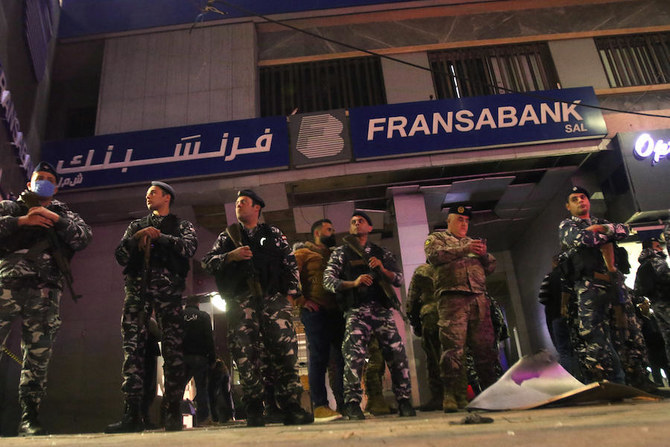
BEIRUT: Bank staff in Lebanon have called for extra security measures after a man took hostages and threatened to blow up a branch in Bekaa Valley this week.
Lebanese security forces arrested Abdullah Al-Saii on Tuesday after the incident at the Bank of Beirut and Arab Countries branch in Jeb Jannine as he attempted to withdraw $50,000 of his own money.
Armed with a gun, a grenade and bottles of benzene when he stormed into the bank, Al-Saii said the bank staff had rejected his requests to withdraw his money on previous occasions, blaming it on the economic crisis in the country.
Al-Saii held more than 10 of the bank’s staff and customers hostage for several hours, demanding he be allowed to withdraw the money. He said he would blow up the branch if his demands were not met. The building was cordoned off and the standoff was resolved following negotiations.
The incident has triggered fear among banking staff in Lebanon, who have called for beefed-up safety.
Lebanese bank clerk Hana Saleem was asked by her parents to quit her banking job or work remotely following the incident.
“After bank staff and clients were taken hostage at a bank in Bekaa Valley, my folks felt scared for my life, so they’ve begged me to quit,” she told Arab News.
Another bank employee, Dalia Hassan, believes the BBAC incident is just one in a litany of similar situations, which have put banking employees’ lives at risk.
“Since the financial crisis started over two years ago, banks have been subject to numerous attacks by armed clients, bulldozers and even angry customers carrying Molotov bombs,” she said, confirming that she feels scared whenever an agitated client yells inside her workplace.
“Whenever an angry client shouts, my co-workers and I hide under our desks or inside washrooms fearing the client might be armed and shoot at us,” said Hassan, who confirmed that the Hamra branch where she works has only employed two private security guards.
Extra policemen and security guards must be stationed inside and outside banks for “protection and safety,” she added.
Wael Imad, a branch manager, told Arab News that when banks cannot fulfill a request for a withdrawal from a customer, it is the staff and not management who are at the forefront facing angry clients.
He blamed the banks for the often reckless actions carried out by irate clients and said: “Banks are responsible when clients resort to illegal methods in, what I believe to be, a rightful bid to access their deposits.”
He said banks are supposed to protect their staff who feel unsafe in their work environments.
“Last year, I was beaten by a group of angry clients. Police arrived late to our branch before the assailants were held off,” recalled Imad.


![]()

Lebanese bank staff want security beefed up after hostage standoff
Short Url
https://arab.news/vw6vy
Lebanese bank staff want security beefed up after hostage standoff
- Employees are holding banks responsible for angry customers’ occasionally criminal behavior
- Family scared for daughter’s life ask her to quit banking job or work remotely

Latest updates


Recommended


© 2026 SAUDI RESEARCH & PUBLISHING COMPANY, All Rights Reserved And subject to Terms of Use Agreement.