

Texas Muslims express support for hostages in synagogue assault

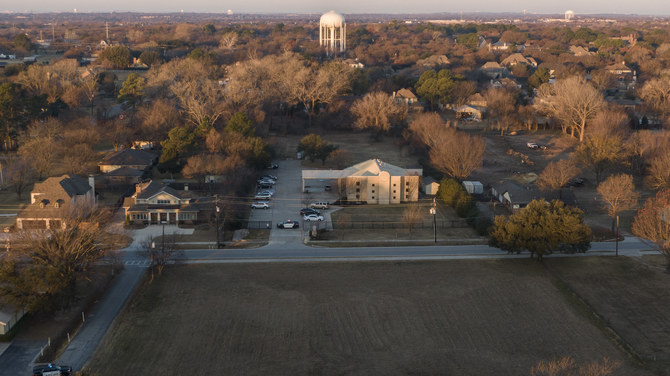
An aerial view of police standing in front of the Congregation Beth Israel synagogue, Sunday, Jan. 16, 2022, in Colleyville, Texas. (AP)
Short Url
Updated 16 January 2022
Follow

Texas Muslims express support for hostages in synagogue assault

  • Imams at nearby mosques condemned the violence and prayed for the safety of the synagogue's congregation
  • The FBI on Sunday identified the gunman killed as 44-year-old British national Malik Faisal Akram

CHICAGO: Leaders of the Muslim community in Texas and activists around the US expressed support for members of a synagogue in Colleyville which came under attack on Saturday, sparking a 10-hour hostage crisis.

A SWAT team breached the Congregation Beth Israel synagogue at around 9:30 p.m. in Dallas-Fort Worth, Texas, freeing all the hostages.

No members of the synagogue’s congregation were injured, but the gunman was killed, police said without releasing details. The rabbi, Charlie Cytron-Walker, was reported to be among the four held hostage.

The FBI on Sunday identified the gunman who was killed as 44-year-old British national Malik Faisal Akram.

Imams at nearby mosques quickly responded with statements of support and prayers for the safety of the synagogue's congregation and condemnations of the violence.

“We are shocked and horrified at what is transpiring in the Colleyville synagogue,” said Imam Jawaid Alam, from the Islamic Center of Southlake, as word spread of the hostage crisis. “They are going through an appalling ordeal and we stand with our Jewish brothers and sisters. Our thoughts and prayers are with them, and we condemn these atrocious actions. We will provide our support and hope that this situation comes to a safe resolution as soon as possible. Ameen.”

The Secretary-General of the US Council of Muslim Organizations Oussama Jammal said that Muslims across the US stand in solidarity with “the Colleyville and broader American Jewish community,” and are “relieved” at their safe release.

“This heinous attack on a synagogue, a sacred and inviolable place of worship – and its congregants in the act of prayer – is utterly unacceptable. Whoever the attacker is and whatever his claimed motivations, there can be no excuse for this horrific crime. We praise God for their return to their loved ones,” Jammal said.

Police issued updates on Twitter as the hostage situation continued throughout Saturday evening and Sunday morning. Colleyville Police Spokesperson Sgt. Dara Nelson said a 911 call came in just before 11 a.m.

“Officers arrived on scene and observed an emergency situation that warranted evacuation of the surrounding areas and an external perimeter was established,” Nelson said. “The Colleyville Police Department is on scene along with the FBI's Dallas Field Office, the Texas Department of Public Safety, the North Tarrant Regional SWAT Team and other neighboring agencies.”

Nelson said a gunman was holding several hostages inside the synagogue and reported that at 5 p.m. the suspect released one male hostage uninjured. FBI crisis negotiators were in communication with the suspect, Nelson added.

The SWAT team entered the synagogue and freed all of the hostages and the suspect was killed.

US President Joe Biden issued a statement immediately after the hostages were released late Saturday night.

“Thanks to the courageous work of state, local and federal law enforcement, four Americans who were held hostage at a Texas synagogue will soon be home with their families. I am grateful to the tireless work of law enforcement at all levels who acted cooperatively and fearlessly to rescue the hostages. We are sending love and strength to the members of Congregation Beth Israel, Colleyville, and the Jewish community,” he said.

“There is more we will learn in the days ahead about the motivations of the hostage taker. But let me be clear to anyone who intends to spread hate—we will stand against antisemitism and against the rise of extremism in this country. That is who we are, and tonight, the men and women of law enforcement made us all proud.”

On Sunday, Biden said that the hostage taker had got his weapons off the street.

The hostage incident in Colleyville, Texas, “was an act of terror; it was an act of terror,” said Biden, who was in Philadelphia with first lady Jill Biden.

Pro-Palestinian activists also issued statements against the violence, including Jewish Voices for Peace. It said: “We are grateful to G-d that Rabbi Cytron-Walker and the congregants at Beth Israel in Colleyville, Texas are free and safe. We send love to our fellow Jews everywhere who are breathing slightly easier, and recommit to the fight against antisemitism and Islamophobia.”

Britain's foreign office confirmed the death of a British man in Texas, when asked to respond to a Sky News report that the gunman was a British national. The foreign office did not explicitly say the dead Briton was the gunman.

British foreign minister Liz Truss on Sunday condemned the actions of the gunman, calling it an act of terrorism and anti-Semitism.

“My thoughts are with the Jewish community and all those affected by the appalling act in Texas. We condemn this act of terrorism and anti-Semitism,” she wrote on Twitter.

“We stand with US in defending the rights and freedoms of our citizens against those who spread hate.”

The attack came as the US prepared to commemorate racial and religious tolerance on Monday, what would have been the 93rd birthday of Dr. Martin Luther King Jr. 

King was assassinated on April 4, 1968, in Memphis by James Earl Ray, a white segregationist and escaped felon.


Trump pivots to new 10 percent global tariff, new probes after Supreme Court setback

Updated 28 min 46 sec ago
Follow

Trump pivots to new 10 percent global tariff, new probes after Supreme Court setback

WASHINGTON: US President Donald Trump moved swiftly on Friday to replace tariffs struck down by the Supreme Court with a temporary ​10 percent global import duty for 150 days while opening investigations under other laws that could allow him to re-impose the tariffs.
Trump told a briefing he was ordering new tariffs under Section 122 of the Trade Act of 1974, duties that would go on top of surviving tariffs. These would partly replace tariffs of 10 percent to 50 percent under the 1977 International Emergency Economic Powers Act that the top court declared illegal.
Trump said later on Truth Social that he had signed an order for the tariffs on all countries “which will be effective almost immediately.”
A spokesperson for the US Customs and Border Protection agency declined comment when asked when collections of the illegal IEEPA tariffs would halt at ports of entry.
Trump’s Treasury Secretary, Scott Bessent, said the new 10 percent duties and potentially enhanced tariffs under the Section 301 unfair practices statute and the Section 232 national security statute would result in virtually unchanged tariff revenue in 2026.
“We will get back to the same tariff level for the countries. ‌It will just be ‌in a less direct and slightly more convoluted manner,” Bessent told Fox News, adding that the Supreme ​Court ‌decision had ⁠reduced Trump’s ​negotiating ⁠leverage with trading partners.
The never-used Section 122 authority allows the president to impose duties of up to 15 percent for up to 150 days on any and all countries to address “large and serious” balance of payments issues. It does not require investigations or impose other procedural limits. After 150 days, Congress would need to approve their extension.
“We have alternatives, great alternatives,” Trump said. “Could be more money. We’ll take in more money and we’ll be a lot stronger for it,” Trump said of the alternative tools.
While the administration will likely face legal challenges, the Section 122 tariffs would lapse before any final ruling could be made, said Josh Lipsky, international economics chair at the Atlantic Council, a think tank in Washington.
Trump said his administration also was initiating several new country-specific investigations under Section 301 of the Trade Act of 1974 “to protect our country from unfair trading practices of ⁠other countries and companies.”
Trump’s shift to other statutes, including Section 122, while initiating new investigations under Section 301 ‌had been widely anticipated, but these have often taken a year to complete.
The 10 percent tariffs only last ‌five months, but Trump said that would allow his administration to complete investigations to enhance tariffs.
Asked if rates ​would ultimately end up being higher after more probes, Trump said: “Potentially higher. ‌It depends. Whatever we want them to be.”
He said some countries “that have treated us really badly for years” could see higher tariffs, whereas for others, “it’s going to ‌be very reasonable for them.”
The fate of dozens of trade deals to cut IEEPA-based duties and negotiations with major US trading partners remained unclear in the wake of the ruling, though Trump said he expected many of them to continue. He said deals that are abandoned “will be replaced with the other tariffs.”
“This is unlikely to affect reciprocal trade negotiations with our trading partners,” said Tim Brightbill, trade partner with the law firm Wiley Rein in Washington. “Most countries would prefer the certainty of a trade deal to the chaos of last year.”
US ‌Trade Representative Jamieson Greer said details on new Section 301 investigations would be revealed in coming days, adding these are “incredibly legally durable.” Trump relied on Section 301 to impose broad tariffs on Chinese imports during his first term.
The Supreme Court’s ruling puts about $175 ⁠billion in tariff revenue collected over the past year subject to potential refunds, according to estimates provided to Reuters by Penn-Wharton Budget Model economists.
Asked if he would refund the IEEPA duties, Trump said, “I guess it has to get litigated for the next two years,” a response indicating that a quick, automatic refund process was unlikely.
Speaking in Dallas, Bessent told business leaders that since the Supreme Court did not provide any instructions on refunds, those were “in dispute,” adding: “My sense is that could be dragged out for weeks, months, years.”
Part of the reason why Trump opted for IEEPA to impose tariffs last year was because the 1977 sanctions statute allowed fast and broad action with almost no constraints. Until Friday, he had also used it as a cudgel to swiftly punish countries over non-trade disputes, such as Brazil’s prosecution of former president and Trump ally Jair Bolsonaro.
While Trump’s new investigations will prolong tariff uncertainty, they could inject more order into his tariff policy by forcing him to rely on trade laws that have well-understood procedures, research and public comment requirements, and longer timelines, said Janet Whittaker, senior counsel with Clifford Chance in Washington.
“The administration will need to follow these set processes, conduct the investigations, and so for businesses, that means more visibility into the process,” Whittaker said.
Robert Lighthizer, Trump’s trade chief during his ​first term, said on Fox News that he hoped Congress would revise decades-old ​trade laws to give Trump new tariff tools.
“I think there’s consensus in this Congress that we have to change the old system, and I hope that they will take this as an opportunity to do that,” Lighthizer said.