

Family of jailed Pakistani neuroscientist denies links to hostage standoff at Texas synagogue

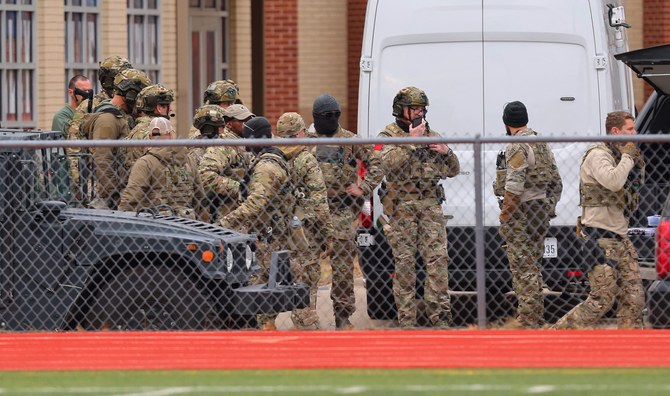
SWAT team members deploy near the Congregation Beth Israel Synagogue in Colleyville, Texas, some 25 miles (40 kilometers) west of Dallas, on January 15, 2022. (AFP)
Short Url
Updated 16 January 2022
Follow

Family of jailed Pakistani neuroscientist denies links to hostage standoff at Texas synagogue

  • US media reported hostage-taker demanded the release of Dr. Aafia Siddiqui who is serving an 86-year sentence in Texas
  • Siddiqui was convicted by a US court in 2010 on charges of attempting to kill American service members in Afghanistan

KARACHI: The family of a Pakistani neuroscientist jailed in the US denied on Sunday rumors over their relation to a standoff at a synagogue in Texas after American media reports linked them to the hostage taker. 
Four people were held hostage at the Congregation Beth Israel in Colleyville, Texas after a gunman entered the synagogue during a Saturday morning service. The suspect was killed and hostages freed in the evening, following a tense standoff with police.
While authorities said they could not yet release the gunman’s identity to the public, US media reported he was motivated by a desire to free Dr. Aafia Siddiqui, who is serving an 86-year sentence on charges of attempting to kill US service members in Afghanistan. Some news outlets said the gunman was Siddiqui’s brother.

The jailed scientist’s family denied the claims.

“False and baseless rumors of my and Aafia’s brother being involved in a hostage situation is another example of how American media and social media trolls jump to blame someone without any proof, especially if that someone is black, brown or Muslim,” Siddiqui’s sister, Dr. Fowzia Siddiqui, told Arab News.
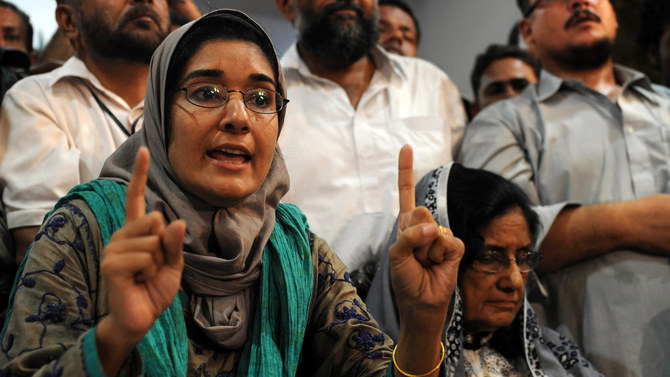


In this file photo, Fowzia Siddiqui, left, sister of US detained Pakistani woman Aafia Siddiqui, speaks during a news conference with her mother Ismat Siddiqui , right, at their house in Karachi on Sept. 23, 2010. (AFP/ File)

She said the rumors came as her mother has been admitted to an intensive care unit.

“Both my brother and I were already preoccupied with her critical condition and this irresponsible reporting comes to add to our anguish,” Siddiqui said. “We are grateful for all the prayers, wishes and trust that our supporters have shown during this trying time.”

The family’s legal counsel in the US, John Floyd, called on the reporters who claimed the synagogue assailant was a member of Siddiqui’s family to correct their reports and issue an apology.

“This assailant has nothing to do with Dr. Aafia, her family, or the global campaign to get justice for Dr. Aafia,” Floyd said in a statement. “Dr. Aafia’s family has always stood firm in advocating for the release of their sister from incarceration by legal and non-violent means only.” 

Siddiqui, a 49-year-old mother of three with degrees from the Massachusetts Institute of Technology and Brandeis University, is serving her sentence at the Federal Medical Center in Carswell, Texas after a New York court in 2010 convicted of attempting to shoot and kill in Afghanistan a group of US soldiers and FBI agents who wanted to interrogate her for alleged links to Al-Qaeda.

Siddiqui’s sentencing has riled many in Pakistan, including the government that had campaigned for her release and paid for her legal defense.


Pakistan says defense pact with Saudi Arabia elevated brotherly ties to ‘new heights’

Updated 25 February 2026
Follow

Pakistan says defense pact with Saudi Arabia elevated brotherly ties to ‘new heights’

  • Pakistan, Saudi Arabia signed strategic defense pact last year pledging aggression against one will be treated as attack on both
  • Deputy PM Ishaq Dar says enduring bonds with Islamic and Arab nations form vital pillar of Pakistan’s foreign policy 

ISLAMABAD: Deputy Prime Minister Ishaq Dar said on Wednesday that Pakistan’s defense pact with Saudi Arabia elevated its brotherly ties with the Kingdom to “new heights,” stressing that close ties with Arab and Islamic nations form a key pillar of Islamabad’s foreign policy. 

Pakistan and Saudi Arabia signed a Strategic Mutual Defense Agreement on Sept. 17 last year, pledging that aggression against one country would be treated as an attack on both, enhancing joint deterrence and formalizing decades of military and security cooperation.

Both nations agreed in October 2025 to launch an economic cooperation framework to strengthen trade and investment ties. 

“In the Middle East, our landmark Strategic Mutual Defense Agreement with Saudi Arabia has elevated our brotherly ties to new heights,” Dar said while speaking at the Pakistan Governance Forum 2026 event in Islamabad. 

The Pakistani deputy prime minister was speaking on the topic “Navigating International Relations Amidst Changing Geo-Politics.”

Dar noted that Pakistan has reinforced partnerships with other Middle Eastern nations such as the UAE, Qatar, Jordan, Oman, Egypt and Bahrain. He said these partnerships have yielded “concrete agreements” in investment, agriculture, infrastructure, and energy sectors. 

“Our enduring bonds with Islamic and Arab nations form a vital pillar of our foreign policy, and we will continue to expand our partnerships across Asia, Latin America, and Africa,” he said. 

Dar pointed out that the presidents of Kazakhstan, Uzbekistan and Kyrgyzstan have undertaken visits to Pakistan in recent months, reflecting Central Asian nations’ desire to boost cooperation with Islamabad.

On South Asia, the Pakistani deputy PM said Pakistan has successfully transformed its fraternal ties with Bangladesh into “a substantive partnership.”

“Similarly, the trilateral mechanism involving China, Pakistan, and Bangladesh has been launched with a view to expanding and deepening regional cooperation and synergy,” the Pakistani minister said. 

He said Islamabad has strengthened its “all-weather” partnership with China via the second phase of the multi-billion-dollar China-Pakistan Economic Corridor agreement and “unwavering support” from both sides for each other’s core interests. 

Dar said Pakistan had also reinvigorated its partnership with the US, advancing cooperation in trade, technology, investment, and regional stability. 

“This calibrated approach has enhanced our ability to navigate complexity with skill and confidence, ensuring that our national interests are served without compromising our core foreign policy principles,” he said.