

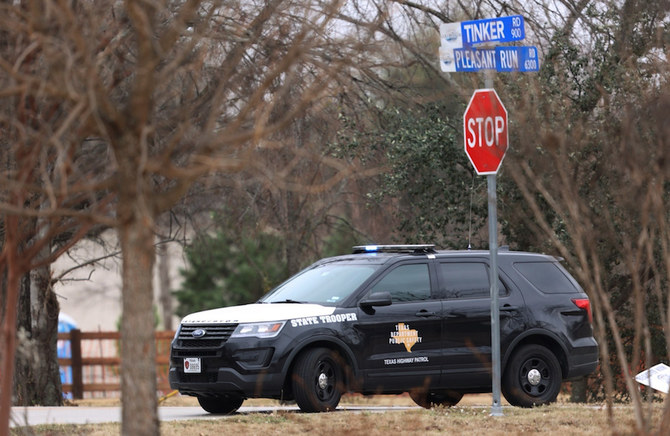
Hostages freed in Texas synagogue standoff, suspect dead

Police secure the area around Congregation Beth Israel synagogue on Saturday, Jan. 15, 2022 in Colleyville, Texas. (Amanda McCoy/Star-Telegram via AP)
Short Url
Updated 16 January 2022
Follow

Hostages freed in Texas synagogue standoff, suspect dead

  • Hostage taker demanded release of jailed Pakistani doctor Aafia Siddiqui, suspected of having ties to Al-Qaeda, according to ABC
  • CAIR denies hostage-taker's claim that Aafia Siddiqui’s brother, Mohammad Siddiqui, was involved

COLLEYVILLE, US: All four people taken hostage in a more than 10-hour standoff at a Texas synagogue have been freed unharmed, police said late Saturday, and their suspected captor is dead.
The siege in the small Texas town of Colleyville — in which the suspect was apparently demanding the release of a convicted terrorist — had sparked an outpouring of concern from Jewish organizations in the United States and the Israeli government.
Colleyville police chief Michael Miller told a news conference a “rescue team breached the synagogue” on Saturday evening and rescued three remaining hostages — all adults — being held inside. A first hostage had been released unharmed a few hours earlier.
“The suspect is deceased,” Miller told reporters.
FBI Dallas Special Agent Matt DeSarno said the four hostages — who included a much-loved local rabbi, Charlie Cytron-Walker — did not need medical attention.
“He did not harm them in any way,” he said.
There were reports from journalists at the scene of a loud explosion and gunshots at the synagogue shortly before the press conference.
That was more than 10 hours after police were alerted to the emergency at the Congregation Beth Israel in Colleyville, about 25 miles (40 kilometers) west of Dallas.
Officers evacuated the synagogue’s surroundings and cordoned off the area, the police force said.
ABC News reported that the hostage-taker was armed and had claimed to have bombs in unknown locations. That was not confirmed by police although Miller said that “bomb techs are clearing the scene.”
At about 3 am local time (0800 GMT) the police force tweeted that it was “now safe for residents who were evacuated to return.”
Quoting a US official briefed on the matter, ABC reported the man was demanding the release of Aafia Siddiqui — a Pakistani scientist who in 2010 was sentenced by a New York court to 86 years in prison for the attempted murder of US officers in Afghanistan.
She is currently being held at a prison in Fort Worth, Texas.
DeSarno told the news conference the suspect had been identified, but did not disclose his identity.
The FBI special agent did not confirm the suspect’s demands, but said they were “focused on one issue that was not specifically threatening to the Jewish community” — and that he did not believe there was an ongoing threat.
ABC initially said the man claimed to be Siddiqui’s brother, but later clarified her brother is in Houston — while experts said the word the man used in Arabic was more figurative and meant “sister” in the Islamic faith.
Siddiqui’s lawyer said she “has absolutely no involvement” in the hostage situation in a statement to CNN. The lawyer confirmed that the man was not Siddiqui’s brother and said she condemned his actions.
DeSarno said police negotiators “had a high frequency and duration of contact with” the hostage-taker.
“There were times when it stopped for periods of time and like many hostage situations, the relationship between the negotiators and hostage-taker had been floating a little bit and sometimes got intense,” he said.


A live stream of the congregation’s Shabbat morning service, available on Facebook for around four hours during the standoff, appeared to capture audio of a man talking loudly — although it did not show the scene inside the building.
He could be heard saying, “You get my sister on the phone,” and “I am gonna die.”
He was also heard saying: “There’s something wrong with America.”
Beth Israel congregation member Ellen Smith described the situation as “shocking and horrifying” in a CNN interview.
She said the congregation was a “tight” community, and the rabbi in particular was “the best human I think anyone could ever meet.”
But she said it was “not shocking” the crisis occurred in a Jewish community.
“Cases of anti-Semitism have risen lately, but since Jews were first walking the Earth, we have been persecuted,” she said.
President Joe Biden pledged to “stand against anti-Semitism and against the rise of extremism in this country.”
“I am grateful to the tireless work of law enforcement at all levels who acted cooperatively and fearlessly to rescue the hostages,” he said.
Israeli Prime Minister Naftali Bennett tweeted: “This event is a stark reminder that antisemitism is still alive and we must continue to fight it worldwide.
“To the Jewish community in Colleyville and around the world: You are not alone — we stand united with you.”
“No one should ever be afraid to assemble in their place of worship,” the Jewish Community Relations Council said in a statement, while the Council on American-Islamic Relations said it was in contact with Colleyville Jewish leaders to “provide any assistance possible.”


Moscow made an offer to France regarding a French citizen imprisoned in Russia, says Kremlin

Updated 26 December 2025
Follow

Moscow made an offer to France regarding a French citizen imprisoned in Russia, says Kremlin

  • Laurent Vinatier, an adviser for Swiss-based adviser Center for Humanitarian Dialogue, Vinatier was arrested in Moscow in June 2024
  • He is accused of failing to register as a “foreign agent” while collecting information about Russia’s “military and military-technical activities” 

The Kremlin on Thursday said it was in contact with the French authorities over the fate of a French political scholar serving a three-year sentence in Russia and reportedly facing new charges of espionage.
Kremlin spokesman Dmitry Peskov told reporters that Russia has made “an offer to the French” regarding Laurent Vinatier, arrested in Moscow last year and convicted of collecting military information, and that “the ball is now in France’s court.” He refused to provide details, citing the sensitivity of the matter.
French President Emmanuel Macron is following Vinatier’s situation closely, his office said in a statement. French Foreign Ministry spokesperson Pascal Confavreux said Thursday that all government services are fully mobilized to pay provide consular support to Vinatier and push for his liberation as soon as possible.
Peskov’s remarks come after journalist Jérôme Garro of the French TF1 TV channel asked President Vladimir Putin during his annual news conference on Dec. 19 whether Vinatier’s family could hope for a presidential pardon or his release in a prisoner exchange. Putin said he knew “nothing” about the case, but promised to look into it.
Vinatier was arrested in Moscow in June 2024. Russian authorities accused him of failing to register as a “foreign agent” while collecting information about Russia’s “military and military-technical activities” that could be used to the detriment of national security. The charges carry a maximum penalty of five years in prison.
The arrest came as tensions flared between Moscow and Paris following French President Emmanuel Macron’s comments about the possibility of deploying French troops in Ukraine.
Vinatier’s lawyers asked the court to sentence him to a fine, but the judge in October 2024 handed him a three-year prison term — a sentence described as “extremely severe” by France’s Foreign Ministry, which called for the scholar’s immediate release.
Detentions on charges of spying and collecting sensitive data have become increasingly frequent in Russia and its heavily politicized legal system since Moscow invaded Ukraine in February 2022.
In addition to criticizing his sentence, the French Foreign Ministry urged the abolition of Russia’s laws on foreign agents, which subject those carrying the label to additional government scrutiny and numerous restrictions. Violations can result in criminal prosecution. The ministry said the legislation “contributes to a systematic violation of fundamental freedoms in Russia, like the freedom of association, the freedom of opinion and the freedom of expression.”
Vinatier is an adviser for the Center for Humanitarian Dialogue, a Switzerland-based nongovernmental organization, which said in June 2024 that it was doing “everything possible to assist” him.
While asking the judge for clemency ahead of the verdict, Vinatier pointed to his two children and his elderly parents he has to take care of.
The charges against Vinatier relate to a law that requires anyone collecting information on military issues to register with authorities as a foreign agent.
Human rights activists have criticized the law and other recent legislation as part of a Kremlin crackdown on independent media and political activists intended to stifle criticism of the war in Ukraine.
In August 2025, Russian state news agency Tass reported that Vinatier was also charged with espionage, citing court records but giving no details. Those convicted of espionage in Russia face between 10 and 20 years in prison.
Russia in recent years has arrested a number of foreigners — mainly US citizens — on various criminal charges and then released them in prisoner swaps with the United States and other Western nations. The largest exchange since the Cold War took place in August 2024, when Moscow freed journalists Evan Gershkovich and Alsu Kurmasheva, fellow American Paul Whelan, and Russian dissidents in a multinational deal that set two dozen people free.