

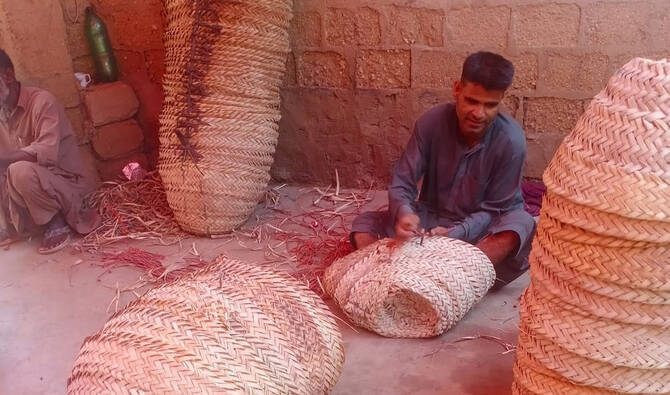

KARACHI: In the narrow streets of Karachi’s historic Lyari neighborhood, stacks of handwoven baskets sit outside homes and workshops as elderly Baloch men and women bend over strips of dried reeds and palm leaves, weaving patterns passed down over generations.
And in the days before Eid Al-Adha, the pace quickens.
Before sunrise, piles of freshly woven baskets are loaded onto motorcycles, rickshaws and small delivery vehicles bound for markets across Pakistan’s largest city, where families use them to carry sacrificial meat, traditional flatbreads and flowers during one of the country’s busiest religious festivals.
For many artisans in Lyari’s Ali Mohammad Mohalla area, the seasonal rush offers a brief financial lifeline for a craft that has steadily declined over the years as younger Pakistanis move toward urban jobs and factory work.
The basket-weaving tradition traces back to the 19th century, when members of the Nigori and Dashti Baloch communities migrated from southwestern Balochistan province to Karachi in search of work. Over decades, weaving became both a livelihood and a marker of cultural identity for those who settled in Lyari and nearby areas.
Across Pakistan, similar baskets have long been used in homes, fisheries and village markets. Artisans typically gather date palm leaves, pandanus leaves, reeds or rushes, dry them and split them into thin strips before weaving them into baskets, trays, mats and storage containers.
Local vendor Shahjahan Neik told Arab News that during Eid the baskets were used to keep meat and sheermal, a type of flatbread.
“Those who place orders for sheermal and animal sacrifice, these baskets are used to carry them to their homes or venues.
“I have seen this craft ever since I was born in 1972. When I was in school my family, including my mother and my sister, used to make these baskets,” he said.
The raw materials are still sourced from Balochistan, where the plants used for weaving grow in mountainous and river-fed regions. In the Lyari, Golimar and Hub Chowki areas of Karachi families weave the baskets by hand before selling them to traders and shopkeepers.
In the past the baskets were mainly used to transport fish and prawns. Today they are more commonly associated with Eid sacrifices, wedding bread deliveries and flower arrangements.
But there are concerns the tradition is fading.
Neik said that there was a time when almost every woman in the neighborhood would make baskets at home.
“(But) the new generation did not learn the art … a lot of people left from here to other cities."
For many families the work is now more a necessity than a tradition.
Fehmida Ali, a 40-year-old mother of three who has spent more than a decade weaving baskets, said the money she made helped to pay for her children’s education because her husband’s earnings as a driver were not enough.
“We receive a pile of these strips with which we make the baskets,” she told Arab News.
“One bundle contains 20 strips and I make 20 baskets every day. We get 300 rupees ($1.06) for 20 pieces.”
Ali said it took her about two hours to complete the work.
“We make more of these baskets around Eid Al-Adha and get about 50 rupees more, compared to the usual wage,” she said.
“During Eid it picks up followed by the wedding season, for flatbread. Even during the month of Muharram, the demand increases.”
Still, even artisans who have spent their lives preserving the craft say they do not want their children to depend on it financially.
Murad Ali, 54, said basket weaving had supported generations of his family and that his wife and four children had all learned the skill. But he no longer sees a future in it for younger people.
“This kind of work is for the elderly,” he said. “Since we don’t get work opportunities elsewhere we do this to pass the time.”
Murad said he made 80 baskets a day during the Eid season, earning slightly more than $3 a day.
“Youngsters should get a job in a company or government sector,” he said. “This is not as fruitful for them.”


