

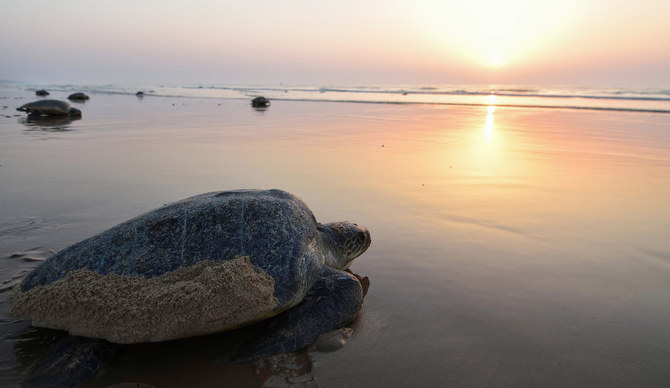
Saudi Arabia protecting endangered turtles through rescue programs

Saudi Arabia is committed to preserving and restoring its marine biodiversity through initiatives. (AFP)
Short Url
Updated 16 January 2022
Follow

Saudi Arabia protecting endangered turtles through rescue programs

  • Through rehabilitation programs and research studies, the Saudi National Center for Wildlife aims to protect nesting sites of endangered sea turtles to maintain an environment in which they can thrive

JEDDAH: The Saudi National Center for Wildlife has rescued and rehabilitated five turtles found on the coasts of Saudi Arabia.
According to the center, the world’s oceans include seven species of sea turtles, five of which have been discovered in the Kingdom’s territorial waters of the Red Sea and Arabian Gulf.
For more than 100 million years, sea turtles have crossed great distances across the world. They play a vital role in maintaining the health and balance of the marine ecosystem.
The Kingdom has recorded sightings of green, hawksbill, loggerhead, olive ridley and leatherback turtles.
According to the center, during nesting season, sea turtles lay 60 to 160 eggs at once. This can be repeated up to six times over the course of a nesting season. In some cases, turtles have been seen to return to the same areas that they were born in more than 40 years later.

FASTFACT

For more than 100 million years, sea turtles have crossed great distances across the world.

The islands of Karan and Jurayad along the Kingdom’s coasts on the Arabian Gulf are found to be primary nesting sites for both the hawksbill and green turtles.
And on the Red Sea, Ra’s Baridi, Farasan Island, Shakir Islands, Ras Al-Shaaban, Jabal Hassan and Sanafir Island are also important locations for the two species.
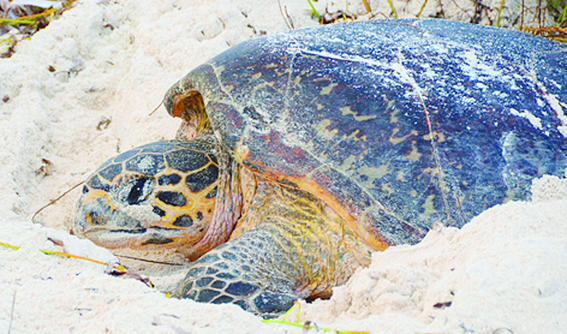


Sea turtles are facing many threats, including overfishing, pollution, climate change and habitat destruction, mainly due to development in coastal areas and the wildlife trade. (Shutterstock)

Sea turtles are facing many threats, including overfishing, pollution, climate change and habitat destruction, mainly due to development in coastal areas and the wildlife trade.
The World Wildlife Fund has listed the hawksbill and green turtles as “endangered,” while loggerhead, olive ridley and leatherback turtles are classified as “vulnerable.”
Through rehabilitation programs and research studies, the Saudi National Center for Wildlife aims to protect nesting sites of endangered sea turtles to maintain an environment in which they can thrive.
The Kingdom is committed to preserving and restoring its marine biodiversity through initiatives.
Among the many projects to restore and protect marine life, NEOM has launched programs to protect endangered species such as the hawksbill sea turtle and hammerhead shark.
The Red Sea Development Company also works towards implementing initiatives to protect marine life and endangered sea turtles in the Kingdom.
The company, in cooperation with King Abdullah University of Science and Technology, early last year worked on the rehabilitation of two hawksbill turtles.
The turtles were safely returned to the waters of Waqadi Island, which will remain untouched and undeveloped as a protected area overseen by the The Red Sea Development Company.
The Saudi National Center for Wildlife continues to set standards for sustainable development initiatives to lay the foundation for marine protection in all future development plans.


Jeddah students get closer look at electric motorsport

Updated 24 January 2026
Follow

Jeddah students get closer look at electric motorsport

  • A PIF-linked initiative highlights technical and engineering careers behind electric racing events

JEDDAH: Students from local and international schools in Jeddah were introduced to STEM-related career pathways in electric motorsport this week, as part of an education program linked to the UIM E1 World Championship held on the Red Sea.

The sessions formed part of Driving Force Presented by the Public Investment Fund, an initiative run by Formula E and its electric racing series partners, to familiarize students aged eight to 18 with science, technology, engineering and mathematics through electric racing and sustainability-focused industries.

The sessions for students formed part of Driving Force Presented by the Public Investment Fund, an initiative run by Formula E and its electric racing series partners. (Supplied)

The programme took place alongside the 2026 E1 Jeddah GP and included workshops, school visits and trackside access designed to show how engineering, data, broadcast technology and event operations function within professional motorsport.

According to organisers, the initiative reached more than 60,000 students globally in 2025, with further expansion planned this year. 

HIGHLIGHTS

• The program took place alongside the 2026 E1 Jeddah GP and included workshops, school visits and trackside access.

• Students learned about E1 races and their technical and environmental dimensions and discussed the engineering and marine aspects of electric boats.

• According to organisers, the initiative reached more than 60,000 students globally in 2025, with further expansion planned this year. 

John Williams, managing director at E1, told Arab News: “The PIF is absolutely vital to everything we do here at the E1. They were crucial initial investment partner since the start of the championship and they continue to support us in a number of ways and more specifically around the Driving Force program.”

The sessions for students formed part of Driving Force Presented by the Public Investment Fund, an initiative run by Formula E and its electric racing series partners. (Supplied)

Elaborating more on the program, he said: “What we are doing is presenting and showing these students the available careers of science, technology, engineering and mathematics, as well as careers in sports, not only pilots but also engineers and mechanics.”

Williams added that the main key to the program was bringing a new generation to the mechanism of sport.

“We are introducing to these exciting new technologies around the race but it could be our technology on the boat or our broadcast products, as well as how to manage the event its self. There are a range of opportunities to show it to the children in addition to enjoying the excitement of the race and meeting the pilots.”

The program’s Jeddah activities began at King Abdulaziz University’s faculty of maritime studies, where students took part in a hands-on workshop focused on STEM careers in the motorsport and sustainability areas conducted by technology experts and famous water pilots such as Dani Clos, Emma Kimilainen and Patricia Pita.

Students learned about E1 races and their technical and environmental dimensions and discussed the engineering and marine aspects of electric boats.

They also enjoyed exclusive behind-the-scenes access at the E1 Jeddah GP, pilot meet-and-greets, and front-row seats to watch the RaceBird boats in action.