

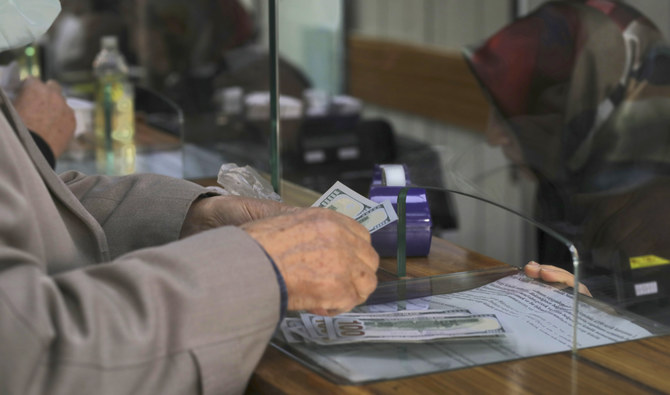

ANKARA: The Turkish lira continues to suffer heavy losses against foreign currencies. It plummeted to nearly 15 to the dollar on Monday before the Central Bank of Turkey intervened.
Worries about the country’s ongoing economic policy are increasing among domestic and international investors, and another interest rate cut by 100 basis points to 14 percent is expected during Thursday’s meeting of the Central Bank, despite rising inflation.
However, such actions have been futile so far in the light of lira’s volatility. Ratings agency S&P has also downgraded Turkey’s outlook to “negative” due to an unclear policy direction and the rising external risks the country has been facing.
The lira depreciation has further increased the country’s inflation rate as the economy greatly depends on imports. Kilometers-long lines of people queuing to buy cheap bread have become the norm across the country.
Turkish President Recep Tayyip Erdogan met Central Bank Governor Sahap Kavcioglu and Finance Minister Nureddin Nebati on Monday. Nebati also met more than 60 representatives of the business community in an attempt to reassure them.
“The economy will recover very fast. You’ll see that we can deal with it without raising interest rates. Just trust us,” the finance minister said, adding that the country’s macroeconomic indicators are all positive.
In line with the unorthodox assumption that reducing interest rates will lower inflation, the Turkish government claims that the rate cuts and the lira’s downfall support a new national economic plan that promotes economic growth, cheap credit, production and exports.
“If we win, we’ll win together. If we lose, we’ll lose together,” Nebati said on Monday about the government’s new economic model.
Meanwhile, some grocery stores have started to ration sales of milk and oil amid skyrocketing prices.
In November alone, the lira lost about 30 percent of its value, while the official annual inflation rate reached 21.3 percent.
“The market has already priced in a further 100 basis points of rate cut (at the meeting) on Thursday — with the policy rate cut to 14 percent, which should also be the current cyclical low — which explains the recent further lira depreciation to a new record low,” Nikolay Markov, a senior economist at Pictet Asset Management in Switzerland, told Arab News.
“Against this backdrop, a decision not to cut rates on Thursday will be a clearly positive surprise as it will convey a positive message on the (central bank’s) independence from the government. That will be just enough to contain the lira depreciation and improve investors’ sentiment at least in the very short-term.”
Turkey’s top economic team has been discussing and explaining a new road map for the economy for a couple of weeks. Erdogan even suggested the country follows China’s economic-growth strategy by pursuing low interest rates and luring foreign investors with a devalued currency.
“It is a credit-driven and exports-oriented economic-growth model, which has worked well so far, especially in light of the quick and significant economic rebound in the aftermath of the first pandemic shock in summer 2020,” Markov said.
“Overall, the Turkish economy has been impacted only mildly by the pandemic shock, avoiding a recession in 2020, and is expected to grow at the stellar rate of 10.8 percent in real terms in 2021, which would be close to 14 percent above its prepandemic level.”
However, he added that the Turkish model is heavily reliant on cheap credit funding, which explains the government’s current obsession with the central bank’s policy interest rates, and its push for lower rates to reduce the private sector’s debt burden and hence boost credit growth.
Last month, Turkish exports reached an all-time high of $21.5 billion, a 33.4 percent year-on-year increase.
But economists warn that this type of model, which prioritizes credit, production, exports and growth, only works in the short term and is unsustainable in the medium-to-long term.
“This model leads to the build-up of macro imbalances that are raising the financial-stability risks in the country, and leads to a higher country risk premium and higher borrowing costs,” Markov said. “This will be detrimental to foreign investors’ capital inflows.
“Such a model also leads to a structural current-account deficit, which makes the country highly dependent on foreign capital flows. The recent market turmoil was mostly triggered by the elevated and rising inflationary environment, which has led to a record depreciation of the lira, thus hampering foreign investors’ capital flows.”
Economists point out that there is a solution to the current economic turmoil in Turkey.
“We know what the remedy is to this situation: The reversal of the previous rate cuts by the (central bank), in order to start building some inflation credibility by showing their determination and overriding goal to fight inflation, thus containing the lira depreciation.”
Izzet Ozgenc, a Turkish law professor, suggested that the authorities in the country might declare a state of emergency.
“We, as the society, should be ready for the state of emergency that could be declared as a result of a heavy economic crisis,” he wrote in a message posted on Twitter on Monday. He highlighted article 119 of the Turkish Constitution, which empowers the cabinet to declare a state of emergency for up to six months in response to economic crises, natural disasters and infectious diseases.
However the idea of a state of emergency was rejected and criticized by opposition figures.
Sales of houses in Turkey to foreigners soared by 48.4 percent in November as the lira slid. About 7,363 properties were sold to buyers from other countries, the highest monthly total since 2013. They were especially popular among Iranian, Iraqi and Russian buyers, who favored Istanbul, southern Antalya and the capital Ankara as purchase locations.


