

Turkish lira collapse piles misery on northern Syria

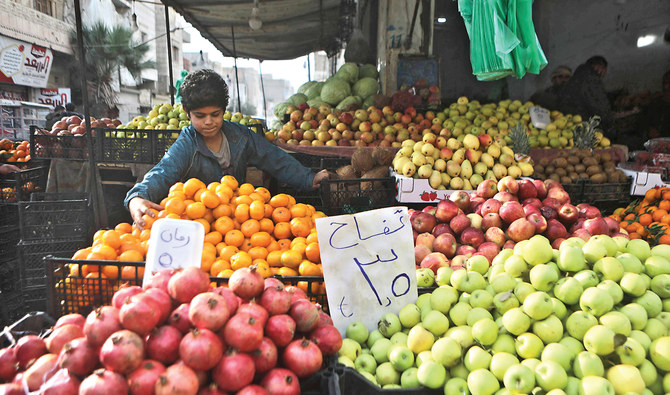
A young vendor sells fresh produce in the main market of Al-Bab in Syria’s northern Aleppo province on the border with Turkey amid economic pain. (AFP)
Short Url
Updated 13 December 2021
Follow

Turkish lira collapse piles misery on northern Syria

  • Currency's sharp fall piles more misery on enclave whose inhabitants are already scarred by war

AL-BAB: Mohammed Al-Debek, a schoolteacher in northern Syria, is on strike: The currency devaluation in neighboring Turkey has slashed the value of his salary by two-thirds.

His town of Al-Bab lies in a northern area of war-torn Syria that in recent years has turned into a de facto Turkish protectorate.

Because the Turkish lira is now the main currency in the area, its recent nose-dive has heaped further pain on the people living there.

“My salary in 2017 was worth $160, but today it is worth $50, a fraction of its value,” the 33-year-old said outside the washed-out yellow walls of his school.

“It’s barely enough to pay the rent.”

Ankara does not only have military control of the border region, but most of the products available on the markets and even the mobile phone operator are also Turkish.

Areas of northern Syria run by Turkish-backed opposition groups switched to the lira as the main currency last year, replacing the massively devalued Syrian pound.

The lira has lost 45 percent of its value against the dollar this year alone and Debek’s purchasing power has plummeted, as has everybody else’s in the region.

“After the collapse of the lira, I was forced to look for a second job after school,” he said.

His new afternoon job in a bookshop earns him another $40 but that still leaves him short of the $200 he says he needs to make ends meet.

Turkey directly administers several districts of northern Syria and, to seal its presence in the area, has invested heavily in education, health and other sectors.

The region’s economic fate is inextricably tied to Turkey’s and the lira’s sharp fall in recent weeks piled more misery on an enclave whose inhabitants are already scarred by war.

A recent UN report on the humanitarian situation cited estimates that “97 percent of the population, even those that are in employment, are living in extreme poverty.”

Inflation is soaring just as fast as it is in neighboring Turkey, with basic food items such as bread selling at record prices and purchasing power at its lowest ever.

And when the price of a bag of flatbread stops rising, locals say, the amount of bread inside goes down.

Ahmed Abu Obeida, an official with the region’s chamber of commerce who also owns a company importing food products from Turkey, acknowledged that consumption had slumped.

“The demand for basic materials has decreased, and the citizens in general cannot afford basic things such as their daily needs in food, medicine and heating,” he said.

Hanaa Al-Yasbu, a 36-year-old woman who was widowed in an air strike five years ago and has since been living in a camp for war-displaced people, is one of them.

She usually earns around 20 Turkish lira a day by harvesting wheat and potatoes, enough to keep her five children warm and fed.

With her daily income now worth just a dollar and a half, Hanaa has to venture into the countryside to find firewood.

“I dream that I have about 50 lira a day to buy food for my children to feed them, so they do not sleep hungry,” she said.


UN rights chief shocked by ‘unbearable’ Darfur atrocities

Updated 10 min 31 sec ago
Follow

UN rights chief shocked by ‘unbearable’ Darfur atrocities

  • Mediation efforts have failed to produce a ceasefire, even after international outrage intensified last year with reports of mass killings, rape, and abductions during the RSF’s takeover of El-Fasher in Darfur

PORT SUDAN: Nearly three years of war have put the Sudanese people through “hell,” the UN’s rights chief said on Sunday, blasting the vast sums spent on advanced weaponry at the expense of humanitarian aid and the recruitment of child soldiers.
Since April 2023, Sudan has been gripped by a conflict between the army and the paramilitary Rapid Support Forces that has left tens of thousands of people dead and around 11 million displaced.
Speaking in Port Sudan during his first wartime visit, UN Human Rights commissioner Volker Turk said the population had endured “horror and hell,” calling it “despicable” that funds that “should be used to alleviate the suffering of the population” are instead spent on advanced weapons, particularly drones.
More than 21 million people are facing acute food insecurity, and two-thirds of Sudan’s population is in urgent need of humanitarian aid, according to the UN.
In addition to the world’s largest hunger and displacement crisis, Sudan is also facing “the increasing militarization of society by all parties to the conflict, including through the arming of civilians and recruitment and use of children,” Turk added.
He said he had heard testimony of “unbearable” atrocities from survivors of attacks in Darfur, and warned of similar crimes unfolding in the Kordofan region — the current epicenter of the fighting.
Testimony of these atrocities must be heard by “the commanders of this conflict and those who are arming, funding and profiting from this war,” he said.
Mediation efforts have failed to produce a ceasefire, even after international outrage intensified last year with reports of mass killings, rape, and abductions during the RSF’s takeover of El-Fasher in Darfur.
“We must ensure that the perpetrators of these horrific violations face justice regardless of the affiliation,” Turk said on Sunday, adding that repeated attacks on civilian infrastructure could constitute “war crimes.”
He called on both sides to “cease intolerable attacks against civilian objects that are indispensable to the civilian population, including markets, health facilities, schools and shelters.”
Turk again warned on Sunday that crimes similar to those seen in El-Fasher could recur in volatile Kordofan, where the RSF has advanced, besieging and attacking several key cities.
Hundreds of thousands face starvation across the region, where more than 65,000 people have been displaced since October, according to the latest UN figures.