Nobel economics prize goes to 3 US-based economists

Short Url
Updated 11 October 2021
Follow

Nobel economics prize goes to 3 US-based economists

  • Winners are considered pioneers in use of ‘natural experiments’

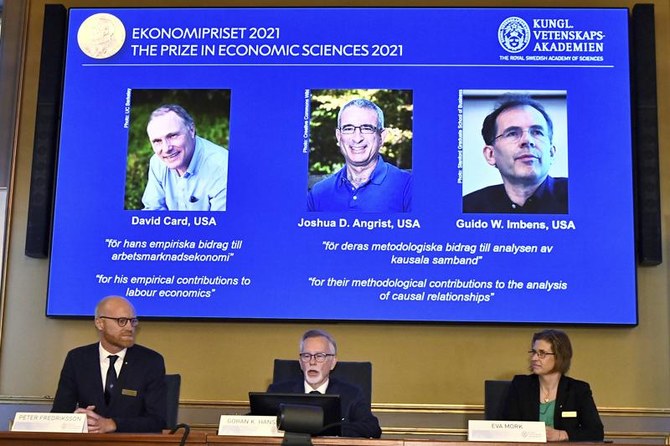
STOCKHOLM: Economists David Card, Joshua Angrist and Guido Imbens won the 2021 Nobel economics prize on Monday for pioneering the use of “natural experiments” to understand the causal effects of economic policy and other events.

Natural experiments use real-life situations to work out impacts on the world, an approach that has spread to other fields and revolutionized empirical research.

One such experiment by Canada-born economist Card on a minimum wage increase in the US state of New Jersey in the early 1990s prompted researchers to review their view that such increases should always lead to falls in employment.

“Natural experiments are everywhere,” Eva Mork, a member of the Prize Committee for the Alfred Nobel Memorial Prize in Economic sciences, told a news conference of the impact the method has had across all the social sciences.

The prize, formally known as the Sveriges Riksbank Prize in Economic Sciences in Memory of Alfred Nobel, is the last of this year’s crop of Nobels and sees the winners share a sum of 10 million Swedish crowns ($1.14 million).

Card took half the prize “for his empirical contributions to labor economics,” the academy said. Angrist and Imbens shared the other half “for their methodological contributions to the analysis of causal relationships.”


Armah Sports net profit up 62% on strong personal training demand

Updated 14 sec ago
Follow

Armah Sports net profit up 62% on strong personal training demand

RIYADH: Strong demand for personal training services and continued expansion in its membership base drove Armah Sports Co.’s net proft to shareholders up 62 percent to SR62 million ($16.53 million) in 2025.

Revenue increased rising 27 percent annually to SR224.9 million in the year ending Dec. 31, while while operating revenue climbed 48 percent to SR81.1 million, reflecting operating leverage as revenue growth outpaced cost increases.

Personal training profit increased 51 percent during the year, supported by sustained demand for high-quality training services. 

Subscription and membership revenue grew 24 percent, driven by expansion in the average member base and the increasing maturity of existing clubs. The company also recorded growth in ancillary revenue streams from its fitness centers.

Industry data suggests the company’s performance reflects broader structural growth in the Kingdom’s fitness sector.

Ahmed Attallah, manager at the organizers of health and fitness exhibition FIBO Arabia, told Arab News: “Saudi Arabia’s fitness industry is undergoing structural expansion rather than cyclical growth.”

He added: “The market has grown from approximately SR3.4 billion in 2017 to SR7.7 billion in 2024 and is projected to reach SR15.5 billion by 2030. This growth is supported by regulatory reform, rising female participation, and sustained private-sector investment aligned with Vision 2030.” 

FIBO Arabia is one of the largest annual health, fitness and wellness industry exhibitions in Riyadh that brings together operators, suppliers, investors and other sector stakeholders to showcase innovations and business opportunities.

Attallah added that revenue growth across operators is increasingly driven by premium services. 

“Personal training and premium services remain underdeveloped compared to mature markets, creating room for further revenue growth. At the same time, boutique formats and digitally integrated models are attracting younger, experience-driven consumers,” he said.

Attallah stated that strong financial results from leading operators reflect underlying market fundamentals, and said: “Capital inflows, international brand expansion, and fitness infrastructure embedded within gigaprojects and mixed-use developments point to long-term confidence in the sector.”

He added: “Saudi Arabia is moving from rapid expansion to institutional maturity, positioning it as the Middle East’s leading growth market for fitness and wellness investment.”

Deferred revenue at Armah rose to SR62.6 million across the year, reflecting strong membership renewals and enhancing revenue visibility for future periods.

Cost of revenue increased 22 percent in line with higher activity levels, while operating expenses rose 46 percent, reflecting investments in automation and key senior hires to support future expansion. Interest expenses were linked to financing and lease liabilities associated with the company’s growth strategy.

During the year, Armah recorded non-recurring items including a SR9.5 million gain from a sublease transaction, a SR0.8 million gain from a rent waiver on a lease, and SR1.5 million in expenses related to preparations for transitioning to the Kingdom’s Main Market from Nomu.

Excluding non-recurring items, adjusted net income attributable to shareholders reached SR53.2 million, while adjusted earnings before interest, taxes, depreciation and amortization totaled SR115 million, in line with the reconciliation disclosed in the audited financial statements.

Armah has advanced its expansion and market positioning over the past year, announcing plans in January for a new men’s B_FIT club in Riyadh’s Irqah district. In 2025, it signed agreements for additional clubs in Al Maseef and a SR224 million development deal with Qimam Noshoz.