


Inside the Jeddah fitness movement that’s racing with Saudi Vision 2030

1 / 5
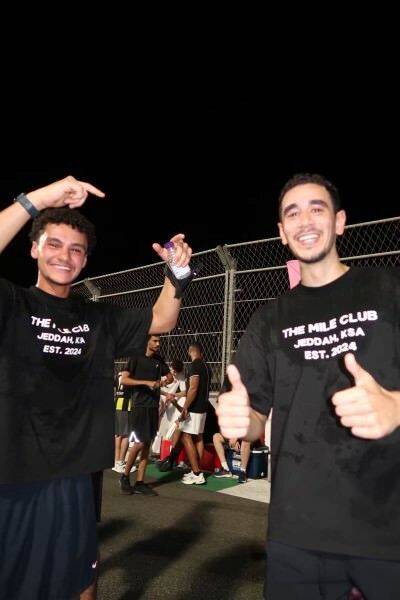
M.I.L.E. Run Club, an acronym for Make It Look Easy, is a homegrown community where Saudi youth chase personal bests and collective belonging. (Supplied)
2 / 5
M.I.L.E. Run Club, an acronym for Make It Look Easy, is a homegrown community where Saudi youth chase personal bests and collective belonging. (Supplied)
3 / 5
Ammaar Malak, right, founded the M.I.L.E. Run Club to create a community of like-minded fitness enthusiasts. (Supplied)
4 / 5
M.I.L.E. Run Club, an acronym for Make It Look Easy, is a homegrown community where Saudi youth chase personal bests and collective belonging. (Supplied)
5 / 5
M.I.L.E. Run Club, an acronym for Make It Look Easy, is a homegrown community where Saudi youth chase personal bests and collective belonging. (Supplied)
Short Url
Updated 06 August 2025
Follow

Inside the Jeddah fitness movement that’s racing with Saudi Vision 2030

  • M.I.L.E. Run Club emphasizes communal bonding, mental health
  • Group encourages inclusive training, supports those with mobility issues

RIYADH: M.I.L.E. Run Club is a homegrown community where Saudi youth chase personal bests and collective belonging on Jeddah’s corniche.

Founded by 23-year-old Ammaar Malak and 22-year-old Tariq Jamal, M.I.L.E. (Make It Look Easy) is forging a generation that wears perseverance like a medal.

The club was designed to leave no one behind. Its Walking Circle, which has Malak’s mother as a member and is tailored for retirees and rehab patients, exemplifies this ethos.

Malak’s origin story is full of cinematic grit. Weeks before an MMA fight in London he tore a ligament and needed surgery.

“Alone in that sterile hospital room, I truly believed my life was over,” he told Arab News. “Competitive fighting was my identity. Without it, I was lost.”

His recovery began with limping walks, then shuffling jogs through London’s parks. Now, a 184-day run streak pays testimony to his determination.

“Showing up bridges who you are and who you want to be,” Malak said. “Running taught me true freedom: disciplining your mind to conquer anything.”

The club’s ethos is “not about faking perfection. It’s carrying weight with grace. Staying compassionate when life tries to harden you,” he said.

Malak, who was named most promising athlete at the American International School of Jeddah in 2019 and became one of the Middle East’s youngest CrossFit-certified trainers at age 20, felt there was a mental health aspect missing from conventional training.

“We had gyms and tracks but few spaces nurturing mental armor alongside physical strength,” he said.

M.I.L.E. focuses on strengthening mental resilience through community. Its secret weapon emerges when the running stops: communal ice cream tubs passed under streetlights.

Here, marathoners and first-timers share stories: the fear before kilometer one, the cramps at kilometer eight, the euphoria of conquering doubt.

The closeness of the team exemplifies M.I.L.E.’s alchemy. Malak recounted how each of them joined during Ramadan with no running experience but later conquered 21 km – a testament to the club’s support.

The clubs other members are: Mohammed Alhumaidi (21), Adnan Softa (22), Albaraa Al-Bakri (24), Sarah Al-Mansour (25), Faisal Al-Bar (23) and Hamza Al-Kaffas (21).

“This community is far greater than any individual,” Malak said.

As well as the support the Walking Circle provides to those with mobility issues, the club’s Steady Striders supports teenagers, like Malak’s 16-year-old sister Tamara, targeting 10K races.

The Athlete Tier trains ultra-runners for 50K+ distances. Mohammed Al-Humaidi, 21, engineers adaptive routes to ensure universal access.

“Within M.I.L.E., no one is background noise,” Malak said.

The solidarity becomes evident after the front-runners finish. Instead of dispersing, they double back, sprinting alongside stragglers, screaming encouragement with cracked voices.

Team members have waited hours under the scorching sun to uphold Malak’s core covenant: No M.I.L.E. member crosses alone.

This promise helped to create 10 first-time half-marathoners, showing how communal solidarity helps beginners to conquer the 21 km.

For Malak, there is an element of national pride in M.I.L.E.

“Bringing Saudi Vision 2030 to life isn’t abstract, it’s our hands-on duty,” he said.

“We sweat today out of love for our nation’s tomorrow.”

This conviction fuels his routine of 4 a.m. runs and midnight exam studies after coaching sessions.

Malak’s newly minted UESCA ultra running coach certification propels M.I.L.E. into uncharted territory. From September, workshops will shepherd beginners to 50K+ ultramarathons.

“We’re engineering resilience,” he said.

The ambition? Global reckoning.

“Abroad, ‘Saudi’ still whispers ‘lazy’ or ‘entitled’ to some. We’ll crush those cliches underfoot,” he told Arab News.

“Bringing Saudi Vision 2030 to life isn’t abstract. And we’ve only begun.”


Saudi Food and Drug Authority pioneering digital health safety

Updated 4 sec ago
Follow

Saudi Food and Drug Authority pioneering digital health safety

  • Digital foundation enabled the development of centralized dashboards that provide real-time analysis of adverse events
  • Major improvement has been the use of Robotic Process Automation (RPA) to ensure medication safety works smoothly

TOKYO: Saudi Arabia is establishing itself as a regional leader in digital health regulation by integrating advanced technologies into the Saudi Food and Drug Authority’s (SFDA) pharmacovigilance and cosmetic safety oversight.

In line with Vision 2030’s digital goals, these projects are creating new standards for using data to protect public health, according to the SFDA.

A report by the Oxford Business Group says the transformation began with modernising the National Pharmacovigilance Centre’s adverse reaction reporting system. Moving from paper-based submissions to the fully digital “Saudi Vigilance” platform marked a significant step forward.

The introduction of smart reporting forms with structured data fields and behavioural nudges grounded in psychological principles significantly improved reporting quality and completion rates.

This digital foundation enabled the development of centralised dashboards that provide real-time analysis of adverse events, enabling early identification of safety signals and under-reporting trends.

A major improvement has been the use of Robotic Process Automation (RPA) to ensure medication safety works smoothly. By letting computers handle repetitive tasks like sorting reports and checking data, the SFDA has become more efficient.

The new RPA system for identifying safety signals has also sped things up. These technology solutions have made work easier and happier employees by eliminating boring manual tasks.

The SFDA’s digital changes also help prevent risks by using new online learning tools. The aRMMs e-learning system, with training videos about high-risk medicines, has changed how health care workers learn. Adding digital safety steps directly into hospital computer systems has also made a big difference. This new approach puts safety alerts and learning materials directly into doctors’ daily work, ensuring important information reaches them when they need it.

Digital innovation has also helped prevent medication errors. Moving from the old Phonetic and Orthographic Computer Analysis system to the new Saudi Name Registration (SNR) platform has made it easier to spot potentially confusing drug names. With better computer programs that check both Arabic and English names, plus real-time alerts and automatic updates, the SNR system is a big step forward in ensuring the safety of medicines before they reach the market.

Looking ahead, the SFDA plans to use these digital changes to make cosmetic products safer as well.

Planned projects using artificial intelligence include computer systems that spot rule-breaking, automated ingredient checks, and tools that read customer feedback to identify early warning signs.

This digital strategy puts Saudi Arabia ahead in new ways of making rules. By using artificial intelligence, automation, and data analysis in its work, the SFDA is improving how it tracks medicine safety and preparing for further progress in keeping products safe for consumers.

All these efforts support Vision 2030’s goal of building a knowledge-based economy and keeping Saudi citizens as safe as possible.