Pakistan offers Arabian Sea trade routes to Russia, Central Asia, minister says

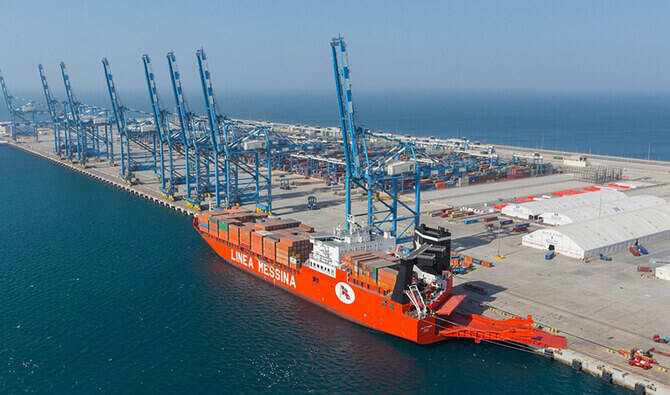
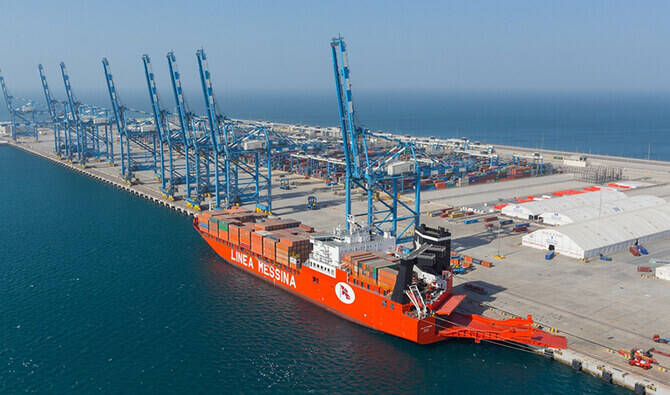
This file photo, released on November 13, 2016, shows a general view of Gwadar port, some 700 km west of Karachi. (APP/File)
Short Url
Updated 19 February 2026
Follow

Pakistan offers Arabian Sea trade routes to Russia, Central Asia, minister says

  • Islamabad pitches transit corridors linking Eurasia to global shipping lanes
  • Government invites foreign investment in Sukkur–Hyderabad M-6 motorway

ISLAMABAD: Pakistan is offering overland trade routes to Russia and landlocked Central Asian states through its Arabian Sea ports, Communications Minister Abdul Aleem Khan said on Thursday, positioning the country as a strategic transit hub as regional supply chains shift toward alternative corridors.

Pakistan has long sought to leverage its geography to connect landlocked Central Asian economies to warm-water ports, a strategy that has gained importance in recent years as countries explore routes that bypass traditional maritime chokepoints and longer shipping lanes. Islamabad promotes its ports at Karachi and Gwadar as gateways linking South Asia, the Middle East and Eurasia.

Speaking at the 88th session of the UN Economic Commission for Europe (UNECE) Inland Transport Committee in Geneva, Khan said Pakistan’s growing integration into Eurasian connectivity networks marked a new phase in regional trade cooperation.

“Pakistan’s strategic integration into the Belarus, Russia, and Central Asia corridors represents the dawn of a new era in regional connectivity,” he said, adding the country was providing “high-efficiency trade routes for Russia and landlocked Central Asian Republics.”

The minister said six land corridors were now facilitating transit trade, including routes via Türkiye, Azerbaijan and Iran, as well as China-Kazakhstan connectivity and Trans-Afghan links connecting Central Asian states to the Arabian Sea. He added that the Quadrilateral Traffic in Transit Agreement (QTTA) route could also expand northward.

He cited the transit of a Kazakh cargo shipment to the United Arab Emirates via Pakistan in June 2024 as proof of the country’s logistical viability for intercontinental trade.

Khan also pointed to more than 1,800 international TIR road-transit shipments — a UN customs system that allows sealed cargo trucks to cross borders without repeated inspections — as evidence of Pakistan’s operational readiness.

Central to Islamabad’s investment pitch was the proposed Sukkur–Hyderabad (M-6) motorway, a planned highway in southern Pakistan that would complete the country’s main north-south trade corridor linking ports on the Arabian Sea with inland and regional markets. Khan described it as a key missing link in Pakistan’s north-south transport backbone and an opportunity for foreign investors.

He said the project offered “nearly 30 percent guaranteed equity” and would significantly strengthen regional connectivity while generating predictable returns.

Pakistan has increasingly promoted infrastructure built under the China-Pakistan Economic Corridor (CPEC) as the backbone of its connectivity ambitions, arguing that improved road and logistics networks could transform the country into a transit economy rather than solely a destination market.

The government has also allocated a 100-acre terminal at Gwadar Port for Central Asian states and expanded visa-on-arrival access for citizens of 126 countries to facilitate business travel, according to the communications ministry.

Officials say digitalization of transport data and coordination with regional partners including Uzbekistan and Kazakhstan are aimed at making cross-border trade faster and compliant with international conventions.

Khan said the goal was to position Pakistan not merely as a transit territory but as “a proactive hub for global economic activity and a catalyst for a regional trade revolution.”


Pakistan’s president defends ongoing strikes in Afghanistan, urges Kabul to dismantle militants

Updated 02 March 2026
Follow

Pakistan’s president defends ongoing strikes in Afghanistan, urges Kabul to dismantle militants

  • Afghanistan on Thursday launched attacks in retaliation for Pakistani airstrikes the previous Sunday
  • Pakistan’s military says it is only targeting Afghan military installations to avoid civilian casualties

ISLAMABAD: Pakistan’s president on Monday defended his country’s ongoing military strikes in neighboring Afghanistan, saying Islamabad tried all forms of diplomacy before targeting militants operating from Afghan territory, and called on the Taliban government in Kabul to disarm groups responsible for attacks in Pakistan.

Pakistan earlier said it is in “open war” with Afghanistan, alarming the international community. The border area remains a stronghold for militant organizations including Al-Qaeda and the Daesh (Islamic State) group.

“(The Afghan Taliban) must choose to dismantle the terror groups that survive on conflict and its war economy,” Asif Ali Zardari said during a speech to lawmakers, adding that “no state accepts serial attacks on its soil.”

Afghanistan on Thursday launched attacks in retaliation for Pakistani airstrikes the previous Sunday. Since then, Pakistan has carried out operations along the border, with Information Minister Attaullah Tarar claiming the killing of 435 Afghan forces and the capture of 31 Afghan positions.

Kabul has denied such claims.

In Afghanistan, the deputy government spokesman Hamdullah Fitrat said Pakistan’s military fired mortar shells at a refugee camp in eastern Kunar province, killing three children and injuring three others.

Afghanistan’s defense ministry said Afghan forces carried out strikes targeting a Pakistani military facility near Paktia province, causing “substantial losses and heavy casualties.”

Pakistan’s military did not respond to questions. It has said Pakistan is only targeting Afghan military installations to avoid civilian casualties.

Pakistan has witnessed a surge of violence in recent months and blames it on the outlawed Pakistani Taliban, known as Tehreek-e-Taliban Pakistan or TTP. It operates both inside Pakistan and from Afghan territory.
Islamabad accuses Afghanistan’s Taliban government of providing safe havens for the TTP, which Kabul denies.

The latest cross-border fighting ended a ceasefire brokered by Qatar and Turkiye in October. The two sides failed to reach a permanent agreement during talks in Istanbul.

Zardari reiterated Pakistan’s call for talks, saying, “We have never walked away from dialogue.”

The Pakistani leader again accused Afghanistan of acting as a proxy for India by sheltering militant groups.

“Stop being used by another country as a battlefield for their ambitions,” he said.

Zardari cited a recent report from the United Nations Security Council’s monitoring team that described the presence of militant groups in Afghanistan as an extra-regional threat.