

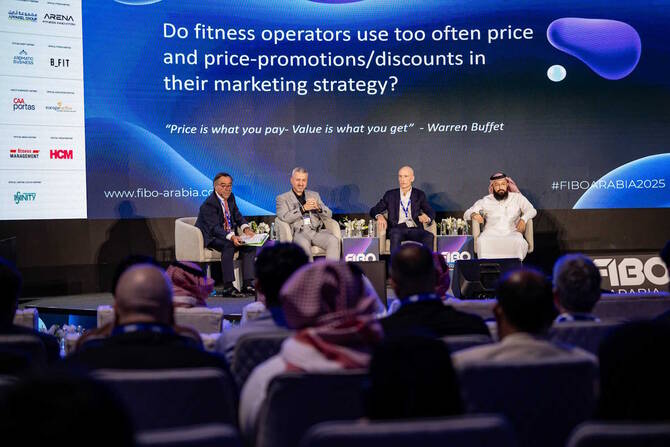

RIYADH: Leading voices from the Kingdom’s health and fitness industry took part in a high-impact panel discussion at FIBO Arabia on Thursday titled “Unlocking the Growth of the Fitness and Wellness Economy in the Kingdom.”
Moderated by Herman Rutgers, president of consulting firm Global Growth Partners BV, the panel included Nasser Obeid, CEO of Pure Gym Arabia; Hani Abdulhafeez Bukhari, CEO of Riyadh Combat Club; and Nathan Clute, chief strategy officer at Armah Sports Company. Their discussion offered a deep dive into the operational, strategic and cultural levers that are accelerating sector-wide growth in alignment with the goals Saudi Arabia’s Vision 2030 plan for national development and diversification.
The participants addressed several critical questions about the future of the fitness and wellness sector in the Kingdom, including whether operators remain overly dependent on discounts and price-led promotions.
The fitness industry in the region has historically relied heavily on such incentives to attract customers, but Obeid said: “Clubs offering discounts are a result of market-driven factors. We want to stop that and, as of today, we’re moving away from this, we’re pushing towards value with the focus on the consumer and what is valuable for the consumer.”
The value of learning lessons from mature international fitness markets to help drive faster growth in Saudi Arabia was discussed at length.
“The answer is easy: learning from any market is important,” said Clute. “The more you know about the industry, the more you know about fitness consumers in general, which will be beneficial.
“But that doesn’t outweigh the value of local market knowledge. You could be the most experienced person in the world but if you don’t have the local market knowledge, I think you’re setting yourself up for failure.”
The discussion also touched on the challenge of attracting new demographics, particularly women and older adults, to increase participation in the sector. There was agreement that effective targeting requires deep understanding of specific customer types, and that tailored approaches based on real demand and clear market segmentation are key to attracting and retaining the various groups, including women.
“We learned that targeting everyone is not targeting anyone,” said Bukhari. “When we started, we had three branches. We had a lot of young girls and when they grew up, they always requested that we open a branch but few signed up. So we converted to an adults and kids branch, which is our main target audience.”
Other sessions on FIBO Arabia’s conference stage on Thursday included: “Avoiding the retention mistakes made in mature markets,” led by Paul Bedfor, director of Retention Guru; “What longevity medicine can learn from cancer innovation,” with Dr. Marwan Ghosn, founder of IGH Clinic; and “Climbing your Everest,” led by Nelly Attar, a Lebanese-Saudi athlete, adventurer and entrepreneur.
The “Fitness Sector Development Report — Kingdom of Saudi Arabia” was unveiled on Wednesday at FIBO Arabia. Produced in collaboration with the Ministry of Sport and management consultancy CAA Portas, it provides a blueprint for the sector’s growth over the coming five years, and highlights key trends that are being discussed during the conference. These include the shift from price-led competition to value-driven models, the exponential growth of female participation, and the untapped potential in underserved regions.
With market revenues forecast to double to SR15.5 billion ($4.1 billion) by 2030, the report highlights the urgent need for tailored offerings, investments in workforce development, and strategic expansions, steps that have been echoed by panelists as critical to the efforts to unlock the next phase of the Kingdom’s fitness and wellness economy.
FIBO Arabia, which began on Wednesday and concludes on Friday at the Riyadh Front Exhibition and Conference Center, is a new annual event that aims to bring together key players from the health, fitness, and wellness sectors to create a platform for innovation, investment, and trends tailored to an active lifestyle. The participants include 140 international and regional exhibitors, 50 global speakers, and thousands of health and wellness professionals from around the world.
Vasyl Zhygalo, managing director for the Middle East and Emerging Markets at event organizer RX, said: “FIBO Arabia is a catalyst for channeling investment into one of the world’s most dynamic health, fitness and wellness markets. By uniting key stakeholders from these sectors, the event fosters high-impact partnerships that directly support Saudi Arabia’s Vision 2030 ambitions.
“It’s about driving long-term economic growth, accelerating innovation, attracting strategic capital, and scaling initiatives that enhance quality of life across the Kingdom.
“The conference platform is central to this mission, offering a space for critical dialogue, thought leadership, and the exchange of ideas that shape the industry’s future.”


